The Thermodynamics of Words: Explaining Word Frequency Distributions in Texts with Physical Models
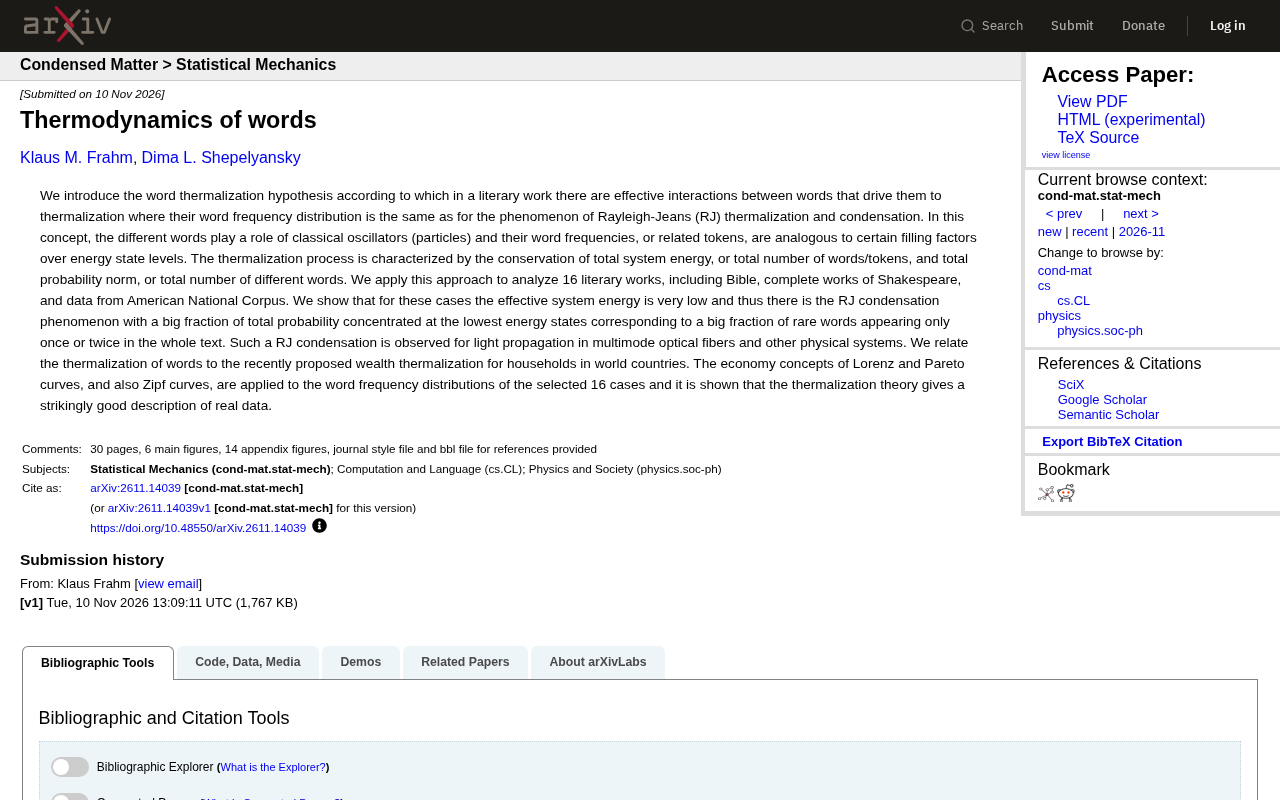
A paper proposes the word thermalization hypothesis, using Rayleigh-Jeans condensation from statistical physics to explain word frequency distributions and Zipf's law.
A paper from arXiv proposes the "word thermalization hypothesis," analogizing words to classical oscillators and word frequencies to energy level filling factors to explain word frequency distributions via statistical physics. Analyzing 16 works including the Bible and Shakespeare, it finds low effective system energy producing Rayleigh-Jeans condensation where rare words concentrate at the lowest energy state. The paper also links word thermalization to wealth thermalization and Lorenz, Pareto, and Zipf curves.
If someone told you that the word frequency distribution in literary works follows similar physical laws to the propagation of light in optical fibers—or even the distribution of household wealth—would you find it surprising? A paper from arXiv proposes the "word thermalization hypothesis," attempting to understand the frequency of words in texts through the framework of statistical physics. This interdisciplinary study introduces the Rayleigh-Jeans thermalization and condensation phenomena from thermodynamics into linguistic analysis, offering a new perspective on Zipf's law.
Core Hypothesis: Words Also "Thermalize"
The paper's central idea is that within a literary work, effective interactions exist among words that drive them toward a "thermalized" state, making the word frequency distribution consistent with that found in Rayleigh-Jeans thermalization and condensation phenomena.
In this conceptual framework, different words play the role of classical oscillators (particles), while their word frequencies or associated token counts resemble filling factors at energy levels. The thermalization process is constrained by two conservation laws: conservation of total system energy (i.e., total word/token count) and conservation of the total probability norm (i.e., the total number of distinct vocabulary items).
This analogy is not arbitrary. In statistical physics, the Rayleigh-Jeans distribution describes the situation where low-frequency modes occupy a large amount of energy, while condensation refers to a large number of particles gathering at the lowest energy level. The paper finds that word frequency distributions in texts exhibit precisely these features—a large number of rare words (words appearing only once or twice) concentrate at the "lowest energy level."
Rayleigh-Jeans Distribution and Condensation: The Rayleigh-Jeans law originally describes the energy distribution of low-frequency electromagnetic modes in blackbody radiation, in the form that higher energy levels have fewer occupations. However, under certain conditions (such as extremely low effective temperature or restricted system dimensionality), a "condensation" phenomenon occurs—a large number of particles (or energy) gather at the lowest energy state while higher energy states are nearly empty. In the textual analogy, the lowest energy state corresponds to rare words appearing only once or twice, which occupy a large share of the total probability. This condensation differs from Bose-Einstein condensation but is mathematically similar, both arising from the combined effect of energy level density and conservation laws leading to macroscopic occupation. Understanding this helps grasp why the paper directly maps word frequency distributions to thermalization phenomena.
Zipf's Law: Zipf's law is an empirical regularity in linguistics stating that in natural language texts, a word's frequency is approximately inversely proportional to its frequency rank—that is, the r-th most frequent word has a frequency roughly proportional to 1/r. Since its proposal in 1949, this law has been widely verified across many languages and texts, but its origin has lacked a first-principles explanation. The paper attempts to derive or explain Zipf's law using the statistical physics framework of thermalization, treating word frequency distributions as statistical results after the system reaches thermal equilibrium. This background helps understand the paper's motivation: why introduce the thermalization hypothesis to explain a known empirical regularity.
Empirical Testing Across 16 Works
The study analyzes 16 literary works, including the Bible, the complete works of Shakespeare, and data from the American National Corpus. Results show that in these cases, the effective system energy is very low, giving rise to Rayleigh-Jeans condensation: a large portion of the total probability concentrates at the lowest energy state, corresponding to the many rare words appearing only once or twice.
This condensation phenomenon is not unique to texts. The paper notes that similar Rayleigh-Jeans condensation has been observed in light propagation in multimode optical fibers and other physical systems. This implies that seemingly unrelated systems—from photons to words—may follow some common statistical regularity.
From Words to Wealth: A Broader Analogy
The paper further connects word thermalization with recently proposed household wealth thermalization. Classical tools from economics and linguistics—Lorenz curves, Pareto curves, and Zipf curves—are applied to analyze the word frequency distributions of the 16 selected cases.
Results show that thermalization theory describes real data "astonishingly well." This hints at a deeper possibility: whether it's the distribution of words in texts, light propagation in optical fibers, or wealth distribution among populations, similar statistical mechanical mechanisms may underlie them all.
Lorenz Curves and Pareto Curves: The Lorenz curve describes the cumulative proportion of income or wealth distribution, with the horizontal axis representing cumulative population percentage and the vertical axis representing cumulative wealth percentage—the more curved the line, the higher the inequality. The Pareto curve describes the power-law characteristics of the high-income tail in wealth distributions, where a small number of people hold most of the wealth. In the paper, these economic tools are used to characterize the inequality of word frequency distributions: the many rare words correspond to the "low-income" group, while the few high-frequency words correspond to the "high-income" group. By comparing word frequency distributions with wealth distributions, the paper attempts to show that both may be governed by the same type of statistical mechanical mechanism, thereby strengthening the persuasiveness of the interdisciplinary analogy.
Value and Limitations of the Interdisciplinary Perspective
The value of this research lies in providing a unified physical framework for understanding word frequency distributions. Although Zipf's law describes the power-law relationship between word frequency and rank, it has long lacked a first-principles explanation. The word thermalization hypothesis attempts to fill this gap by bringing linguistic phenomena into the computable domain of statistical physics.
However, this hypothesis also faces challenges. The text generation process involves multiple layers of factors including semantics, syntax, and pragmatics—is reducing words to "classical oscillators" an oversimplification? Do texts in different languages and different genres all follow the same thermalization laws? Although the paper covers diverse texts including the Bible and the complete works of Shakespeare, the scale of 16 cases remains limited. Moreover, the mathematical relationship between the thermalization hypothesis and Zipf's law requires more rigorous derivation.
Nevertheless, this interdisciplinary attempt opens new directions for research at the intersection of computational linguistics and statistical physics. If word distributions can truly be described by thermodynamics, then text analysis, information retrieval, and even natural language generation could all benefit.
One-line Summary
A paper proposes the word thermalization hypothesis, using Rayleigh-Jeans condensation from statistical physics to explain word frequency distributions and Zipf's law.
Paragraph Summary
A paper from arXiv proposes the "word thermalization hypothesis," analogizing words in literary works to classical oscillators and word frequencies to energy level filling factors, attempting to explain word frequency distributions through a statistical physics framework. The study analyzes 16 works (including the Bible and the complete works of Shakespeare) and finds that effective system energy is very low, giving rise to Rayleigh-Jeans condensation: large numbers of rare words concentrate at the lowest energy state. The paper also connects word thermalization with household wealth thermalization, Lorenz curves, Pareto curves, and Zipf curves, demonstrating that thermalization theory describes real data well. Despite limited sample size and simplified semantic factors, this interdisciplinary attempt provides a new explanation for Zipf's law and opens new directions at the intersection of computational linguistics and statistical physics.
Related articles

MIT PhD Takes You from Scratch to Build DeepSeek: A 25-Hour Hardcore Course
MIT PhD Raj Dandekar launches a 25+ hour Bilibili course building DeepSeek from scratch—MoE, MLA, GRPO, hand-written code plus math derivations, aiming to reproduce mini R1.

DeepSeek Harness in Practice: From Installation to Plugin Ecosystem, Building a Fully Automated AI Workflow
Based on a hardcore Bilibili tutorial, this guide systematically covers DeepSeek Harness installation, three plugin installation methods, and real-world use cases to help developers quickly build customizable AI Agent workflows.

DeepSeek Harness in Practice: From Installation to Automated Workflows
Hands-on DeepSeek Harness tutorial covering Mac/Windows installation, login, workspace binding, model & permission setup, and minimal closed-loop verification for AI automation workflows.