The Thomas Crown Affair Trailer Analysis: When AI Content Creation Meets Classic Suspense

Using The Thomas Crown Affair trailer to explore how dialogue-driven and fragmented narratives inspire AI content creation.
The article uses the official trailer for The Thomas Crown Affair as a starting point to analyze how it quickly establishes character motivations and core conflict through concise dialogue and fragmented information—such as the intellectual battle between Crown and Miss Bennett and the art theft mission. The author distills three techniques applicable to AI-assisted content creation: using dialogue instead of flat exposition, creating suspense with fragmented information, and keeping character motivations clear without revealing everything at once. The article also notes AI's potential in video dialogue extraction, character relationship identification, and sentiment analysis, while acknowledging limitations in understanding metaphor and implicature—final narrative structure and tone still require human editors.
Introduction: Narrative Tension in the Trailer
Recently, the official trailer for The Thomas Crown Affair was released on YouTube. As a remake of a classic suspense-crime property, the trailer showcases the intellectual battle between billionaire Thomas Crown and investigator Miss Bennett within just a few minutes. The dialogue is filled with lines like "Are you hustling me?" and "No, hunting," sketching out a story about art theft, risk, and personal motivation. While the material itself is entertainment content, the narrative structure and character design it contains can offer AI/tech creators some food for thought on content creation and AI applications.
The original The Thomas Crown Affair was a 1968 film directed by Norman Jewison, starring Steve McQueen and Faye Dunaway, telling the cat-and-mouse game between a millionaire who plans a bank heist and an insurance investigator. The 1999 remake starring Pierce Brosnan and Rene Russo shifted the core conflict to art theft. The IP is known for its "intellectual chess match" and "mutual scheming," and this trailer clearly continues that tradition. Understanding its remake background helps grasp the intertextuality of lines like "personal grudge" and "commitment issues" in the trailer—they serve both new audiences and the expectations of longtime fans.
Key Information and Character Setup in the Trailer
Dialogue Reveals Character Motivations
The trailer quickly establishes character relationships through a series of dialogue snippets. Mr. Crown is described as a billionaire with an art collection, while Miss Bennett is asked, "You found some impressive paintings while working at the FBI—you're this good, why did you leave?" She replies, "I don't want to be tied down." This hints at her independent, freedom-loving personality. Meanwhile, Crown is noted to have "commitment issues" and "doesn't like being tied down"—a similarity that sets the stage for the ensuing game.
Core Conflict: Art Theft and the Chase
The trailer reveals that over the past decade, a thief has stolen five important artworks from around the world. Mr. Crown proposes, "You find my Van Gogh, you get your ten million." This directly establishes the mission objective. Miss Bennett is asked, "Why would Mr. Crown target me?" The answer: "It's personal." And Crown's plan "is far more than one fact." These exchanges indicate the story is not just about theft but involves a personal-level showdown.

Content Creation Lessons from the Trailer: How AI Can Borrow Narrative Techniques
Dialogue-Driven Suspense Building
The trailer relies heavily on dialogue to convey information rather than voiceover or subtitles. For example, exchanges like "Are you hustling me, Miss Bennett?" and "Hustling, no. Hunting, yes." both reveal character and advance suspense. For AI content creators, this suggests that when writing articles or scripts, we can enhance readability and immersion by designing concise dialogue or quotes. AI tools can assist in generating such conversational content, but human editors are needed to control tone and pacing.

As a highly compressed marketing text, a trailer typically follows a micro-structure of "hook—conflict—climax—suspense," usually lasting between 90 seconds and two and a half minutes. Its core task is to spark curiosity rather than tell a complete story, so it relies heavily on dialogue fragments, rapid cuts, and musical rhythm. In the field of AI video understanding, trailer analysis often involves subtasks such as shot boundary detection, speech-to-text, speaker diarization, and sentiment classification. Because trailers have extremely high information density and lack complete context, automatically extracting character relationships and plot threads remains a challenging research direction.
Fragmented Presentation of Character Backstory
The trailer does not fully explain character histories but reveals key information through fragmentary dialogue: Bennett once worked at the FBI, Crown has commitment issues, the thief stole five artworks, etc. This fragmented narrative is very common in short videos and social media content. AI can help extract key information points from large amounts of material and reassemble them in fragmented form, but how to create logical connections between fragments still requires human judgment.

Fragmented narrative refers to a storytelling strategy that intentionally disrupts timelines or omits background information, letting audiences piece together the full story from scattered clues. In short-video and social media contexts, it is often combined with "information gap" theory—extending audience attention by leaving unresolved questions. For AI, processing fragmented content requires cross-segment coreference resolution and event-chain reasoning—for example, linking "five artworks stolen" and "find my Van Gogh" as the same task thread. Current large language models perform well on single-segment understanding, but long-span, multi-segment logical stitching still requires human verification.
AI's Potential in Film Trailer Analysis
While trailer analysis is still primarily manual, AI technology has made progress in video content understanding. For example, through natural language processing, AI can automatically extract dialogue text from trailers and identify character relationships, emotional tendencies, and key plot points. For content creators, such tools can help quickly organize material and save preliminary research time. However, AI still has limitations in understanding metaphors and implicatures—for instance, the double meaning in "Are you hustling me?" requires human interpretation in context.
Takeaways for AI Content Creators
From The Thomas Crown Affair trailer, we can learn several techniques applicable to AI-assisted content creation: first, use dialogue instead of flat exposition to enhance appeal; second, create suspense through fragmented information to keep readers engaged; third, character motivations should be clear but need not be fully explained all at once. These techniques also apply when writing product reviews, industry analyses, and similar articles. AI can assist in generating drafts or providing material, but the final narrative structure and tone control still require human editors.
Conclusion
The The Thomas Crown Affair trailer is itself promotional material for an entertainment work, but its narrative techniques offer valuable reference for content creation. In today's era of increasingly widespread AI tools, how to borrow traditional narrative techniques to improve content quality is a direction every creator can consider.
Related articles

Cyber Monday Early Deals: Tech Offers Worth Watching
Cyber Monday deals start early as Black Friday discounts continue. We outline tech deal trends and shopping strategies to help you buy wisely this season.
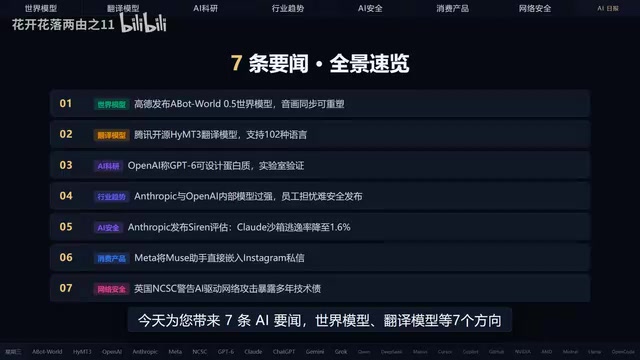
Amap World Model Launched, GPT-6 Protein Design Validated
AI daily roundup: Amap launches interactive world model ABot-World 0.5 with audio-visual sync and natural language reshaping; Tencent open-sources HiMT3 translation model covering 102 languages; OpenAI says GPT-6 can design proteins validated in labs; Anthropic and OpenAI internally concerned about models being too powerful; UK NCSC warns of rising AI-driven cyberattacks.
GPT-6 Designs Proteins on Its Own: 35 of 322 Bind, General Model Challenges Specialized Tools
OpenAI's GPT-6 protein design paper: 35 of 322 small proteins bind, all five targets hit. A general model designs backbones and sequences without specialized tools, but structure prediction and experimental validation remain weak spots—the paper lists four limits.