GPT-6 Designs Proteins on Its Own: 35 of 322 Bind, General Model Challenges Specialized Tools
OpenAI says GPT-6.2 can design proteins without specialized models, achieving ~10% hit rate in experiments while listing four limitations.
OpenAI published a blog post and preprint claiming GPT-6.2 can design protein backbones and sequences using only reasoning and code, without RF diffusion or MPNN. Of 322 synthesized designs, 35 showed binding signals across all five mature targets—about a 10% hit rate, below RF diffusion's original 19%. Sequence redesign produced two highly divergent sequences for the same structure that both bind, largely ruling out memorization. GPT-6.2 wins on computational fold-type and mutation-stability tasks but slightly trails on backbone design. The paper lists four limits: screening still relies on specialized models, overall structure prediction scores 0.38 vs 0.93, possible training data contamination, and binding ≠ druggability. The field views it as a "declaration of war" on specialized pipelines.
OpenAI recently published a blog post and preprint paper claiming that the GPT-6 series models can design entirely new proteins using only reasoning and code-writing, without relying on specialized biological models. Research partners synthesized and tested 322 small proteins designed by GPT-6.2, of which 35 showed binding signals, with hits across all five targets. This result has pushed the debate between general large models and specialized protein design models into the spotlight.
General Models Enter: From "Writing Code" to "Designing Proteins"
Protein design is essentially a reverse-engineering problem: first determine the target 3D structure, then work backward to an amino acid sequence that will fold into that structure. The traditional pipeline relies on three specialized models—an RF diffusion model to generate the backbone scaffold, an MPNN sequence model to fill in the amino acid sequence, and finally a structure prediction model for screening. OpenAI's claim is that GPT-6.2 can handle the first two steps itself: given the 3D structure of a target protein and the desired binding site, the model writes code to compute candidate small-protein designs, without calling any specialized protein model at any point.
The paper also demonstrates programmable control: designs can be specified as all-helix, all-sheet, or mixed topology, and the model "follows instructions almost perfectly." The published reasoning trace shows the model first analyzing the target surface, arranging helical segments, then writing code to repeatedly check whether the two proteins can fit together. OpenAI's rationale is that specialized models are each tied to fixed inputs—changing requirements means changing software or retraining; a general model only needs a different prompt for a new task.
RF diffusion model (RoseTTAFold Diffusion) is a protein backbone generation model released in 2023 by the Baker lab, whose core idea borrows from the diffusion process in image generation: starting from random noise and progressively "sculpting" a 3D backbone satisfying target constraints through multiple denoising steps. It turns protein design into a conditional generation problem, accepting inputs such as symmetry and binding target position, and outputs diverse backbone candidates. The MPNN sequence model (ProteinMPNN) handles inverse folding—given a fixed backbone, it predicts the amino acid most likely to fold stably at each position. The two models in tandem form the classic "backbone first, sequence second" pipeline, and it is precisely this combination that GPT-6.2 benchmarks against and attempts to replace in this article.
Hit rate in wet-lab protein design refers to the proportion of submitted designs that show detectable target binding signals, and is the core metric for design success. Since each design requires gene synthesis, expression, purification, and binding assays—all costly—typically only dozens to hundreds of candidates are tested. Different studies use different thresholds for "binding" (e.g., affinity strength, assay sensitivity), making hit rates difficult to compare directly—which is the main reason OpenAI cites for its results being lower than the original RF diffusion study.
The Experimental Ledger: Hit Rates and the Awkward Comparison
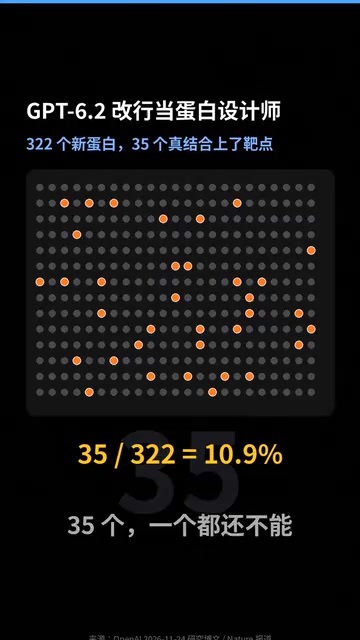
The first experiment focused on backbone design. Of the 322 small proteins synthesized from GPT-6.2 designs, 35 showed binding signals—a hit rate of about 10%. The five targets were all well-established pharmaceutical targets, including those associated with globally best-selling anticancer drugs and a long-standing anti-angiogenic drug, and were clearly targets previously validated by competitors. The original 2023 RF diffusion paper happened to test three of them, with a wet-lab hit rate of about 19%. OpenAI acknowledges in the paper that this is lower than the competitor's original study, explaining it as differences in filtering strictness and the definition of "binding." On purely computational scores, GPT-6.2's backbone designs also slightly trail RF diffusion; what overtakes it is an internal research model OpenAI has not disclosed.

The second experiment was sequence redesign—the key test of whether the model is "memorizing." Given the 3D structure of an existing small protein with the original sequence removed, the model must write a new sequence. Of three targets, the most permissive yielded 75 binders out of 88 designs, the middle 26 out of 42, and the hardest 8 out of 59. Stronger evidence came from three never-before-published structures: only 107 proteins were synthesized from new sequences, and 14 bound. For the same structure, the model wrote two sequences—one changing 52 of 90 positions, the other 58—and the two differed from each other at 44 positions: two completely different paths to the same endpoint, essentially ruling out memorization of training data. In antibody experiments, six nanobodies had three loop sequences removed for the model to complete, and 128 of 182 designs retained binding; for the binding loops of more than five antibodies with about half the amino acids changed, 179 of 272 fragments retained binding.
On purely computational benchmarks: in the task of designing surrounding proteins around a fixed local structure, the internal model scored 4×3 versus RF diffusion's 2×8; for a given overall fold type, 1×9 versus 1×7, a clear win for GPT-6.2; for predicting small-molecule binding sites on proteins, GPT-6.2 scored 9×3, the internal model 9×6, and a specialized docking model only 5×. It also beat specialized models in predicting the effect of sequence mutations on stability. From GPT-5.6 to GPT-6 to GPT-6.2, scores rose across all 14 tasks.
Sequence redesign is a classic test of whether a generative model truly understands the structure–sequence relationship: fix the 3D structure of a known protein, erase the original sequence, and ask the model to write a new sequence that folds into the same structure. If the model merely memorizes training data, it will reproduce the original sequence or near variants; if it has learned folding rules, it may write entirely new sequences that differ greatly from the original yet remain structurally compatible. In this article, two sequences changing 52 and 58 of 90 positions respectively—differing from each other at 44 positions—both binding is precisely the key evidence ruling out "reciting answers."
Four Buckets of Cold Water the Paper Pours on Itself
OpenAI proactively lists the boundaries in this paper.

First, the so-called "intrinsic capability" has limits. The paper acknowledges at the end that candidate screening still relies on specialized models; apart from the backbone and sequence steps, it cannot yet be considered end-to-end zero-shot. The technical community is divided: some question "the sequence is the protein itself—can you really claim credit for designing the backbone?" while industry insiders respond that "backbone first, sequence second is the standard pipeline, and the backbone is the bulk of the work."
Second, the overall exam remains a weak spot. Asked to predict a complete 3D structure from sequence, the general model's best score is 0.38 versus 0.93 for specialized models. Individual steps blossom across the board, but the integrated whole still lags far behind.
Third, scores may be inflated. The paper cautions that some test items appeared in training data, so results may carry background contamination. Binding also does not equal usefulness—specificity, stability, and biological activity are all unverified, and many hurdles remain before drug viability.
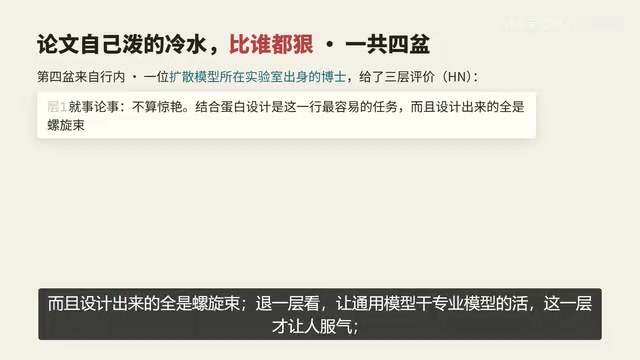
Fourth, three layers of assessment from within the field. A PhD from a diffusion-model lab commented: taken at face value, this binding-protein design is the easiest task in the field, and everything designed is helical bundles; stepping back one layer, making a general model do a specialized model's job is what commands respect; stepping back yet another layer, this is a "declaration of war"—at this pace, things will get much better soon.
Zero-shot in machine learning means a model completes a task directly using only general capabilities, without task-specific fine-tuning or examples. OpenAI calls GPT-6.2's backbone and sequence design nearly zero-shot, but admits candidate screening still requires calling specialized structure prediction models, so the overall pipeline is not end-to-end zero-shot. End-to-end means going from input to final output without manually stitching intermediate modules; the ideal state in this context is the model independently completing the entire design-and-screening pipeline, but currently the third step remains guarded by specialized models.
Multi-Source Perspectives and Timeline
Synthesizing summaries from Bilibili creators and YouTube technical community discussions, the consensus is: general models can now independently complete backbone and sequence design, programmable control has been validated, but overall structure prediction and experimental validation remain weak spots. The disagreement is over the fairness of hit-rate comparisons—OpenAI attributes it to filtering strictness and differing binding definitions, while critics argue the gap between 10% and 19% cannot be ignored. Unique takes from single sources include: some commenters see this as "a declaration of war on specialized models," while industry insiders judge that "[specialized model makers] may need to find new directions quickly—I thought we had at least five years."
The tweet received over 5,600 likes, and the technical community thread scored 179 points with 49 comments—higher heat than previous similar topics. OpenAI's life sciences line has taken four steps in two years: last August it partnered with pharma companies to build a lab; this February it used GPT-5 to lower the cost of cell-free protein synthesis; in April it released a specialized life sciences model; and recently it announced that the general model can design on its own. The April specialized model has not been discontinued—specialized and general models are now in a horse race.
Each individual step looks like an adult; the integrated whole still looks like a child. Of the three steps, the general model has learned the first two; the third remains in the hands of specialized models.
Related articles
Amap World Model Launched, GPT-6 Protein Design Validated
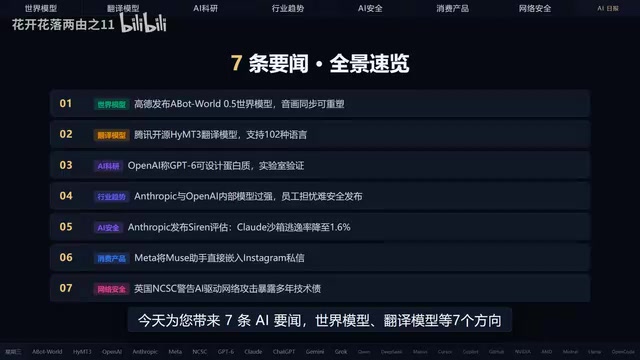
AI daily roundup: Amap launches interactive world model ABot-World 0.5 with audio-visual sync and natural language reshaping; Tencent open-sources HiMT3 translation model covering 102 languages; OpenAI says GPT-6 can design proteins validated in labs; Anthropic and OpenAI internally concerned about models being too powerful; UK NCSC warns of rising AI-driven cyberattacks.
GPT-6.2 Protein Design: 35 of 322 Bind Successfully — How Far from a Drug?
OpenAI's preprint claims GPT-6.2 designs proteins via reasoning, with 35 of 322 binding successfully (10.9%). But the pipeline relies on specialized models, structure prediction trails expert models, it's not peer-reviewed, and none of the 35 is close to becoming a drug.

GLM-5.4 Loop Transformer: The Gap Between Z.ai's Claims and Measured Reality
Z.ai released GLM-5.4 with a loop Transformer, claiming it matches larger models and beats GLM-5.3—but methodology is missing and the API is closed. We break down the gap between vendor claims and verifiable results.