The Truth About AI Coding Tools: They'll Only Help You Write Bad Code Faster
AI coding tools are capability multipliers — they amplify both your strengths and your weaknesses.
AI programming assistants like Copilot, Cursor, and Claude Code don't fix weak engineering skills — they amplify them. This article explores why coding speed doesn't equal engineering value, how AI-generated code silently accumulates technical debt, and why developers should treat AI as leverage rather than a crutch while never skipping code review.
The Illusion of Efficiency: What Is AI Actually Accelerating?
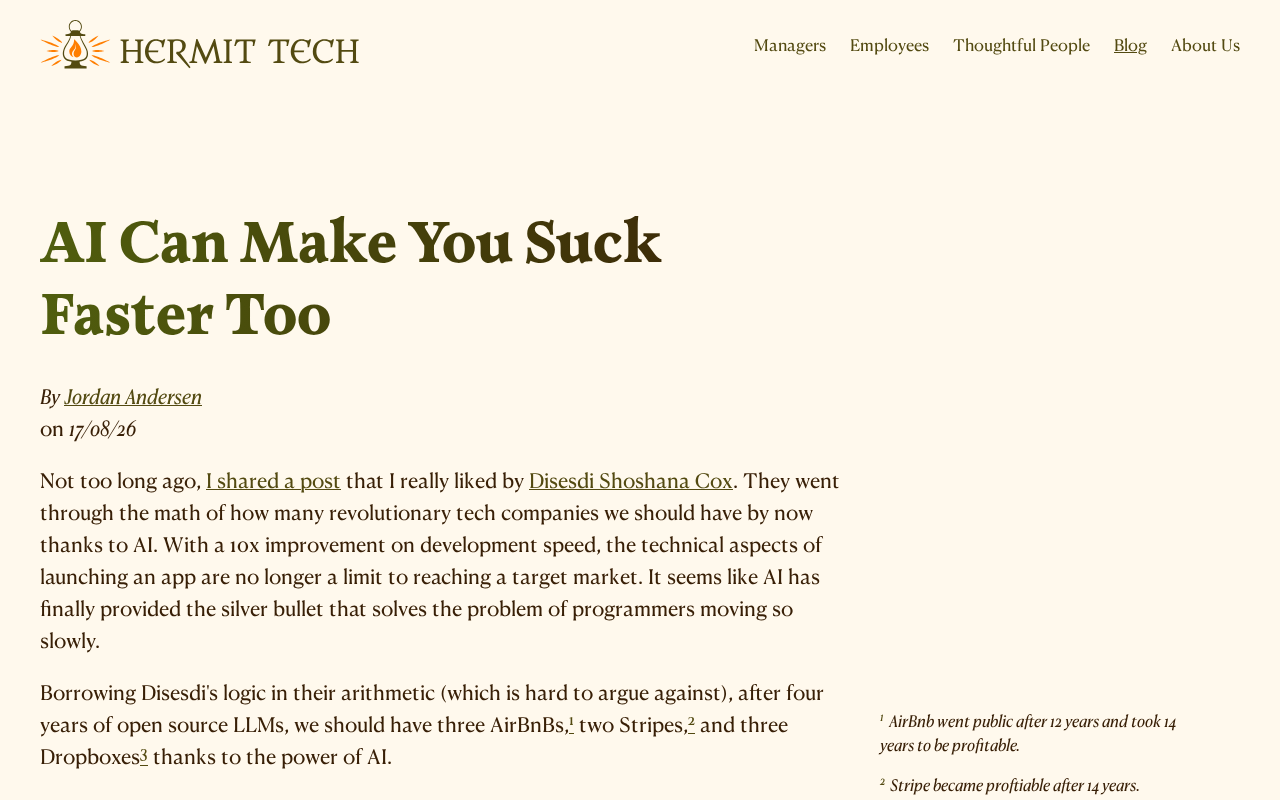
Recently on Hacker News, a playfully titled article — AI Can Make You Suck Faster Too — sparked heated discussion in the developer community, garnering 55 upvotes and 46 comments. The slightly provocative title touches on a core issue that's been widely overlooked amid the current wave of AI coding tools: What exactly is AI accelerating?
Many people assume by default that AI coding assistants (such as GitHub Copilot, Cursor, Claude Code, etc.) will make developers stronger and more productive. These tools represent three typical forms of AI-assisted programming today: GitHub Copilot, launched in 2021 as a collaboration between GitHub and OpenAI, is built on the Codex model and embeds itself into developer workflows through inline IDE completions — it now has over a million paying users. Cursor is an AI-native IDE deeply rebuilt on top of VS Code, integrating large language models into every interaction layer of the editor (including multi-file editing and codebase-level context understanding) in an attempt to redefine the programming experience. Claude Code is a command-line AI coding agent from Anthropic that can autonomously navigate codebases, execute terminal commands, and carry out complex multi-step programming tasks. Together, they represent an evolutionary path from "completion suggestions" to "AI IDE" to "autonomous agent," forming a rapidly expanding AI-assisted programming ecosystem.
But the article puts forward a much more sobering perspective — if your engineering skills, code taste, and system design abilities are already flawed, AI won't fix those shortcomings for you. It will simply let you produce equally terrible things at a much faster pace.
The Core Argument: AI Is an Amplifier, Not a Corrector
The article's core logic is remarkably straightforward: AI is a capability amplifier. It amplifies the speed of your output but does not change the quality of what you tend to produce.
This insight has rich precedent in the history of technology. Spreadsheet software didn't eliminate the need for financial analysis skills — it enabled excellent analysts to handle more complex models while also allowing those lacking financial literacy to produce flawed forecasts faster. CAD tools didn't replace the professional judgment required in architectural design — they made good designers more efficient and allowed bad designers to churn out structurally flawed drawings more quickly. In software, from assembly to high-level languages, from handwritten code to frameworks and libraries, every increase in the level of abstraction has acted as an "accelerator," all following the same pattern: tools lower the barrier to execution but raise the importance of judgment. AI coding tools are the latest extension of this historical thread — except this time the leap in abstraction is larger, and so the "scissors gap" between judgment and execution has widened even further.
If You Don't Understand It, AI Can't Help You Judge It
When an experienced engineer uses AI coding tools, they can quickly identify problems in AI-generated code — unreasonable abstractions, hidden performance traps, incorrect boundary handling. They treat AI as a high-speed first-draft generator, then apply their own judgment to filter and refine the output.
But for a developer lacking foundational skills, the situation is completely different. They can't assess whether the AI's proposed solution is sound, can't identify the technical debt embedded within it, and may not even notice code that appears to run fine but harbors hidden risks. The result: AI helps them generate large volumes of code they can't even evaluate, and problems are amplified and accumulated exponentially.
Coding Speed Does Not Equal Engineering Value
The essence of software engineering has never been "how fast you write code" but rather "the ability to make correct decisions." Many developers in the comments section deeply resonated with this point. A frequently echoed view was: Writing code accounts for only a small fraction of a software project's lifecycle cost. What's truly expensive is maintenance, debugging, and comprehension.
If AI merely helps you write unmaintainable code faster, then it's effectively shifting costs from "now" to "the future" — and often with compound interest.
Why This Problem Deserves Our Attention
The Productivity Illusion of "Feeling Like You're Making Progress"
The most dangerous aspect is that AI coding assistants give users a powerful illusion of "productivity gains." Code rapidly appearing on screen, tasks quickly marked as closed, workflows that seem highly efficient — all of these deliver instant gratification.
But that gratification may be hollow. Real capability growth comes from deliberate practice and deep thinking: manually resolving a tricky bug, independently designing a system architecture, repeatedly weighing the tradeoffs between different approaches. Deliberate Practice is a theory of professional skill development proposed by psychologist Anders Ericsson. Its core elements include: targeted practice at the edge of one's comfort zone, immediate feedback, and deep analysis and correction of errors. The theory emphasizes that professional skill growth isn't a product of simple repetition but comes from actively tackling difficult tasks. In software engineering, this means independently debugging a complex concurrency issue, designing a scalable system architecture from scratch, or conducting in-depth tradeoff analysis between multiple technical approaches — these painful but immensely valuable processes are the crucible in which engineering judgment is forged.
When AI takes over these "difficult but valuable" thinking processes, beginners lose precisely the most precious opportunities for growth. In cognitive science, this is known as the loss of "desirable difficulties" — developers complete tasks but skip the critical path of skill formation, which in the long run severely impedes the internalization of deep skills.
The Hidden Accumulation of Technical Debt from AI-Generated Code
Developers in the discussion also pointed out that AI-generated code often looks "clean" at a local level but lacks consistency and coherence at the architectural level. When a team relies heavily on AI-assisted development without rigorous review, the codebase gradually morphs into a Frankenstein monster stitched together from countless "local optima" — each piece looks fine on its own, but the combination becomes a maintenance nightmare.
The concept of Technical Debt was first introduced by Ward Cunningham in 1992, using a financial metaphor to describe the hidden costs incurred when software development sacrifices long-term code quality for short-term speed. Just as financial debt accrues interest, technical debt continuously increases maintenance costs over time. Traditional technical debt is usually a conscious tradeoff made by developers under time pressure, and teams have some awareness of its existence and location. But the technical debt introduced by AI-generated code has a distinctive new quality: it tends to be unconscious, distributed, and difficult to locate. Because AI models lack an understanding of the overall architectural evolution of a codebase, they tend to provide independent "best" solutions for each local problem — and these solutions may be inconsistent with each other in terms of design patterns, error handling strategies, and dependency management, forming a kind of "diffuse technical debt."
This type of technical debt accumulates in an especially insidious way: it doesn't suddenly explode one day but instead continuously adds friction with every requirement change and every feature iteration, until the project's development velocity drops back to — or even below — the level it was at without AI.
The Right Way to Use AI Coding Tools
The article and its discussion aren't a blanket rejection of AI tools' value. Rather, they're calling for a more clear-eyed approach to using them.
Treat AI as Leverage, Not a Crutch
For capable engineers, AI is a powerful lever — it can multiply your judgment and experience many times over. You remain the decision-maker; AI merely accelerates execution.
For beginners, treating AI as a "crutch" is dangerous. A healthier approach is to treat it as a teacher you can ask questions of at any time — use it to understand concepts and explore different implementation approaches, but always maintain the habit of hands-on work and independent thinking. Use AI to learn, not as a substitute for learning.
Code Review Can Never Be Skipped
Regardless of the user's skill level, rigorous review of AI-generated code is a non-negotiable baseline. You need to truly understand every line of code, grasp why it was written that way, and know under what conditions it might fail. If you can't review it, you shouldn't commit it.
Code review as a software engineering practice traces back to the 1970s, when Michael Fagan promoted formal code inspections (Fagan Inspection) at IBM. Modern code review has evolved from formal meeting-based inspections to asynchronous collaboration models based on Pull Requests. Its core value lies not only in finding defects but also in knowledge sharing, code style consistency, and maintaining team engineering culture. In the era of AI-assisted programming, code review's role is undergoing a subtle but important shift: reviewers must not only assess code correctness and maintainability but also develop the ability to identify "AI-style code" — such as over-engineered abstractions, the introduction of unnecessary dependencies, or implementations that look correct but lack deep consideration of edge cases. Some teams have already begun explicitly tagging which code is AI-generated in their review process, allowing reviewers to adjust their review strategies and attention allocation accordingly.
This is not just about being responsible for code quality — it's also a critical practice for keeping your own engineering skills from atrophying.
Capability Is What Ultimately Matters
The wisdom of the title AI Can Make You Suck Faster Too lies in its humorous yet profound reminder: AI is not a substitute for capability — it's a multiplier of capability.
A multiplier applied to a positive number yields a larger positive number; applied to a negative number, it yields a larger negative number. The sophistication of a tool can never compensate for a weak foundation. In this era of increasingly ubiquitous AI coding tools, what remains truly scarce and resistant to devaluation is solid engineering fundamentals, good code taste, and clear systems thinking.
Rather than worrying about "Will AI replace me?," it's worth asking yourself a more practical question first: When AI increases my output speed tenfold, am I producing ten times the value — or ten times the garbage?
Related articles

Chain of Thought Isn't Just for AI: How Humans Can Use CoT to Improve Thinking Quality
Chain of Thought isn't just a prompt trick for large models. Starting from a Hacker News discussion, this article analyzes why CoT works for human thinking too, breaks down actionable ways to transfer it, and highlights the key differences between human CoT and machine CoT.
Cloudflare Teams Up with OpenAI: Closi…
Cloudflare Teams Up with OpenAI: Closing the Loop from Vulnerability Discovery to Defense with AI
Cloudflare uses OpenAI Daybreak to investigate security vulnerabilities and generate reviewable remediation plans, while developers use Codex to boost coding efficiency and quality.

Orca Multi-Agent Orchestration in Practice: A Guide to Parallel Collaboration with Claude and Codex
Orca is Stable AI's free open-source agent workbench supporting 34 agents like Claude Code and Codex in parallel. Learn its Git worktree isolation, multi-model orchestration, and mobile management.