The Truth About Cursor Pay-Per-Use Plugins: Four Hidden Risks of Low-Cost Shared Accounts

Exposing the four hidden risks behind Cursor's low-cost shared account pay-per-use plugins.
This article analyzes third-party Cursor pay-per-use plugins that offer shared Pro accounts at steep discounts. While their "pay only for what you use, credits never expire" model appears attractive, the underlying shared account rotation mechanism carries significant risks: ToS violations leading to bans, service provider instability, code security vulnerabilities, and long-term cost-effectiveness concerns for professional developers.
Introduction: A Cursor Billing Plugin That Promises "Credits That Never Expire"
Recently on platforms like Bilibili, a category of third-party "virtual cup plugins" (essentially proxy billing/shared account services) targeting the AI programming tool Cursor has emerged. Unlike the typical monthly, quarterly, or short-term trial accounts, these products promote a pay-per-use model with credits that never expire, claiming to offer users "real official Pro accounts" at "2.5x discount" or even "90% off" the official price.
Cursor is an AI-native code editor developed by Anysphere, deeply customized on top of the VS Code open-source core. Its key capability lies in deeply integrating Large Language Models (LLMs) into the coding workflow — not only supporting AI conversational programming but also automatically reading the entire project's code context (including file structure, dependencies, function call chains, etc.) to provide precise code completion, refactoring suggestions, and bug fix solutions. Because Cursor has rapidly gained popularity among developers, its Pro subscription pricing ($20/month) has spawned a large gray market centered around account sharing and proxy top-ups.
This article will objectively break down the operational logic and claimed selling points of such products based on their promotional content, and analyze the real risks lurking beneath from both technical and compliance perspectives, helping developers make informed decisions.
Claimed Core Selling Points of Cursor Pay-Per-Use Plugins
According to the content creator's introduction, this plugin differentiates itself from the common "multi-account rotation" plugins primarily in its billing model and account quality.
Pay-Per-Use with Credits That Never Expire
The product claims to adopt a "pay-per-use, charge only for what you consume" model, with official pricing converted at a 2.5x discount, and account credits that never expire until fully consumed. Compared to Cursor Pro accounts purchased on secondhand platforms (which have fixed expiration dates and forfeited balances afterward), this model is indeed more attractive in terms of "zero waste."
To understand the underlying logic of "pay-per-use" here, you need to understand the Token billing mechanism of large language models. In the LLM field, a Token is the smallest unit of text processed by the model — for English, one Token corresponds to approximately 4 characters or 0.75 words; for Chinese, one character typically corresponds to 1-2 Tokens. Each model call incurs costs from both input Tokens (Prompt) and output Tokens (Completion), with dramatically different pricing across models. For example, Claude Sonnet's input price is approximately $3 per million Tokens, while GPT-4o's output price is even higher. Cursor's official Pro subscription includes a certain free quota (e.g., 500 fast requests per month), with Token-based charges applying beyond that limit. Therefore, these "pay-per-use" plugins essentially repackage and resell the official Token consumption costs at a discount.
The promotional material provides specific calculations: charging 100 RMB provides access to 1,000 RMB worth of official credits, which at an exchange rate of 7.3 equals approximately $137 in official usable credits.

Claims of Using "Real Official Pro Accounts"
The product emphasizes that all accounts assigned to users are "legitimate, long-term usable premium Pro accounts" rather than 7-day trial accounts. The Pro status can be verified in the settings interface, and all models officially supported by Cursor are fully unlocked in the model list, including Sonnet, o-series, and other mainstream high-precision models. They claim there is no "model degradation" or feature restrictions.
The "model degradation" mentioned here is a common issue encountered by shared account users. When Cursor detects abnormal account usage (such as frequent IP switching or multi-device logins), it may route that account's requests to lower-performance model versions or reduce response quality. This is a common soft risk-control measure on the platform side — rather than directly banning accounts, it suppresses unauthorized use by degrading service quality.
No Modification of Native Code, Only Two Core Features Retained
The product claims the plugin "never modifies any of Cursor's native code" and retains only two core functions: intelligent account rotation and consumption billing records. This means users can update to the latest official Cursor version at any time without waiting for plugin compatibility updates.
Billing System and "Smart Consumption" Mechanism Explained
To support the credibility of "pay-per-use," the product has built a billing record system.
Transparent Consumption Details
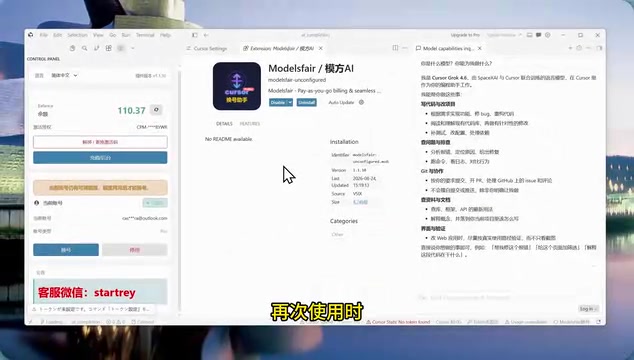
The promotional material mentions that every consumption is recorded, including remaining balance, the model used for each request, official billing standards, output token count, consumption time, etc., and claims to support reconciliation with official records.
Notably, the claim of "reconciliation with official records" contains an inherent logical contradiction. Since users are not using their own official accounts but shared accounts provided by the service, users cannot directly log into Cursor's official backend to view the account's real consumption records. The so-called "reconciliation" is merely data displayed unilaterally by the service provider, and its accuracy depends entirely on the service provider's integrity.

Account Pool and Automatic Rotation Mechanism
The product relies on a "massive intelligent consumption system" and "large-scale account pool." The operational logic works as follows: when the system detects that a user has had no conversation activity for an extended period, it automatically releases idle accounts; upon resuming use, a fresh Pro account is immediately reassigned and billing resumes; if the current account's credits are exhausted, the system automatically rotates to a new account. The service provider claims to reduce costs through bulk purchasing and only earns a reasonable markup.
This "account pool" operation model is technically similar to the concept of Resource Pooling in cloud computing — treating a large number of accounts as shared resources and dynamically allocating them to active users through scheduling algorithms, thereby improving the utilization rate of each individual account. From an economic model perspective, if only 10-20 out of 100 users are simultaneously online and active, then theoretically only 20-30 Pro accounts need to be maintained to serve all users. This is the mathematical basis that makes the "2.5x discount" pricing viable. However, this "overselling" model also means that once concurrent users exceed expectations, queuing, lag, or even service unavailability may occur.
A Sober Analysis: Four Real Risks of Cursor Shared Account Plugins
From technical and business logic perspectives, while such services' marketing may be internally consistent, there are several risks that developers cannot afford to ignore.
Risk 1: Questionable Account Sources and Compliance
Regardless of how much the product emphasizes "real official Pro accounts," its essence is a shared account + account rotation model. The source of "bulk purchased" accounts is impossible to verify and likely violates Cursor's official Terms of Service (ToS). Once official risk controls identify abnormal multi-device, multi-IP sharing behavior, mass account bans are only a matter of time — fundamentally no different from the "secondhand account ban risk" that the content creator themselves criticizes, merely shifting from the individual level to the platform level.
Virtually all mainstream SaaS products' Terms of Service explicitly prohibit account sharing and resale. Taking Cursor's parent company Anysphere as an example, their ToS typically includes clauses such as "accounts may not be shared, transferred, or sold," with violations resulting in account termination without refund. From a technical standpoint, modern SaaS platforms have very mature risk control systems capable of identifying sharing behavior through Device Fingerprinting, login IP analysis, and usage pattern anomaly detection. As a desktop application that needs deep integration with local development environments, Cursor can collect richer device characteristic information (such as hardware ID, OS version, screen resolution, installed extension lists, etc.) than pure web applications, meaning risk control identification accuracy is correspondingly higher.
Risk 2: "Never Expires" Depends on the Service Provider's Continued Existence
"Credits that never expire" is an extremely attractive promise, but its validity is predicated on the service and its account pool remaining stable long-term. The lifecycle of such gray-market services is often highly uncertain: once the official platform strengthens risk controls, the account pool fails en masse, or the service provider disappears, users' pre-charged balances will instantly become worthless. The so-called "never expires" effectively transfers the risk from "account expiration" to the far more uncontrollable variable of "platform survival."
Looking at the historical performance of similar gray-market services for other products, this risk is far from unfounded. ChatGPT Plus shared accounts and proxy top-up services proliferated during 2023-2024, but as OpenAI continuously strengthened risk controls (including device binding, IP geo-fencing, and abnormal usage pattern detection), large numbers of sharing services collapsed within just a few months, with users' prepaid funds unrecoverable. Netflix's experience in combating account sharing is even more illustrative — after Netflix fully implemented password-sharing restrictions in 2023, the "Netflix co-rental" services that had proliferated globally collapsed virtually overnight. These precedents demonstrate that the "value" of gray-market services is essentially short-term arbitrage built upon the platform's tolerance period, and once the platform decides to act, the service provider's ability to respond is extremely limited.
Risk 3: Code Security and Data Privacy Concerns
As an AI programming tool, Cursor reads users' code context. Using third-party rotated shared accounts means your code requests pass through the service provider's account system. Although the product claims "no modification of native code, no API relay," the account rotation mechanism itself requires intervention at the client level, and the actual degree of data flow exposure is something users cannot independently verify. For developers working on projects involving trade secrets or sensitive information, this risk is particularly worth heeding.
To deeply understand this risk, you need to understand Cursor's technical mechanism for reading code context. When a user initiates an AI request in Cursor (whether code completion, conversation, or code editing), Cursor automatically collects current file content, relevant file snippets, project structure information, terminal output, and other contextual data, sending it as part of the Prompt to the backend model. This means every AI interaction may contain core project code, API keys, database structures, business logic, and other sensitive information. Under normal use, this data is encrypted and transmitted to Cursor's servers through the user's own account; but under the shared account model, the account rotation plugin must at minimum manage authentication credentials locally (such as Session Tokens or OAuth Tokens), creating a potential attack surface for man-in-the-middle attacks or credential theft. Even if the plugin itself has no malicious intent, its intervention in the authentication process breaks Cursor's native security chain and increases the attack surface for data leakage. Furthermore, the service provider could theoretically view the account's historical request records through the account backend, indirectly obtaining users' code content.
Risk 4: Official Stance and Long-Term Cost-Effectiveness Considerations
You may not have noticed, but Cursor's official position has consistently been explicitly against account sharing and third-party proxy top-ups. Choosing a legitimate subscription, while more expensive per unit, provides account stability, data compliance, and ongoing official support. For professional developers who use AI programming as a long-term productivity tool, gambling workflow stability for a "90% discount" may not be the wisest trade-off.
From a long-term financial perspective, Cursor Pro's monthly fee is $20 (approximately 146 RMB), with annual billing at $192 (approximately 1,400 RMB, equivalent to about 117 RMB per month). For full-time developers, if Cursor saves even 30 minutes of coding time per day, at the average hourly rate of 100-200 RMB for mid-level developers in China, the time value saved in a single day already exceeds the daily subscription cost. More importantly, a legitimate subscription means users receive official technical support, first-access feature updates, and formal appeal channels when issues arise — hidden value that is completely absent from gray-market services. For enterprise users, using unauthorized shared accounts may also trigger intellectual property compliance issues, and if commercial disputes or audits arise, the consequences far outweigh the few hundred RMB saved on subscriptions.
Conclusion: A Rational View of "Value" in the Gray Area
These Cursor pay-per-use plugins have indeed tapped into many developers' sensitivity to subscription pricing, and their "pay only for what you use, credits never expire" product design shows some ingenuity. But ultimately, they are built upon the gray area of shared accounts, and compliance risks, ban risks, service continuity risks, and data security risks are ever-present companions.
For developers, before being attracted by "90% off pricing," consider this: are you willing to trade your workflow stability and code security for this uncertain discount? Truly sustainable productivity is often built on a foundation of compliance and stability.
Related articles

JobRunner MCP Server: AI Agents Can Now Fix Failed Java Jobs
JobRunner launches an open-source MCP server enabling AI agents to view cluster status, diagnose failures, and recover Java jobs—incident response from any cloud coding environment or existing agent.

MLAI Digital Launches 9 Security Agents: MCP Server Safeguards the Full Lifecycle of Agentic AI
MLAI Digital launches Security MCP Server with nine built-in specialized security agents covering vulnerability discovery, attack simulation, prompt injection detection, API and infrastructure assessment, and accelerated remediation—embedding security validation across the full Agentic AI lifecycle from development to production.

Running Isaac Lab on H100 GPUs: Exploring Better Approaches
Exploring optimization methods for running Isaac Lab on NVIDIA H100 GPUs, including MIG configuration, mixed precision, TensorRT acceleration, and community experience to improve robotics simulation and reinforcement learning efficiency.