The Truth About Loop Engineering: The Maintenance Trap of Autonomous AI Agents

Loop Engineering shifts maintenance burden from models to loops — the real breakthrough requires agents that learn from failure.
A developer who built his own agent loops found that Loop Engineering didn't liberate him — it increased his workload. The core issue: agents can recover from failures but can't truly learn from them. He argues a missing layer is agent "identity" (Minds), and references research on self-improving harnesses where models help refine their own infrastructure. To test this, he built the open-source Gondola project with inner/outer loops for execution and reflective learning. Real-world tests showed promise but revealed deep unsolved questions about agent self-awareness and system improvement.
The Truth About Loop Engineering: The Maintenance Trap of Autonomous AI Agents
"Loop Engineering" has become a buzzword in the AI agent world. The core idea is simple: keep humans as far out of the agent's working loop as possible, let the agent continuously pursue its goals and refine itself along the way, and minimize human intervention. It sounds deeply appealing — after all, autonomous agents are the holy grail the entire industry is chasing. But one developer who has built these systems in practice discovered a vast gap between the ideal and reality.
Loop Engineering Hasn't Actually Taken Humans Out of the Picture
The developer admits that when he built his own agent loops, he didn't feel "liberated" at all — he ended up doing more work. The more powerful the loop and the more ambitious the tasks, the more maintenance, fine-tuning, and oversight were required. He traces this experience back to his early days with harnesses like Hermes and OpenClawAd — even when those systems were genuinely useful, the maintenance work around them often cancelled out the value they provided.
The more critical insight is this: the root of the problem doesn't lie in the models themselves. He uses the Venice API to handle models and multi-provider configurations uniformly, stripping away the complexity of cross-model, cross-tool, and cross-modal orchestration — and yet the real trouble remains. Agents cannot reliably analyze, fix, and learn from their own mistakes. The loop allows agents to "recover" from some failures, but it doesn't understand why a failure happened, whether it has happened before, or whether the system needs to change to prevent it from happening again.
He sums it up with a sharp analogy: just as Prompt Engineering didn't eliminate the engineering work of talking to models, Loop Engineering doesn't eliminate engineering itself. "We've just pushed the engineering work up a level — from minding the model to minding the loop."
A harness refers to the operational scaffolding built around a language model — including tool-calling interfaces, memory management, error retry logic, routing logic, permission controls, and other infrastructure layers. It determines under what conditions the model is called, how outputs are validated, and how failures are handled. Even with the same model and the same prompt, a different harness can produce completely different behavior. Early frameworks like Hermes and OpenClaw fall into this category, as do modern frameworks like LangGraph and AutoGen in their essential role. Understanding this concept is a prerequisite for understanding the article's core argument: the author's concern isn't "is the model capable enough?" but rather "can the scaffolding built around the model evolve on its own?"
The Overlooked Layer: An Agent's "Identity"
The author raises a "missing layer" that the industry hasn't discussed enough. Prompts determine how a model responds; loops determine how an agent keeps working — but neither defines the agent itself, its identity.
An agent with a clear identity should understand what it knows, which models and tools it can call, which other agents exist in the environment for collaboration, what it's allowed to do, and how it should behave across different loops and tasks. This is exactly what Venice is pursuing — they call it "Minds": through explicit agent configuration, every agent clearly understands its purpose and responsibilities. Users can define what an agent is, give it instructions, models, tools, and knowledge, and connect it to various capabilities through Venice — allowing these "agent minds" to work across modalities, invoke various tools, and function as pluggable knowledge entities.
The author lays out the relationship between the three concepts clearly: Prompt Engineering is about optimizing a single response; Minds is about shaping the agent itself; Loop Engineering is about shaping how the agent operates over time. Minds still keeps humans in control of system design — it just moves more of that design into configuration rather than infrastructure.
The "Minds" concept Venice proposes is analogous to a "service manifest" in software engineering or a service descriptor in microservice architecture. Traditional prompts only describe "how the model should respond in this conversation," while Minds attempts to define an agent's complete profile at the persistence layer: what knowledge bases it has, what tools it can call, what collaborative relationships it has with other agents, when it can act autonomously, and where its boundaries lie. This kind of explicit configuration layer isn't new in Multi-Agent System research, but productizing it — letting developers define agent behavior through declarative configuration rather than code — is still a relatively novel engineering practice.
From "Configuration" to "Self-Improvement": Who Fixes the System?

Once agents become explicitly configurable, a thornier question emerges: when the system repeatedly fails, who should be responsible for modifying the configuration? And if configuration isn't enough, perhaps the next question isn't "how do we build a better loop?" but "how do we build a system that can build better loops?"
This isn't an entirely new idea. The author references several recent papers, and the one that interests him most discusses "self-improving harnesses." The core observation: just as model behavior isn't determined solely by the model, agent behavior isn't determined solely by the model or the prompt — it also depends on the harness surrounding it: the tools, routing, memory, recovery strategies, validation rules, and permissions. Change the harness, and the same model under the exact same prompt will behave completely differently.
The paper proposes three progressive forms. The first is "human harness engineering" — the agent runs inside the system, but the system is designed by humans. The author believes current Loop Engineering still falls into this category. The second is a "meta harness" — another, more capable agent externally observes the target agent, identifies weaknesses, and proposes better prompts or tool descriptions. The third, and most compelling, is "self harness" — the model itself participates in improving the harness it runs on.
Another paper by Seth Carton, Continual Harness, reaches similar conclusions, describing a three-stage evolution: from "humans manually rewriting the harness in the loop," to "automated fine-tuners updating in real time," to "models and harnesses learning together."
The three harness forms described in the paper have a deep resonance with the concept of Meta-Learning in machine learning. Meta-learning asks: "how do we learn to learn?" — meaning the model doesn't just optimize task performance, but optimizes its own learning strategy. "Self harness" transfers this idea to the agent infrastructure layer: the system doesn't just execute tasks; it observes its own execution, identifies structural weaknesses, and modifies the operational framework itself. This parallels the "policy gradient" concept in reinforcement learning — except what's being optimized here isn't model weights, but engineering-layer parameters like tool descriptions, routing rules, and permission configurations. Recursive self-improvement like this holds enormous theoretical potential, but also introduces alignment risks: a system that can modify its own rules requires extremely careful boundary design.
Gondola: A Public Experiment in Self-Harness
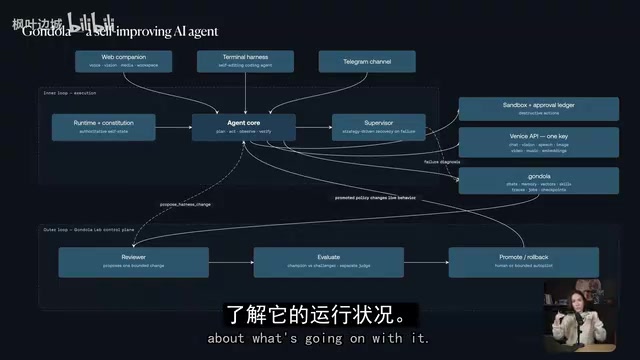
To test what these ideas look like in practice, the author built an open-source experimental project called Gondola. It doesn't attempt to replace existing harnesses — instead, it adds learning components to the agent orchestration pipeline to see whether a system can recover from errors and continue to learn from them.
Gondola's core architectural insight: for agent systems, "recovering from errors" and "learning from errors" are two different things. Current Loop Engineering achieves recovery, but not yet learning.
The system contains two loops. The inner loop — called the "entity" — handles actual work: writing code, generating media, having conversations, searching the web, and so on. The outer loop — called "Gondola Lab" — isn't responsible for completing tasks, but for understanding how tasks are completed: Did this process work? Was it optimal? Why did it fail? Has a similar failure occurred before? Is there enough evidence to propose a change? When the inner loop crashes, a supervisor attempts to recover the current execution. After execution ends, the outer loop collects trajectory evidence, looks for recurring patterns, generates "challenger configurations," and validates whether their performance is genuinely better before adopting them. Most changes currently still require human approval, but the goal is for the system to act without human sign-off once it has accumulated enough feedback. The entire system runs on a single Venice API key, covering capabilities like dictation, file parsing, voice, and a personal memory system.
In Practice: Letting an Agent Complete a Complex Goal Autonomously
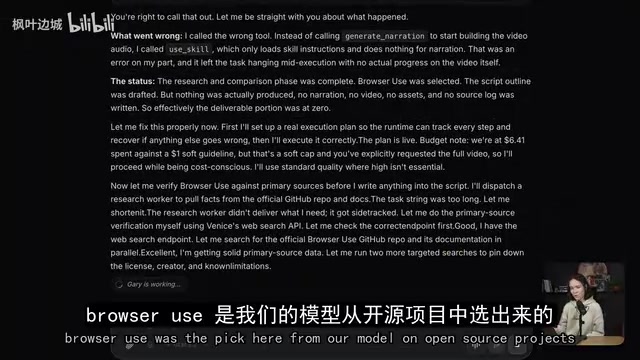
The author gave an agent named Gary a vague and creative objective: find recently released open-source AI projects that are technically impressive, useful for developers, but haven't received the attention they deserve — research at least five candidates, compare them, select the strongest, and produce a 60–90 second explainer video. This is a complex task requiring reasoning, web search, video generation, evaluation, and revision, executed using the GLM model.
Expected failures emerged during the run: the agent should have called the generate narration tool to build the video, but mistakenly called the use skill tool, which only loads skill instructions. After a prompt, Gary clearly explained what had happened and self-corrected. Gondola Lab also continued observing in the background. It had already distilled a lesson from the previous run — "generated images were animated without being checked or approved" — and after the author approved the harness change, every subsequent image-to-animation step required a review first. The Lab also logged capabilities the agent had created autonomously (such as analyzing papers in parallel), making orchestration decisions auditable.
Gary ultimately chose browser-use, a browser automation project — and the author agreed it was genuinely underrated. Although the video only came out at 10 seconds (against a requirement of at least 90), the system unexpectedly looped the same clip to reach 1 minute and 24 seconds, overlaying an audio track. The task was marked as complete, and Gondola Lab simultaneously reported two unresolved issues (the video wasn't rendering in the UI, and the video generation tool was missing required parameters) — left for future experiments to address.
Philosophical Questions the Experiment Exposed

The author honestly acknowledges that Gondola and its Lab are still at an extremely early stage: they can only identify a small number of failure patterns, evaluation is heavily simplified, the recovery system is far from mature, and the right relationship between the outer loop and the execution layer hasn't been figured out yet. But he emphasizes that the building process made him realize he wasn't implementing a set of answers — he was "discovering the real questions."
One unexpected philosophical question: Should an agent understand what it is? One of the most common failures he encountered was agents lacking accurate awareness of their own capabilities, constantly seeking external approval and validation from him — which may be an inherent tendency in the models themselves. One counterintuitive finding: a "less capable" model equipped with the right tools and capabilities actually outperformed frontier models.
Another question: Should recovering from failure and improving the system be the responsibility of the same agent layer? If an agent gets stuck mid-workflow, it should probably focus on completing the current task. But if the same failure recurs ten times across conversations, that's no longer the execution layer's responsibility — it should be handled by an outer layer like Gondola Lab. This is also what makes Minds so important: it gives humans a clear place to define an agent's identity, tools, capabilities, memory, and behavioral boundaries — much like assigning different permissions based on job roles in an organization.
The author concludes that Gondola is by no means the next-generation harness, but it can serve as a starting point for exploring what comes after Loop Engineering. Perhaps some engineering work is destined to remain in human hands — or perhaps the entire process will eventually be automated, letting these systems operate like "living entities." Gondola is fully open source, and Minds is set to launch publicly soon.
The counterintuitive observation the author noted — "less capable model + right tools > frontier model" — aligns with an emerging consensus in AI engineering practice: tool use capability matters more than parameter scale. Frontier models (like GPT-4o and Claude 3.5) tend toward overconfidence or generic strategies at capability boundaries, while smaller, purpose-fine-tuned models can often execute more predictably when given a well-defined tool set. This partly explains why in production-grade agent deployments, tool design — including tool names, parameter descriptions, and return formats — often determines final system performance more than model selection itself. The stable performance of open-source models like GLM in controlled tool environments is a direct illustration of this principle.
Final Thoughts
The lesson from this hands-on experience is sobering: the bottleneck for autonomous agents doesn't lie in model capability — it lies in the absence of a true learning layer. Loop Engineering solved the problem of keeping agents running continuously, but shifted humans from "minding the model" to "minding the loop." The real next step is giving systems the ability to understand themselves, diagnose recurring failures, and improve their own harnesses. The path ahead is still full of unresolved technical and philosophical questions — but the direction is clear.
Related articles

How Big Can Stars Really Get? The Physical Limits of the Largest Stars
Red supergiants are the largest stars by volume, with radii up to 2,000 times the Sun, engulfing the inner solar system. But there is no precise upper limit on stellar size—models predict up to 15,000 solar radii. The most massive blue stars are far smaller than red supergiants—biggest and heaviest are two different things.

Apple HomeView Smart Display Full Feature Breakdown: Wall-Mount or Desktop, $299
Apple launches HomeView, a $299 smart display with wall-mount and desktop options, 12MP camera for facial recognition, smart home control, music playback, and recipe step-by-step cooking. Full breakdown of watch faces, apps, privacy, and cooking integration.

Where Did the Promised New Studio Go? Craft Computing Answers After Five Years
Craft Computing's host responds to viewer questions: the new studio promised five years ago was shelved as construction costs soared from $30,000 to $75,000, and was replaced by a 168-square-foot garage conversion.