The Truth About Reasoning Models: Not Smarter, Just Slower and More Expensive

Reasoning models aren't the default answer—they're a premium tier with admission criteria, and only ~15% of tasks are worth paying for.
Reasoning models are being treated as the new default option for large model products, but frontline team measurements show latency is 3 to 10 times that of fast models, cost per million answers differs by up to 30x, and only about 15% of enterprise prompts genuinely benefit. The author proposes three design patterns—escalate rather than default, budget your thinking, cache conclusions not reasoning chains—and layers deployment by interaction type: interactive interfaces under 2 seconds perceived latency, async overnight batching, human-in-the-loop reasoning, and iteration limits in agent loops. Evaluation should measure cost per correct answer, not per request; reasoning models typically win on only ~12% of tasks. The right approach is treating reasoning as a premium tier with clear admission criteria, not a default LLM.
Reasoning models are becoming the "new default option" for large model products, but the ledgers of frontline engineering teams tell a different story. According to a practitioner's account on ayraix.com, when one team switched their code review pipeline to a reasoning model, they didn't get more accurate results—they got slower responses, an extra $3,700 monthly bill, and "the same mistakes made with more steps and greater confidence." This article isn't about bashing reasoning models; it's answering a more practical question: which tasks are worth paying for "thinking," and which aren't.
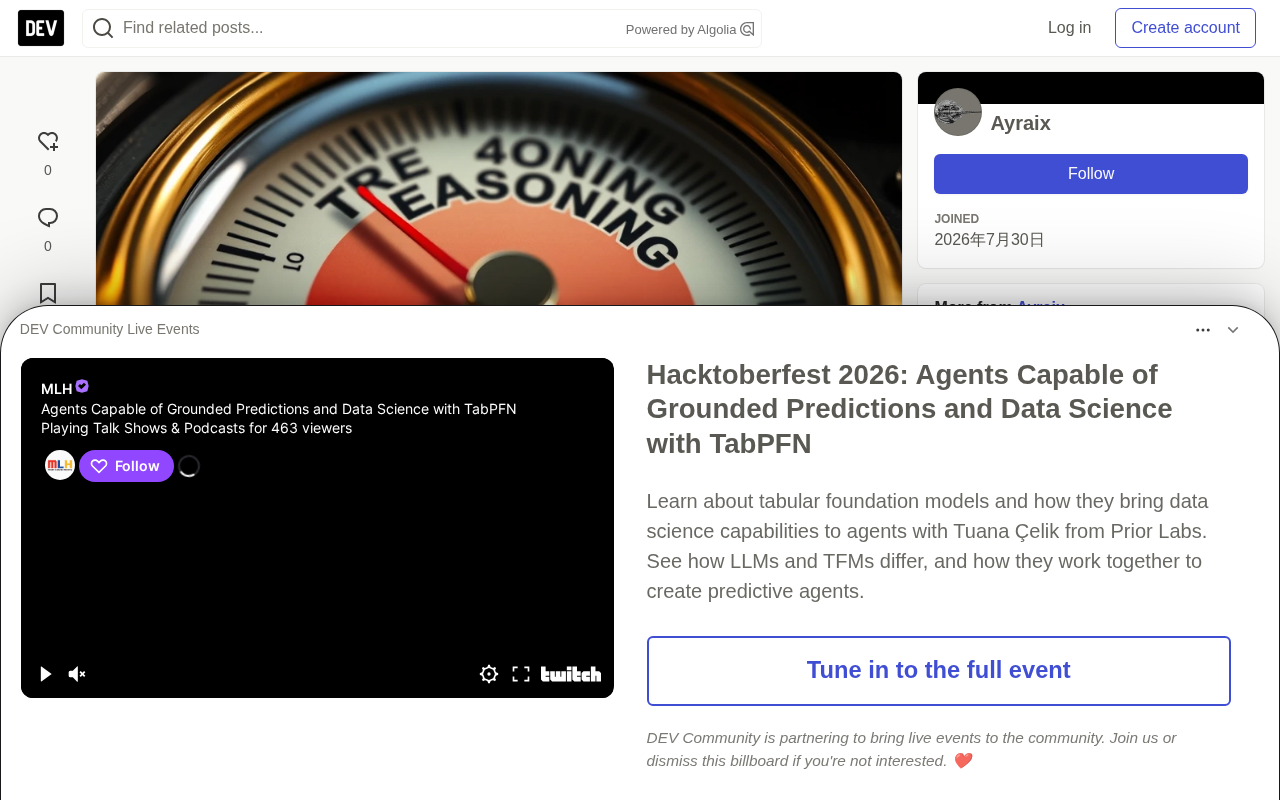
What You Actually Get with a Reasoning Model
Multi-step logical capability, plus verifiable intermediate states. Mathematical proofs, constraint solving, code that must compile, policy clauses where a single misunderstanding cascades into errors—in these scenarios, the model spends tokens on draft reasoning (whether visible or hidden) in exchange for higher accuracy than "one-shot" generation.
But what reasoning models can't buy is equally clear: speed, cheapness, and immunity from hallucination. A reasoning chain can absolutely arrive at a confidently wrong conclusion through twelve rigorous steps. The author specifically emphasizes that when models "show their work," observability becomes more important, not less.
How high is the cost? The author provides measured comparisons under identical hardware conditions:
| Model | Latency | Tokens per Answer | Cost per Million Answers |
|---|---|---|---|
| qwen2.5-coder:14b (fast) | ~2 seconds | ~500 | ~$5 |
| deepseekAd-r1:14b (thinking) | ~15 seconds | ~3,000 | ~$30 |
| o1-class (reasoning) | ~45 seconds | ~15,000 | ~$150 |
Latency is 3 to 10 times that of a single generation, and costs differ by up to 30x. According to the author's six-month routing audit, only about 15% of enterprise prompts genuinely benefit from extended reasoning.
Reasoning Model refers to a class of models that improve output quality by extending their internal thinking process. Representative examples include OpenAI's o1/o3 series, DeepSeek's R1, and the QwQ variants in the Qwen series. The core mechanism is generating a lengthy "Chain-of-Thought" or hidden reasoning tokens before producing the final answer, replacing the previous "one-shot" generation with multi-step deliberation. This training typically combines reinforcement learning to teach models self-checking, sub-problem decomposition, and backtracking before arriving at an answer. The cost is that reasoning tokens are used only for computation and not directly output—users are billed by token but can't see this content. Therefore, the "expense" of reasoning models isn't just about unit price; it's about paying for an invisible thinking process.
Three Design Patterns That Actually Work
Escalate rather than default. Do cheap intent classification first, and only invoke the reasoning model when confidence is low or risk is high. Make users wait eight seconds for a hashtag suggestion, and they won't become your fans.
Set a budget for thinking. Cap reasoning token count, step count, and wall-clock time. An agent that can think indefinitely will think indefinitely and send you the bill.
Cache conclusions, not reasoning chains. Store validated output results rather than replaying the full reasoning trajectory on every similar ticket.
When it comes to task routing, the author's dividing line is quite clear: code completion, simple edits, and formatting go to fast models; debugging, refactoring, and multi-file changes go to thinking models; architecture decisions, mathematical proofs, and new algorithms are worth deploying o1-level reasoning models; and single-pass tasks like summarization, extraction, and classification are fine with fast models.
Prompt Routing refers to dispatching requests to models of different capabilities and costs based on the type, difficulty, or risk level of the input task. The article's suggestion to "do cheap intent classification first, and only invoke the reasoning model when confidence is low or risk is high" is a classic two-tier routing approach: front-load a lightweight classifier to determine task category, then decide whether to escalate. Routing criteria typically include task category, historical accuracy, user wait time, and whether financial or legal commitments are involved. It essentially transforms "model selection" from a one-time architectural decision into a continuously operating policy layer that requires periodic recalibration of thresholds using online data. Without routing, all requests go to the strongest model, and the cost curve quickly spirals out of control.
The Latency Bill Nobody Budgets For
The cost of reasoning models isn't just higher cost per token—it's the wall-clock time that's more expensive. An eight-second response in a support component isn't "deeper thinking" in the user's eyes; it's "open another tab and submit a ticket manually." SLAs don't grant exceptions because the model is philosophically more thorough.
The author points out an industry-wide pricing illusion: model vendors market "thinking" as a selling point, but every thinking token is actually paid for twice—once in compute, once in user experience. The faster your alternatives, the more expensive the reasoning tax.
The deployment principle derived from this is layering by interaction type:
- Interactive interfaces: Keep perceived latency under 2 seconds; reasoning models basically shouldn't appear here
- Asynchronous tasks: Put reasoning in overnight batch processing; users just need an email notification
- Human-in-the-loop: Running reasoning with someone watching is fine; making users wait alone in a chat box is not
- Agent loops: Limit iteration count; reasoning agents are especially prone to getting stuck in endless "let me reconsider"
Wall-clock Time refers to the real-world time from when a user sends a request to when they receive a complete response, which is not equivalent to the number of reasoning tokens or compute consumed internally by the model. In reasoning model scenarios, wall-clock time often includes queuing, multiple rounds of chain-of-thought generation, and tool-calling chains. It's a direct metric for user experience and SLA assessment. The article emphasizes that "an eight-second response in a support component" is fatal because once wall-clock time exceeds the user's patience threshold, they'll turn to alternatives regardless of answer quality. Methods for optimizing wall-clock time include asynchronous processing, streaming output, progress indicators, and limiting reasoning steps—rather than simply pursuing a lower token unit price.
How to Measure Whether Reasoning Pays for Itself
Run A/B tests on the same set of prompts against your evaluation set: fast model vs. reasoning model, measuring three metrics—accuracy difference, p95 latency, and cost per correct answer, not cost per request. The author's experience: reasoning models typically win on only 12% of tasks and lose on the economics of the other 88%. This isn't failure; it's a routing table.
For implementation, the author suggests adding a feature flag for reasoning escalation that logs the reason for each trigger. After two weeks, you'll be able to answer with real data whether "low confidence" actually correlates with "needing a stronger model," or whether it's just your classifier being nervous. Thresholds need weekly adjustment—this is product work, not a one-time architectural decision.
Escalation criteria can also be quantified: financial or legal commitments and multi-step dependency chains should trigger escalation; style or tone adjustments and users who've already waited more than 5 seconds should not—the latter should be moved to async or deferred processing.
A/B Testing in model evaluation refers to running the same set of prompts through both fast and reasoning models, then comparing key metrics to determine routing strategy. The article specifically points out the need to measure "Cost per Correct Answer" rather than "Cost per Request." The difference: a reasoning model may be more expensive per request but have higher accuracy—looking only at per-request cost would undervalue it. Conversely, if accuracy improvement is limited for certain tasks, per-request billing masks the waste. A more precise approach combines accuracy difference, p95 latency, and cost per correct answer to reach an actionable conclusion: "On which tasks does reasoning pay off?"
Product Copy Is Part of the Solution Too
If you're going to make the system "think" for eight seconds, don't leave users staring at a spinning dot with no explanation. Progress UI, async handoff, or honest latency labels are all better than a little circle that looks broken. Reasoning models have already trained users to expect depth; your user experience must keep up, or they'll leave before the answer arrives.
The author suggests A/B testing copy on the slow path: in legal workflows, "Analyzing policy" outperformed "Loading." Measure completion rate, not just accuracy—a correct answer nobody waited for is a failed request.
The sharpest summary: "If you treat reasoning models as your new default LLM, you'll quickly learn what API bills and SLA violations have in common." The right approach is to treat reasoning as a premium tier with clear admission criteria, not a default setting.
One-line Summary
Reasoning models aren't the default answer—they're a premium tier with admission criteria, and only ~15% of tasks are worth paying for.
Paragraph Summary
Reasoning models are being treated as the new default option for large model products, but frontline team measurements show latency is 3 to 10 times that of fast models, cost per million answers differs by up to 30x, and only about 15% of enterprise prompts genuinely benefit. The author proposes three effective design patterns—escalate rather than default, budget your thinking, cache conclusions not reasoning chains—and layers deployment by interaction type: keep perceived latency under 2 seconds for interactive interfaces, batch async tasks overnight, run reasoning with human-in-the-loop, and limit iterations in agent loops. Evaluation should measure cost per correct answer, not per request; reasoning models typically win on only about 12% of tasks. The right approach is to treat reasoning as a premium tier with clear admission criteria, not a default LLM.
Related articles

Chain of Thought Isn't Just for AI: How Humans Can Use CoT to Improve Thinking Quality
Chain of Thought isn't just a prompt trick for large models. Starting from a Hacker News discussion, this article analyzes why CoT works for human thinking too, breaks down actionable ways to transfer it, and highlights the key differences between human CoT and machine CoT.
Cloudflare Teams Up with OpenAI: Closi…
Cloudflare Teams Up with OpenAI: Closing the Loop from Vulnerability Discovery to Defense with AI
Cloudflare uses OpenAI Daybreak to investigate security vulnerabilities and generate reviewable remediation plans, while developers use Codex to boost coding efficiency and quality.

Orca Multi-Agent Orchestration in Practice: A Guide to Parallel Collaboration with Claude and Codex
Orca is Stable AI's free open-source agent workbench supporting 34 agents like Claude Code and Codex in parallel. Learn its Git worktree isolation, multi-model orchestration, and mobile management.