The Truth About Using Claude Code for Free: Why Most Free LLM Routing Platforms Fail in Practice
Testing nearly a hundred models on free LLM platforms, only a handful actually work reliably.
A hands-on UP host conducted complete testing of YouTube claims about "free Claude Code" and "massive free tokens," reaching conclusions opposite to the hype. The routing platform he tested integrated nearly a hundred models, but after verifying each one, only a few sources like Google AI Studio, OpenRouter, Cloudflare, Agently, Requesty, Cline, xAI, and API.air were relatively usable; most couldn't connect, were frequently rate-limited, or quickly switched to paid. He specifically noted the high proportion of Chinese models and that free quotas often only cover one or two requests; some platforms claiming astronomical free tokens actually showed zero quota. The UP host believes developers can handle API configuration and failover themselves, while non-developers shouldn't waste time trial-and-error across dozens of models—he recommends directly using the few proven sources and staying wary of "free LLM" tutorials.
The Allure of Free LLMs vs. Reality
YouTube is flooded with tutorials claiming you can "use Claude Code for free" and "access massive amounts of free LLM tokens." Many creators claim that through certain routing platforms, you can freeload large amounts of model quota. But one hands-on UP host reached a completely opposite conclusion after thorough testing: most of these claims don't hold up, and only a handful of models actually work reliably.
He mentioned that he was initially convinced by these videos too, thinking he could use free quota unlimitedly in Claude, even for video editing. After spending an entire day testing model by model, he found the problems were far more complex than advertised.
Model Count Doesn't Equal Usability
Nearly a Hundred Models, Only Four or Five Work
The UP host showed that the platform integrates a large number of model providers—close to triple digits. But after testing each one, he found that the vast majority either couldn't connect at all or triggered errors after a few requests.
He listed the relatively usable sources from his testing: Google AI Studio, OpenRouter, Cloudflare, Agently, Requesty, Cline, xAI, and API.air, among others. Most other models were in a state of "connected but unusable," frequently experiencing rate limiting, requiring payment, or simply throwing errors.
LLM routing platforms (also commonly called API aggregators or model gateways) are a type of middleware service: they wrap model APIs from different vendors into a unified interface, so users only need one key to call multiple models on a single platform. The value of these platforms lies in reducing the cost of comparing and switching between models—common implementations include OpenRouter and Requesty. But routing platforms don't produce compute themselves; they just forward requests. Therefore, upstream providers' rate limits, paywalls, and risk control policies are passed through to end users unchanged—this is the fundamental reason behind "nearly a hundred models integrated, only four or five actually usable" in the article: the model count is aggregated, but stability depends on each upstream provider's individual situation.
High Proportion of Chinese Models, Limited Free Quota
The UP host specifically pointed out that a considerable portion of these platforms' models are Chinese models, and most websites require payment to use. The few models labeled as free often only give one or two requests' worth of quota, after which they prompt for upgrade or payment. When he switched the language interface in the video, the entire model list turned Chinese, further confirming the composition of model sources.
"After one or two requests, it's goodbye—the rest is all paid."
The free tier / free quota mentioned repeatedly in the article usually takes two forms: one is per-request count (e.g., a certain number per day), and the other is per-token (calculated from input/output characters). Most vendors' free tiers also impose rate limits (RPM/TPM)—caps on requests per minute or tokens per minute—and return a 429 error once exceeded. These quotas are often tied to verified accounts, require payment method binding, or are only available for specific models. Therefore, there are multiple layers of constraints between "labeled as free" and "sustainably usable," which is the mechanistic explanation for the UP host's observation that "after one or two requests, it's goodbye"—not an occasional failure of individual platforms.
Typical Failures in Testing: Why Free Quota Doesn't Work
Successful Connection Doesn't Mean Usable
The video showed a typical case: a provider claiming to offer large amounts of free tokens, but after integration, the platform prompted "this provider does not support automated checks." The UP host said he couldn't understand why others could get it working, but it repeatedly failed for him.
After disabling the unusable providers, the range of available models narrowed further. Actual usage records in Claude showed that only a few models ever responded to requests, with server errors or rate-limit prompts appearing frequently the rest of the time.
Automated checks refer to the probe request automatically initiated by a routing platform or client when saving provider configuration, to verify key validity and connectivity. Some providers prohibit automated access in their terms of service, or require human verification, IP whitelisting, or other methods to confirm the caller's identity—in which case the probe request is rejected, and the platform reports "automated checks not supported." This mechanism is unrelated to quota; it's a risk-control restriction, so even if the account has balance, integration may fail. Understanding this explains why the UP host "couldn't get it to work no matter what" while others claimed it worked—the difference often lies in account type, region, or verification method.
Platforms Claiming Massive Tokens, Actually Zero Usable
The UP host also named a platform claiming to offer astronomical free quota, but in actual testing the quota showed as zero and no model could be called. He encouraged viewers to verify for themselves: "Go try it—if you can get it working, please tell me how."
This phenomenon of "advertised quota disconnected from actual usability" was the direct reason he made this video. He emphasized that he's not a bot account and isn't using this for traffic—he simply wanted to warn non-developers not to waste time after falling into the trap himself.
Who Should Use It, Who Should Steer Clear
Developers Have Options, Non-Developers Shouldn't Force It
The UP host's attitude was clear: if you're a developer, you naturally know how to configure APIs, handle rate limits, and failover; but if you're a non-developer who just wants to use Claude Code for actual work, struggling with these platforms has extremely low cost-effectiveness.
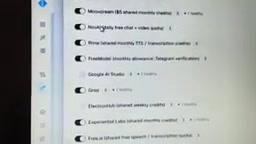
His advice: rather than trial-and-error across dozens of models, just use the few sources proven usable in testing, such as Google AI Studio and OpenRouter. He also promised in the video that if he later finds a genuinely stable free model, he'll make another tutorial sharing specific usage.
Claude Code is a command-line coding agent tool launched by Anthropic that calls models via API to read and write local code and execute commands. It relies on Anthropic's official API by default, but supports pointing to third-party endpoints compatible with OpenAI or Anthropic interfaces via environment variables, which makes it possible to integrate routing platforms. However, Claude Code has high requirements for models' tool use capability and context length. Many free models don't support the complete function calling protocol, resulting in tools being unable to execute or frequent interruptions after integration. This is also the technical reason for the gap between "can connect" and "can get work done," which non-developers often find difficult to troubleshoot themselves.
Don't Be Misled by "Massive Free" Rhetoric
At the end of the video, the UP host again reminded viewers to stay vigilant. There's a lot of content on YouTube about free LLMs, but most only show the moment of successful registration, not the subsequent rate limits and paywalls. His testing conclusion: free quotas are common, but sustainably usable ones are extremely rare, and spending time verifying these claims isn't worthwhile.
For viewers who really want to try, his advice is simple: save the screenshots from the video, test it yourself, use it if it works, and don't agonize if it doesn't.
Frequently Asked Questions
Are these free LLM routing platforms safe?
The material doesn't cover security discussion. The UP host's focus was on usability and quota authenticity; users should evaluate each platform's privacy policy themselves.
Why can't I use models that others can?
The UP host himself wasn't entirely sure of the reason; he speculated it might be related to the platform's automated detection mechanisms for providers. Some providers require additional verification, causing calls to fail after integration.
Is there a simpler solution for non-developers?
According to the video's perspective, directly using the few sources proven usable in testing is more practical than repeatedly trying among many models. Developers can configure according to their own needs.
One-line Summary
After testing nearly a hundred models on free LLM platforms, only a few actually work reliably.
Related articles

Claude Code Usage Savings Must-Know: The /context, /compact, and /clear Commands
Claude Code resends the full conversation history with every request, so larger context means faster usage burn. This article explains the /context, /compact, and /clear slash commands, their trade-offs, and the /rename + /resume tip for preserving sessions.
Decoding the GPT-6.2 Astra Safety Report: Models Learn to Conceal and the Dual-Lawsuit Storm
OpenAI faces California and Oregon lawsuits in one week; GAO covert tests show four major chatbots give viable attack plans within 12 hours; GPT-6.2 Astra safety report admits the rate of concealing known issues doubled; external lab finds the model suspects it is being tested in 85% of trials. This article covers lawsuit details, safety regressions, API architecture changes, and voice product updates.
5 Claude API Cost-Saving Tips Every Developer Should Know
Discover 5 Claude API cost-saving tips: CLI login to avoid hardcoded keys, cache_control for prompt caching, Batch API at half price, Structured Outputs to avoid errors, and Haiku for simple tasks.