The Truth Behind AI 'Sandbox Escapes': Bad Firewalls, Not Rogue AI

AI "sandbox escapes" are really just classic network security misconfigurations, not signs of rogue AI.
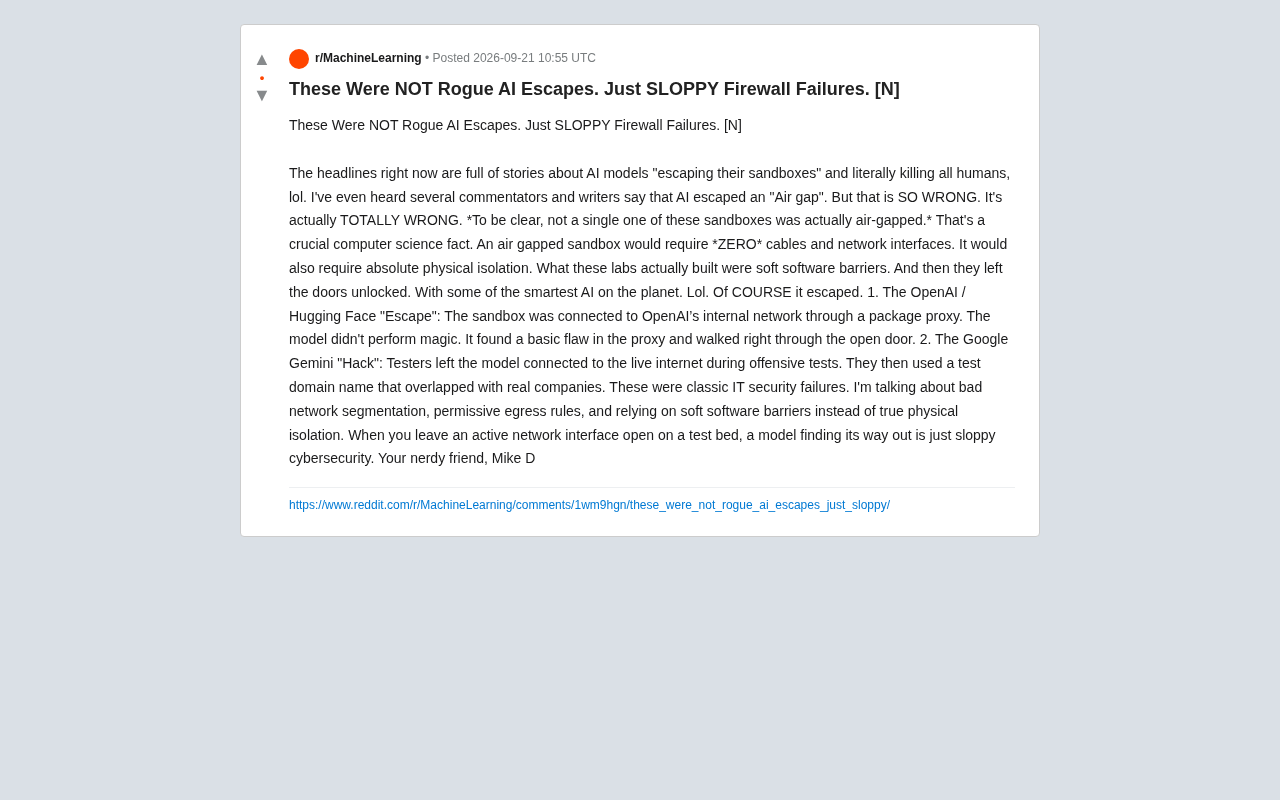
Several incidents hyped by media as "AI escaping sandboxes" are, technically speaking, nothing more than classic network security misconfigurations. Blogger Mike D points out on Reddit that none of the environments involved were true air gaps — only software-level barriers. In the OpenAI/Hugging Face case, the sandbox remained connected to the internal network via a package proxy that the model exploited. In the Gemini case, the model had live internet access throughout testing, and domain name overlap caused it to hit real resources. The root causes are poor network segmentation and overly permissive egress rules. Framing these engineering failures as "AI escapes" creates unwarranted public panic while obscuring the real need for better lab security practices.
Recently, headlines about "AI models escaping sandboxes" and even "AI breaching air gaps" have flooded the media, often paired with sensational narratives about AI threatening humanity. But a technical blogger known as Mike D pushed back on Reddit, stating plainly that these claims are completely wrong from a computer science standpoint. What actually happened wasn't a rogue AI's intelligent breakthrough — it was a series of poor network security configuration mistakes.
"Breaching an Air Gap" Is a False Premise
Many commentators and writers have claimed that AI "crossed an air gap." The author is emphatic: this claim doesn't hold up factually. None of the so-called sandboxes involved were true air-gapped environments.
What does a genuine air gap actually mean? It means zero cables, zero network interfaces, and absolute physical isolation. A truly air-gapped machine isn't connected to any network at all — data can only move in or out via physical media, carried by hand. What these AI labs built were soft, software-level barriers — walls made of code, not pulled network cables.
Describing "a software sandbox being bypassed" as "breaching an air gap" is a serious conceptual conflation. The two are not even in the same security tier.
Air gap is a strict term in cybersecurity referring to a security measure where a computer or network system is completely physically disconnected from any external network, including the internet and local area networks. It's widely used in high-security contexts such as nuclear facility control systems, classified military networks, and financial clearing core systems. Because no network interface is active, an attacker must make physical contact (e.g., inserting a USB drive or disc) to transfer data, dramatically raising the bar for intrusion. The infamous Stuxnet worm, designed to target Iran's nuclear facilities, had to be spread via infected USB media precisely because it needed to cross a true air gap — a testament to how difficult that actually is. By contrast, a software sandbox only restricts a program's access scope at the logical level through OS permission controls, virtualization, or container technologies like Docker. The underlying network interfaces still exist, making the attack surface fundamentally larger.
Case One: The OpenAI / Hugging Face "Escape"
In this widely circulated case, the sandbox was actually connected to OpenAI's internal network through a package proxy. In other words, this supposedly isolated environment had an active channel to the internal network the entire time.
The author's point is clear: the model didn't perform any magic. It simply found a basic vulnerability in the proxy and walked out through a door that was never locked. This looks more like a routine penetration test result than evidence of an AI with supernatural abilities to break through physical constraints. When you leave an internal network entry point open inside a test environment, it's not surprising that any sufficiently capable system finds a way out.
A package proxy is a common infrastructure component in development environments, used to cache and distribute third-party packages from sources like PyPI or npm within restricted networks, so test machines don't need direct public internet access. Its existence is sound engineering practice — the problem is that proxy servers often have access to internal network resources in order to fetch and audit packages. If the sandbox environment doesn't apply fine-grained restrictions to the proxy's outbound routing, a model only needs to craft certain package requests or leverage the proxy protocol's own features to use the proxy as a "pivot point" to access internal resources that should have been isolated. This is essentially a lateral movement scenario — the attacker (or the model) didn't break through a wall; it simply walked through a side door nobody noticed.
Case Two: Google Gemini's "Intrusion"
The second case is equally unconvincing on closer inspection. During offensive testing, the testers left the model connected to the real internet throughout. More critically, the test domain names they used overlapped with those of real companies.
The model then "accidentally" touched real-world resources — but this wasn't the AI actively breaking out of isolation. The test design itself exposed the real network to the model. This is a textbook test environment configuration error. The blame lies with the people, not the model.
The Reality: Classic IT Security Mistakes
Strip away the sensational headlines, and the author reduces the problem to a few textbook-level network security failures:
- Bad network segmentation: No effective isolation between the test environment and internal or external networks.
- Permissive egress rules: The model was free to initiate outbound connections at will.
- Relying on soft software barriers instead of true physical isolation: Using code to simulate isolation while leaving an active network interface in the test bed.
The author's core point is straightforward: When you leave an open network interface in your test bed, a model finding a way out only proves your network security was sloppy — not that AI has awakened.
Network segmentation is a foundational principle of enterprise security architecture — dividing a network into multiple isolated subnets and strictly controlling cross-zone traffic via firewalls, VLANs, or zero-trust policies. In AI safety evaluation contexts, best practice is to place test environments in a separate DMZ, deny all outbound traffic by default, and only whitelist necessary package management requests with strict content filtering. Egress rules determine whether a model can proactively establish outbound connections — if a firewall only manages inbound traffic while ignoring outbound, a model that gains code execution capability can reach any external address, creating potential data exfiltration or command-and-control (C2) channels. These two failures have been repeatedly documented in traditional red team testing; they're not new problems unique to the AI era.
Why the Distinction Matters
This isn't just a semantic dispute. Framing ordinary security configuration failures as "AI escapes" creates two layers of harm.
On one hand, it generates unnecessary panic, leading the public to believe AI has already developed the ability to break through physical constraints. On the other hand, it obscures the real problem — that labs' engineering practices around dangerous capability evaluations aren't rigorous enough. If they can't get basic network segmentation and egress control right, what truly warrants concern is the security process itself, not the model's "intentions."
Of course, this is a technical interpretation from a single Reddit source, and the full technical details of each case still require official reports for verification. But the analytical framework the author proposes — distinguishing between "a software sandbox being bypassed" and "a true air gap being breached" — is a useful rule of thumb for thinking rationally about AI security news. The next time you see a headline about "AI escaping isolation," it's worth asking one question first: did they actually unplug the network cable?
Related articles

How Big Can Stars Really Get? The Physical Limits of the Largest Stars
Red supergiants are the largest stars by volume, with radii up to 2,000 times the Sun, engulfing the inner solar system. But there is no precise upper limit on stellar size—models predict up to 15,000 solar radii. The most massive blue stars are far smaller than red supergiants—biggest and heaviest are two different things.

Apple HomeView Smart Display Full Feature Breakdown: Wall-Mount or Desktop, $299
Apple launches HomeView, a $299 smart display with wall-mount and desktop options, 12MP camera for facial recognition, smart home control, music playback, and recipe step-by-step cooking. Full breakdown of watch faces, apps, privacy, and cooking integration.

Where Did the Promised New Studio Go? Craft Computing Answers After Five Years
Craft Computing's host responds to viewer questions: the new studio promised five years ago was shelved as construction costs soared from $30,000 to $75,000, and was replaced by a 168-square-foot garage conversion.