The U.S. Navy CTO's Investment Thesis: Co-Investing with VCs Instead of Going It Alone

U.S. Navy CTO pushes to co-invest with VCs to acquire AI, quantum, and defense tech at market speed.
U.S. Navy CTO Justin Fanelli has announced a shift in technology acquisition strategy — moving from independently funding early-stage research to co-investing in startups alongside venture capital firms. The model leverages VCs' deal-screening capabilities to reduce the military's risk in backing early-stage technology, while using defense endorsements to unlock larger pools of private capital. A recent $562 million autonomous refueling contract signals that unmanned capabilities have moved from concept to deployment. The Navy also released an updated technology requirements list covering AI, quantum, and other frontier domains to guide startup priorities. Together, these moves reflect the military's effort to import commercial market efficiency into defense procurement to keep pace with rapid technology iteration.
U.S. Navy Chief Technology Officer (CTO) Justin Fanelli has sent a clear signal: the Navy wants to change how it works with startups and venture capital firms. His core idea is to move away from the Navy independently funding early-stage research and instead co-invest alongside VC firms — shifting defense procurement logic closer to how markets operate.
This position reflects a deeper shift in how U.S. defense institutions approach technology acquisition. Traditionally, the military's involvement in cutting-edge technology has been concentrated in early research phases, channeling grant funding toward specific directions. The new path Fanelli describes looks more like positioning the Navy as a "strategic investment partner" — one that understands both technology and operational requirements.
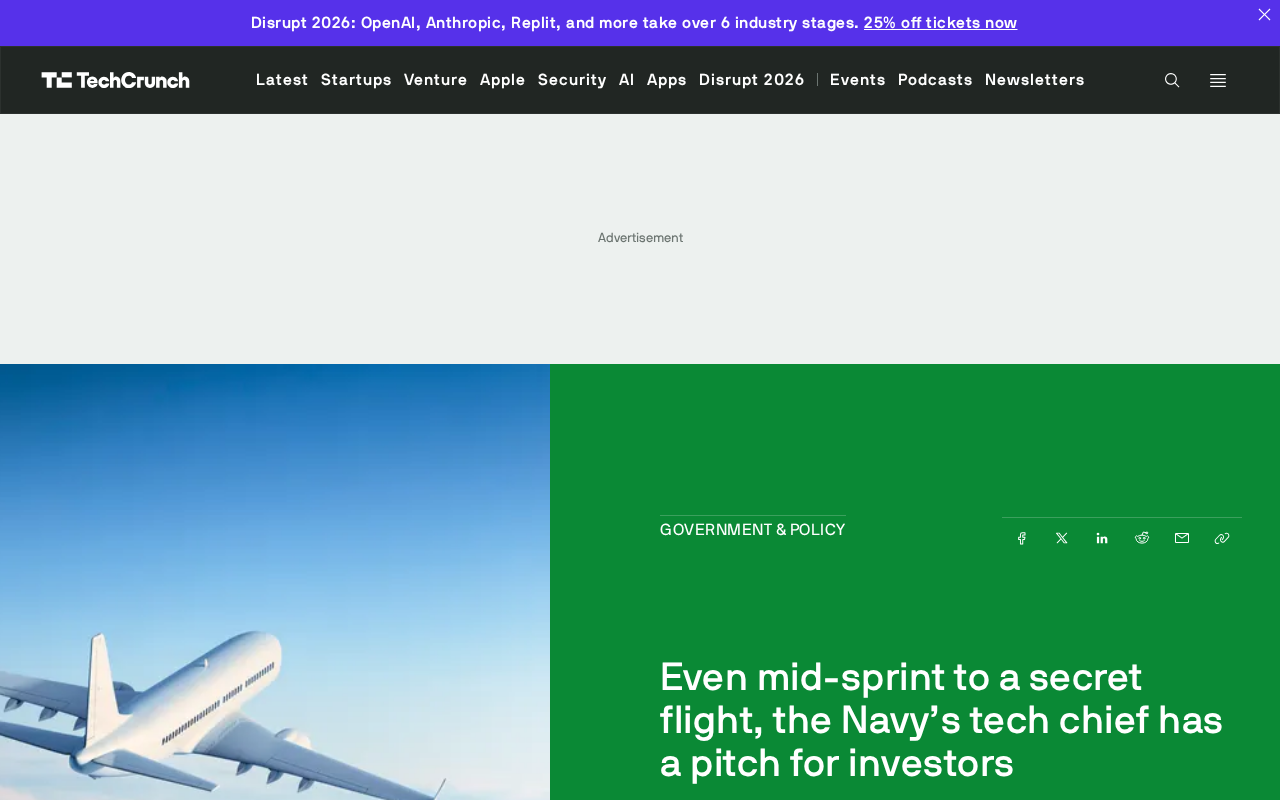
From Going It Alone to Co-Investing with VCs
Fanelli's argument is straightforward: rather than having the Navy independently fund highly uncertain early-stage research, it makes more sense to co-invest alongside VC firms that are already vetting opportunities in the market. This co-investment model carries several implications.
First, it leverages the deal-screening capabilities and market judgment of venture capital firms. VCs have developed mature methodologies for evaluating technology readiness, team execution, and commercial viability. By partnering with them, the Navy effectively reduces the risk of independently betting on early-stage technology.
Second, co-investment means the Navy's capital can unlock significantly larger pools of private capital. When the military stands alongside commercial investors, startups gain not only the prospect of future contracts but also a defense-user endorsement of their technology — which often has a positive effect on subsequent fundraising rounds.
For entrepreneurs, this sends a clear message: the Navy is positioning itself as a partner operating closer to commercial logic, rather than simply a funding source or procurement customer.
What the $562 Million Autonomous Refueling Contract Signals
Among the recent procurement actions Fanelli mentioned, the most striking is a $562 million autonomous refueling deal. This substantial contract reflects the Navy's sustained commitment to unmanned and autonomous operational capabilities.
Autonomous aerial refueling means unmanned aircraft can complete refueling operations without direct human control — a capability with real implications for extending carrier-based aviation's combat radius and reducing personnel risk. The Navy's willingness to commit over half a billion dollars signals that this capability has moved from proof-of-concept into actual deployment and procurement.
For investors and entrepreneurs focused on defense technology, large contracts like this are an important indicator of military priorities — where the money flows often reveals which technologies the military considers closest to real operational needs.
The defining program for autonomous aerial refueling is Boeing's MQ-25A Stingray unmanned tanker. The Navy awarded the initial contract in 2018 to provide an organic refueling capability for carrier air wings, significantly extending the combat radius of aircraft like the F/A-18E/F and F-35C. The MQ-25A completed its first autonomous aerial refueling of an F/A-18F in 2021, marking a critical validation milestone. The $562 million contract Fanelli referenced likely corresponds to subsequent production batches or capability expansion phases of this program, rather than an entirely new technology initiative. It's worth noting that once autonomous refueling matures, its significance goes beyond "extending legs" — it also allows the carrier itself to maintain greater tactical standoff distance, reshaping the overall operational posture of carrier strike groups. This strategic depth is a key reason the Navy continues to invest.
The Navy's Updated Technology Wish List: From AI to Quantum
Fanelli also discussed the Navy's updated technology requirements list, pointing startups toward the areas where they should focus next. The list spans multiple frontier domains, from artificial intelligence to quantum technologies.
AI's inclusion is no surprise. Whether it's decision-making for autonomous systems, real-time processing of massive sensor data streams, or intelligent logistics and maintenance, artificial intelligence is the central lever of current defense modernization. The appearance of quantum technology, meanwhile, signals the Navy's intent to position itself in long-cycle bets around secure communications, precision positioning and navigation (especially in GPS-denied environments), and sensing.
The value of this list lies in presenting the military's genuine needs to the startup ecosystem in a relatively transparent way. For early-stage teams deciding which direction to pursue, aligning R&D priorities with this list is far more effective than guessing what the military actually wants.
Defense applications of quantum technology fall into three primary areas: quantum communications (using quantum key distribution to create theoretically unbreakable encrypted channels), quantum sensing (using quantum coherence for ultra-high-precision gravity gradient measurement and undersea detection), and quantum computing (accelerating cryptanalysis and complex optimization problems). For the Navy, quantum inertial navigation is particularly critical — in contested environments where satellite signals are jammed or denied, navigation systems built on quantum accelerometers and gyroscopes can maintain high-precision positioning without GPS, with direct implications for the survivability of submarines and underwater unmanned systems. The technology as a whole remains in transition from laboratory to engineering-scale deployment, with large-scale fielding still years or more away. The Navy's inclusion of quantum on the list therefore reflects long-cycle strategic positioning rather than near-term procurement intent.
Reshaping the Relationship Between the Military and the Startup Ecosystem
Taken together, what Fanelli is conveying is a systemic shift in partnership philosophy. The Navy is attempting to redefine its relationship with the technology startup ecosystem through three instruments: co-investment, explicit requirements lists, and large-scale demonstration contracts.
The underlying logic is clear: modern frontier technology iterates far faster than traditional military procurement processes can handle. If the military wants to keep pace, it must embed itself more deeply into the commercial innovation chain and acquire capabilities in ways that more closely resemble how markets work. Having VCs screen first and the military co-invest to validate is, at its core, an attempt to import commercial market efficiency into defense acquisition.
Of course, how far this model can go remains to be seen. Military capital and commercial capital have fundamental differences in exit mechanisms, classification requirements, and decision-making timelines. Reconciling these tensions will be an unavoidable challenge as the co-investing concept moves from vision to practice. But based on Fanelli's stated position, the Navy's attitude is sufficiently open — it is extending an olive branch to investors and entrepreneurs alike.
The Department of Defense has built several dedicated channels for startups in recent years, forming the institutional foundation for the model Fanelli describes. The Defense Innovation Unit (DIU), established in 2015, uses a "Commercial Solutions Opening" (CSO) mechanism to rapidly contract commercial technology companies, bypassing the cumbersome procedures of traditional FAR acquisition regulations. Additionally, the Small Business Innovation Research program (SBIR/STTR) distributes over $4 billion annually in early-stage funding to startups — but its "Valley of Death" problem has long been a source of criticism. Many companies that receive Phase II funding still fail to secure follow-on procurement contracts and ultimately cannot achieve commercialization. Fanelli's VC co-investment idea is, in some ways, a direct attempt to address this structural pain point: helping companies that have been validated by commercial capital and have scaling potential to enter the military's procurement pipeline more smoothly, rather than falling into the gap between government grants and commercial financing.
Related articles

Workbuddy for Absolute Beginners: How a Desktop AI Agent Fits Into Real Workflows
A beginner's guide to the Workbuddy desktop AI agent: installation, claiming credits, file management, and building automated workflows—compared with CodeX for fit and cost, helping professionals shift from AI question-askers to AI managers.

OpenAI's New Agent Stack: Computer Use, Decisions API, and Ultra-Fast Workflows
OpenAI Dev Day unveiled a new agent stack: Computer Use outperforms humans, Decisions API delivers ultra-low-latency classification via Luna, Agents API opens the same Computer Use capabilities, and GPT-6.1 Sol costs only one-seventh of Astra. Core updates, benchmark data, and developer insights.

Liang Wenfeng Open-Sources DeepInfo Inference Framework, Takes On U.S. Ban
DeepSeek open-sources its DeepInfo inference framework after its models, featuring GPU/CPU cross-pipelining, small-model prediction with large-model verification, and full Huawei Ascend and NVIDIA chip support—facing the U.S. federal ban head-on. This article analyzes its significance for AI deployment and open-source strategy.