The Ultimate Free Cloud Services Directory: A Must-Have Toolkit with 130K Stars on GitHub

A 130K-Star GitHub list curating permanently free cloud services for developers across the entire DevOps toolchain.
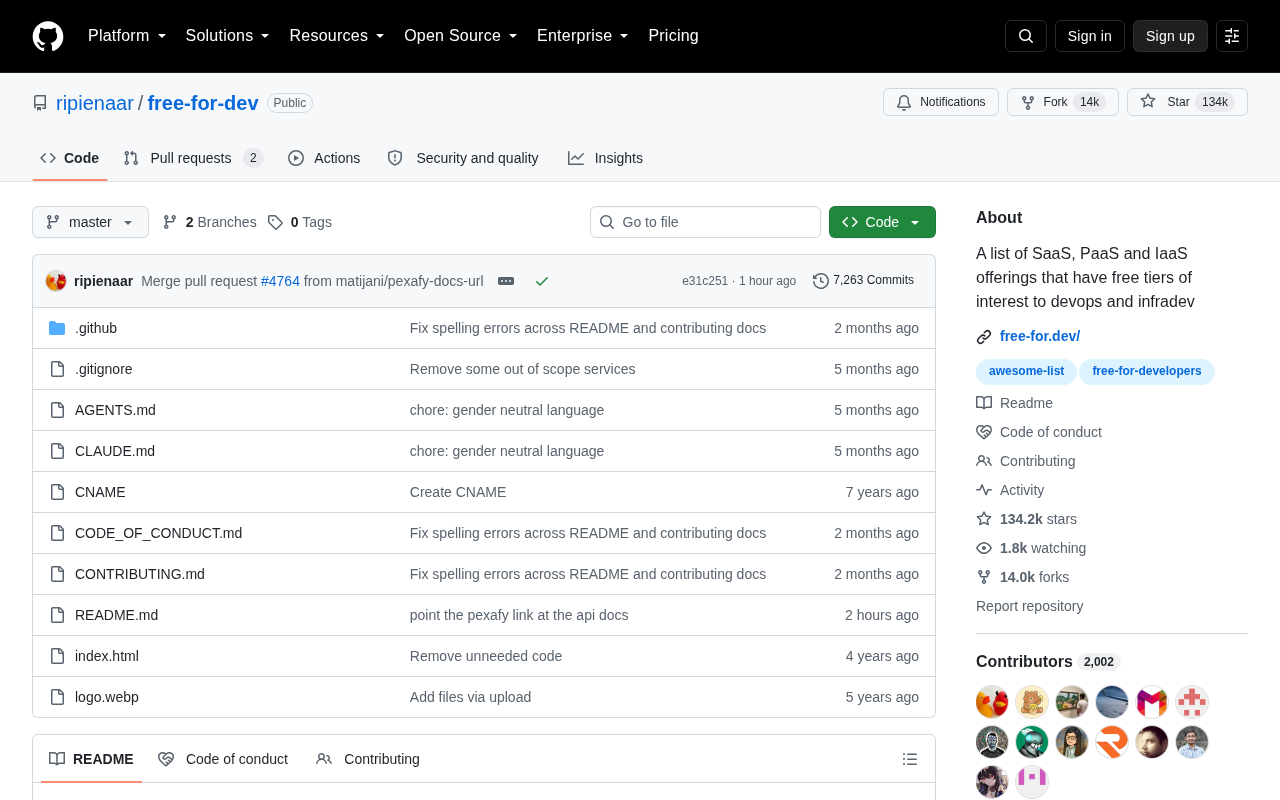
The free-for-dev project on GitHub has amassed over 134K Stars by maintaining a comprehensive directory of cloud services with permanently free tiers. Covering everything from hosting and CI/CD to databases, monitoring, and APIs, it helps developers build complete tech stacks at zero cost. Community-driven via Pull Requests, the list stays current and reflects the intensifying developer-first competition among cloud vendors.
A Free Cloud Services Treasure Trove Bookmarked by 130K Developers
In today's world where cloud computing and SaaS services are flourishing everywhere, developers often face a pleasant dilemma: there are too many tools to choose from, but which ones actually offer genuinely useful free tiers? The open-source project ripienaar/free-for-dev on GitHub was created precisely to solve this pain point.
This project has accumulated over 134,000 Stars and 14,000 Forks, with 829 new Stars added in a single day alone—a testament to its sustained popularity in the developer community. At its core, it's a carefully maintained list that aggregates SaaS, PaaS, and IaaS services offering free tiers that are valuable to DevOps and infrastructure developers.
Cloud computing services are typically classified into three categories by abstraction level: IaaS (Infrastructure as a Service) provides underlying resources like virtual machines, storage, and networking—examples include AWS EC2 and DigitalOcean; PaaS (Platform as a Service) wraps runtime environments and middleware on top of infrastructure, so developers only need to focus on code deployment—examples include Heroku, Railway, and Render; SaaS (Software as a Service) refers to fully managed applications where users directly consume features without worrying about the underlying implementation—examples include GitHub and Slack. Understanding these three layers helps developers choose the appropriate service tier based on project needs and forms the basis for understanding how this list is organized.
Why Is This Free Cloud Services List So Popular?
Focused on "Permanently Free Tiers" Rather Than "Limited-Time Free Trials"
The project has a clear guiding principle: it only includes services that are developer-facing and offer permanently free tiers, not products that merely provide time-limited free trials. This means most services on the list can be used for free indefinitely (within certain usage limits), which is extremely valuable for individual developers, startup teams, and side projects.
Free tiers are a classic customer acquisition strategy in the cloud computing industry, with a business model rooted in the "Freemium" theory. AWS pioneered its Free Tier program in 2010, followed by Google Cloud, Azure, Vercel, Netlify, and others. The core logic is: attract developers by providing limited but practical free resources, and as projects scale, users will naturally upgrade to paid plans. The key to this strategy is the "lock-in effect"—once developers build applications on a platform, migration costs increase over time. This is precisely why distinguishing between "permanently free tiers" and "limited-time trials" is critical for developers' long-term planning.
The project maintainers specifically emphasize that the list covers SaaS, PaaS, and IaaS services—it does not include self-hosted open-source software or products that require payment to access core features. This strict inclusion criteria ensures the list's practicality and signal-to-noise ratio.
A Categorization System Covering the Entire Development Lifecycle
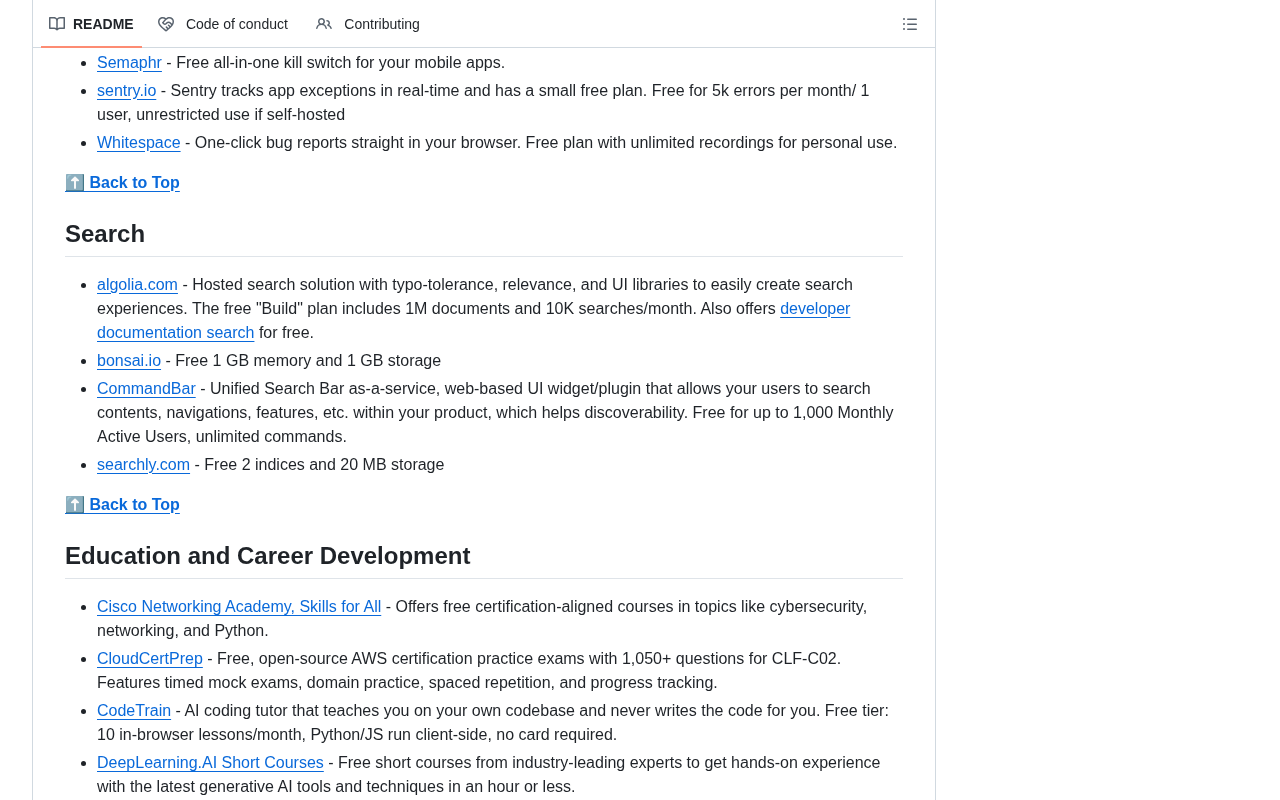
Another major advantage of free-for-dev is its comprehensive categorization. The list is meticulously organized by service type, covering virtually every aspect of modern software development and operations:
- Cloud Platforms & Free Server Hosting: Free compute and storage resources from major cloud providers
- CI/CD & Automation: Free tiers for continuous integration and deployment tools
- Monitoring & Alerting: Application Performance Monitoring (APM), log management, and status page services
- Free Databases & Backend Services: Database hosting and BaaS services
- CDN & DNS Services: Content delivery networks and domain resolution
- Code Quality & Security Scanning: Code review, dependency management, and security audit tools
- Free Email & SMS Services: Transactional email delivery and message notifications
- APIs & Third-Party Integrations: Free API call quotas for various services
This categorization system effectively maps to the complete toolchain needs of modern DevOps engineers. DevOps is an engineering culture and practice that integrates software development (Dev) with IT operations (Ops), emphasizing automation, continuous delivery, and rapid feedback loops. From code hosting, CI/CD pipelines, container orchestration, and Infrastructure as Code (Terraform) to observability platforms, there are numerous commercial products offering free tiers at every stage. The value of the free-for-dev project lies in consolidating information scattered across various vendor websites into a one-stop reference.
Community-Driven Continuous Maintenance
Open Contribution and Update Process
The vitality of free-for-dev comes from its open community collaboration model. Any developer can submit a Pull Request to add newly discovered free services to the list or update changes in existing service quotas. Since cloud service free policies change frequently, this crowdsourced maintenance approach ensures information stays current.
This collaborative model is a unique form of knowledge co-creation in the GitHub ecosystem, commonly known as the "Awesome List" pattern. Maintainers set inclusion criteria and formatting standards, community members contribute content via Pull Requests, which are merged into the main branch after review. The advantage of this model is leveraging collective intelligence to maintain breadth and timeliness—a single maintainer cannot possibly track policy changes across thousands of services, but thousands of contributors each monitoring their familiar domains can achieve efficient information updates. Similar Awesome-series projects on GitHub have formed a vast knowledge graph ecosystem, and free-for-dev is one of its most successful examples.
The project is primarily maintained in English, but its content holds universal value for developers worldwide. Most services on the list are well-known international products, and developers everywhere can find tools suitable for their project scenarios.
Cloud Service Industry Competition Trends Through the Lens of Free Tiers
From a certain perspective, this continuously updated list also serves as a window into the competitive landscape of the cloud services market. Vendors compete to win developer mindshare by offering generous free tiers as a customer acquisition strategy—a classic "developer-first" growth approach. Free tiers reduce developers' cost of experimentation while building moats around product ecosystems.
Developer-First is one of the most successful growth paradigms in B2B SaaS in recent years. Companies like Twilio, Stripe, Vercel, and Supabase are typical representatives of this strategy. The core idea is: developers are both direct product users and key influencers in enterprise procurement decisions. By providing excellent Developer Experience (DX)—including clear documentation, generous free tiers, convenient SDKs, and active communities—companies can achieve bottom-up product adoption. According to SlashData, there are over 35 million active developers globally, and competing for this group's attention has become the core battleground for cloud service providers. The continuously growing number of services in the free-for-dev list is a direct reflection of this intensifying competition.
For developers, leveraging these free resources effectively means validating ideas, building prototypes, or even running small-scale production projects at minimal cost.
How to Effectively Use This Free Developer Tools List
Facing such an extensive list, developers are advised to adopt the following strategies:
- Search by Need: Don't try to read through everything. Based on your current project's specific needs (such as needing a free database or email service), go directly to the relevant category.
- Pay Attention to Free Tier Details: Free tiers often come with usage limits (such as monthly API call counts, storage capacity caps, concurrent connection limits, etc.). Always confirm whether the quota meets your needs before use to avoid unexpected charges from overages. Some services automatically bill when you exceed free limits, while others suspend service—understanding these differences is critical for production environment stability.
- Revisit Regularly for Updates: Since service policies change (for example, Heroku discontinued its widely popular free tier in 2022), for free services you rely on long-term, it's advisable to periodically check the list for updates, stay informed about quota adjustments, and prepare alternative solutions for critical services.
- Combine Multiple Services to Build Your Tech Stack: A single service's free tier may be limited, but by combining multiple complementary services, you can build a fully functional tech stack at minimal cost. For example, combining Vercel (frontend hosting) + Supabase (database and auth) + Resend (email service) + UptimeRobot (monitoring) gives you a zero-cost full-stack application infrastructure.
Conclusion: A Developer's Free Resource Treasure Chest
ripienaar/free-for-dev addresses developers' real pain point of finding free cloud services through a carefully maintained list, proving that "information aggregation" itself is an extremely valuable product form. Behind the 130K+ Stars are countless developers casting their vote of trust through action.
Whether you're a resource-constrained independent developer or a startup team looking to reduce operational costs, this free cloud services directory deserves a spot in your bookmarks. In today's fiercely competitive cloud services landscape, knowing how to properly leverage free tiers is also an important engineering skill—it's not just about cost control, but also reflects keen insight into the technology ecosystem.
Related articles

Python 3.15 New Feature: Is the sentinel Type Better Than None?
Python 3.15 adds the sentinel type, using named unique sentinel objects to replace None and bare object(), resolving confusion among missing values, explicit emptiness, and invalid input while avoiding type hint failures.

Deep Learning's Three Architectures and the Universal Approximation Theorem: A Complete Guide to MLPs, CNNs, and Transformers
Explaining the inductive bias differences among MLP, CNN, and Transformer, the existence meaning of the Universal Approximation Theorem (UAT), and the role of Taylor expansion in approximation analysis, while clearing up common misconceptions.

GitLab Emergency Patch Release: Analysis of Critical Security Fixes
GitLab releases critical patch 19.5.1, sparking 355 points of discussion on Hacker News. This article analyzes the background, upgrade steps for self-hosted instances, and verification points to help DevOps teams respond quickly to security updates.