The Universe's 'Back Door' Beyond Light Speed: A Scientific Exploration of Negative Mass and Wormholes

Special relativity bars acceleration past light speed, but wormholes may offer a spacetime shortcut via negative mass.
Special relativity means no massive object can accelerate past light speed, and the Milky Way's scale would take even light 100,000 years to cross. This article explores a theoretical workaround: hypothetical "negative mass" matter with repulsive gravity could hold open a traversable wormhole, creating a topological shortcut through spacetime rather than requiring faster travel. Rooted in general relativity's mathematics, the idea remains a thought experiment — negative mass has never been observed, and wormhole stability is an unsolved theoretical challenge.
Why the Speed of Light Is an Insurmountable Wall
Before exploring how to "exceed the speed of light," we must first acknowledge a fundamental law of physics: you cannot accelerate any object past the speed of light. According to special relativity, as any object with mass approaches light speed, the energy required grows toward infinity — which is precisely why simply "flooring the accelerator past light speed" is physically impossible.
But that doesn't mean the dream of reaching distant star systems is dead. As the original video points out, the universe may have certain "back doorways" that allow us to bypass the light-speed barrier and reach our destination by another means entirely.
The Harsh Reality of Interstellar Travel
Imagine the most straightforward scenario: a starting point on one end, a destination on the other. The question is — what's the fastest way to get there?

The brutal truth lies in the scale. Even traveling at the speed of light — the fastest known speed in the universe — crossing the entire Milky Way would still take 100,000 years. For the brief span of a human lifetime, such a journey is essentially meaningless. Conventional propulsion methods, whether chemical rockets or ion engines, are utterly negligible against this kind of astronomical distance.

This is why scientists and science fiction writers keep turning their attention to spacetime itself — if you can't move faster through space, can you instead change the structure of space?
Negative Mass: The Key to Prying Open a Wormhole
This is where a bold hypothesis enters the picture: if we could discover a type of matter known as "negative mass" — possessing a kind of "negative gravity" — everything changes.
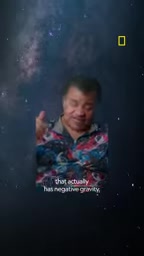
Ordinary matter generates gravity that causes spacetime to collapse and curve inward — this is how black holes form. Negative mass would do the opposite: rather than contracting spacetime, it would push the fabric of spacetime outward, expanding it. The video uses a vivid analogy: we could use this exotic matter to "pry open" a wormhole, much like prying open a door.
It's important to emphasize that negative mass remains purely theoretical and has never been observed in nature. It is "exotic matter" — permitted by the equations of general relativity, but nowhere to be found in reality. The entire concept rests on this premise.
From a quantum mechanics perspective, the idea of "negative energy density" is not entirely unfamiliar. The Casimir Effect has been verified in laboratory settings: between two extremely close metal plates, vacuum quantum fluctuations are suppressed, making the energy density between the plates lower than that of the surrounding vacuum — theoretically interpretable as a weak form of "negative energy." Hawking radiation theory also involves the concept of negative energy. However, the scale of negative energy produced by such effects is vanishingly small — many orders of magnitude below what would be needed to sustain a traversable wormhole. Physicist Kip Thorne (2017 Nobel Prize in Physics), in a 1988 paper co-authored with Morris, was the first to rigorously derive the mathematical conditions for a traversable wormhole. The conclusion was that keeping a wormhole open requires large amounts of exotic matter that violates the "Averaged Weak Energy Condition" (AWEC) — and whether this condition can be satisfied remains one of the central controversies in theoretical physics today.
Wormholes: Shortcuts Through the Fabric of Spacetime
Given negative matter, a wormhole built from it could "open up the fabric of space-time."
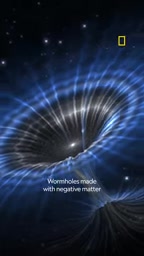
What makes wormholes so fascinating is that they don't require you to travel faster through space — they create a direct shortcut through spacetime itself. You wouldn't actually have to cross 100,000 light-years. Instead, you'd step into one end of the wormhole and emerge from the other, arriving wherever you intended to go. It's like folding a piece of paper so that two distant points touch directly.
This is the core idea behind the universe's "back door": rather than confronting the light-speed barrier head-on, you exploit the malleability of spacetime itself to go around it.
The concept of wormholes was first proposed by Einstein and Nathan Rosen in 1935 within the framework of general relativity, which is why they are also called "Einstein-Rosen Bridges." Initially, this mathematical solution described a tunnel connecting the singularities of two black holes — but subsequent analysis showed that these original wormholes are extremely unstable. Any signal or matter attempting to pass through would cause the tunnel to collapse almost instantaneously, even faster than light itself, making physical traversal impossible. Thorne and others later proposed the "traversable wormhole" model, which uses exotic matter to resist this collapse and theoretically allows matter to pass through in both directions. Even more thought-provoking: if one opening of a wormhole were moved at near-light speed for a period of time and then returned, relativistic time dilation could create a time difference between the two ends — meaning wormholes could theoretically function as a kind of time machine. This is one reason physicists remain cautious about their feasibility.
The Boundary Between Science Fiction and Science
Though this framework is imaginative, it isn't pulled from thin air — it is rooted in the mathematical structure of general relativity. Wormholes (Einstein-Rosen Bridges) and the exotic matter needed to keep them open have been topics of serious discussion in theoretical physics for decades. The ideas presented here draw from an astronomy science communicator whose related work is compiled in a popular science book called Lost in Space.
Of course, an enormous gulf separates theoretical possibility from engineering reality. We have neither found negative mass nor figured out how to stabilize a wormhole. But the value of thought experiments like this lies precisely in how they expand our understanding of the way the universe works — reminding us that the speed limit may not be the end of the road, but rather the starting point for understanding the true nature of spacetime.
Related articles

Kimi K3.1 Hands-On Test: Open-Source Model Nears Opus, Video Generation Steals the Show
Kimi K3.1 completed motion graphics, 3D rendering, mini-games, and video generation in a live test. Analysis of its 2.8T MoE architecture, gap vs Opus/GPT, and hidden video generation.

Sam Altman: Why Life's Biggest Advice Should Still Come from Humans
OpenAI CEO Sam Altman on the limits of AI advice: AI can talk you out of an impulsive email, but life's biggest advice should still come from humans.

"Black October": Did AI Uncover 3% of All Critical Vulnerabilities Ever?
A Reddit post claims 3% of all critical software vulnerabilities ever were found in the past month, dubbed 'Black October.' We break down the statistical issues, how AI-assisted code auditing accelerates discovery, and how developers should respond.