The Untold Story of Windows Me: A System That Never Should Have Existed

Windows Me was a rushed 9x stopgap; the failed Neptune project behind it ultimately gave birth to Windows XP.
Windows Me (2000) wasn't a deliberate technical choice — it was a compromise forced by market timing. Microsoft's original plan was Neptune, an NT-kernel consumer OS, but it missed its deadline while OEM holiday sales pressure made a multi-year gap unthinkable. Microsoft revived the Windows 98 codebase with minimal changes to fill the void, producing an inherently unstable product that became the last and least-loved release of the 9x era. Neptune was cancelled, its team merged with the Windows 2000 successor project Odyssey, and together they built Windows XP — completing the NT kernel's long-delayed conquest of the consumer market.
A "Transitional Product" Born from Business Pressure
Windows Me (Windows Millennium Edition) is perhaps the most awkward product in Microsoft's operating system history. Its very existence was a compromise — a stopgap measure built on technology Microsoft had already been eager to abandon.
According to Microsoft's original roadmap, the next consumer-facing Windows was never supposed to be Me. The true successor was meant to be an entirely new product codenamed Neptune, built on the same stable NT kernel that powered the business-oriented Windows 2000.
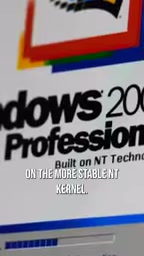
Microsoft had already been talking publicly about migrating mainstream consumer Windows to the NT architecture. Neptune was exactly that kind of ambitious undertaking — it aimed to bring the stability of the NT kernel to home users, paired with web-style "activity centres" for everyday tasks. For its time, this was a remarkably forward-thinking design philosophy.
Why Neptune Never Arrived on Schedule
The vision was bold, but reality had other plans. Neptune failed to ship on time, which meant the consumer-side transition from the 9x kernel to the NT kernel would have to keep waiting.

The problem was the era: the late 1990s, when the PC industry was charging ahead at full speed. Microsoft simply could not go three years without releasing a new consumer Windows — that would have been, as the saying goes, "crazy." PC manufacturers needed new operating systems to drive holiday season sales. As one colorful quip puts it, "Michael Dell still needed to buy a new private jet."
The pressure of the business cycle overrode the logic of sound technical planning. The market wouldn't wait. Distribution channels wouldn't wait. OEM partners certainly wouldn't wait. With Neptune stalled, Microsoft had to produce something it could ship immediately to fill the gap.
9x Kernel vs. NT Kernel: These two architectures represent fundamentally different paths in Microsoft's OS history. The 9x kernel (used in Windows 95/98/Me) descended from DOS and mixed 16-bit and 32-bit code, offering broad hardware driver compatibility but lacking the stability and security isolation needed to prevent a single crashing application from taking down the whole system. The NT kernel, by contrast, was a clean 32-bit design built from scratch, featuring memory protection, multi-user privilege separation, and a stronger hardware abstraction layer — originally aimed at enterprise markets (Windows NT 4.0, Windows 2000). Migrating consumer Windows to NT meant sacrificing compatibility with some older hardware and legacy games, while placing much higher demands on the driver ecosystem. This was one of the core technical challenges that made Neptune so difficult to deliver on time.
Digging Up Windows 98's Old Code: The Hasty Launch of Me
So Microsoft dusted off the aging Windows 98 codebase and asked it to run one final lap. The project, initially codenamed Millennium, shipped under the name Windows Millennium Edition — shortened to Windows Me.

This explains why Windows Me was so frequently criticized for stability problems. It wasn't a technological leap — it was a patch job, a continuation built on the old 9x foundation. It carried not technical ambition but a business mandate: ship on time. In other words, Me was destined from birth to be a temporary solution, a version that never should have existed.
How the "Failed" Neptune Gave Birth to the Classic Windows XP
The real twist in this story lies in that very "failure." Neptune was eventually cancelled — but Microsoft didn't let the team's work or talent go to waste.

Microsoft merged the Neptune team with the development crew working on the successor to Windows 2000, a project codenamed Odyssey. From the union of these two teams came what millions of users would come to regard as a classic: Windows XP.
In a sense, the rushed nature of Windows Me and the premature death of Neptune actually paved the way for Windows XP's success. The migration of the NT kernel to the consumer market was delayed, but it ultimately arrived in XP in a mature and complete form. The ideas explored during the Neptune era — bringing a stable architecture to everyday home users — finally bloomed in XP.
Odyssey was originally scoped as a direct consumer-facing upgrade to Windows 2000, targeting enterprise and high-end home users. The merger of Neptune and Odyssey wasn't simply a reshuffling of personnel — it brought together each project's accumulated UI experimentation (Neptune's "activity centre" concept) with the enterprise-grade stability experience of the NT kernel. The final product, Windows XP (codenamed Whistler), launched in 2001 and for the first time used a single NT kernel codebase to simultaneously cover both the Home and Professional editions, permanently ending Microsoft's dual-track OS strategy. XP's Luna visual style and the "Welcome" login screen can both be traced back to early design experiments from the Neptune era, when engineers were first exploring what a home-user experience on NT could look like.
An Underappreciated Chapter in OS History
Looking back, Windows Me's existence is a textbook case of the tension between business and technology. When technical readiness can't keep pace with market timing, companies often reach for a transitional compromise just to maintain product momentum.
Despite its poor reputation, Me is an essential piece of the puzzle for understanding how Microsoft's operating systems evolved. It witnessed the final curtain call of the 9x kernel, and indirectly set the stage for the NT kernel's complete victory in the consumer market. The true winner, Windows XP, was forged from the fusion of two seemingly failed or parallel efforts — Neptune and Odyssey. Perhaps that's the deeper lesson here: in the technology industry, no exploration is ever truly wasted.
Related articles

Testing the 350K-Star REA in an Isolated Environment: 4-Second Install, but Watch Out for Two Pitfalls
Isolated lab test of the 350K-star open-source reverse-engineering tool REA: 4-second install, 15 seconds to list a screenshot tool's outbound addresses, 565 communication channels mapped, while exposing two pitfalls—user-level settings writes and 31 high-risk tool permissions—plus three safety rules.
Reverse Engineering + AI Agents: The T…
Reverse Engineering + AI Agents: The Technical Truth Behind Cloning Adobe Apps in Weeks
A developer used AI Coding Agents for reverse engineering to build 7 open-source Adobe alternatives in weeks. We explore how it works, the MCP Server that hit 100K stars in 6 days, and the real technical and legal limits.

MCP Protocol Explained: How AI Agents Connect to External Tools
What is MCP (Model Context Protocol)? From APIs and Function Calling to MCP's three-layer architecture, this article explains how AI Agents connect to external tools like calendars and email, and reveals two major security risks—prompt injection and tool poisoning—along with four protection principles.