The Validation Pipeline We Built Before Deploying AI Agents to Customer Environments

An AI team turned Agent reliability from a feeling into a number with a Simulate-Score-Promote pipeline.
This article presents a Simulate-Score-Promote framework developed by an AI engineering team after multiple customer deployments. They design three-tier test scenarios (nominal, edge, chaos) for each Agent skill, use a fixed independent smaller model as a judge, and enforce an 80% pass rate as a hard gate before any customer deployment. At runtime, approval logic is baked into skill definitions rather than left to model judgment, and mid-execution message injection enables real-time course correction. The framework essentially ports CI/CD discipline into the AI Agent domain, replacing subjective demo impressions with quantifiable, reproducible validation.
Why We Stopped Trusting Demos
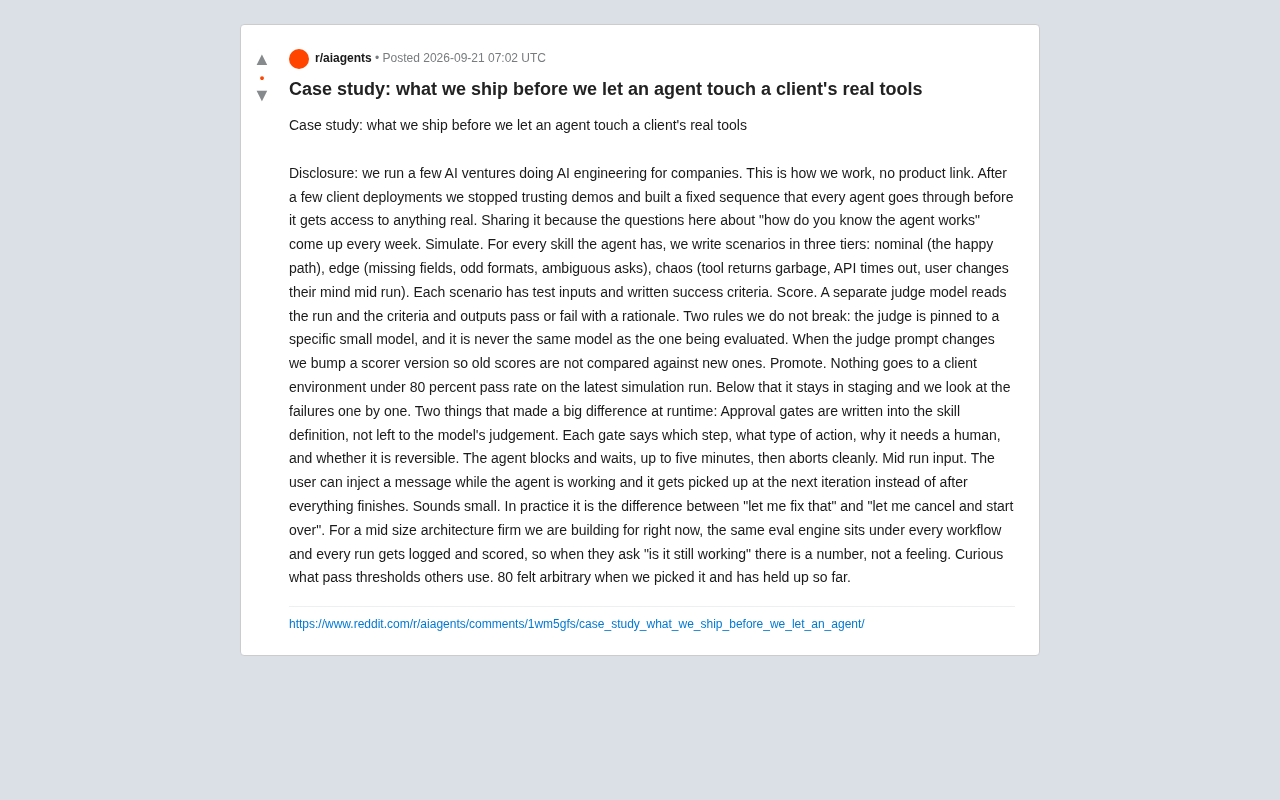
An AI Agent that looks great in a demo doesn't necessarily hold up in a customer's real toolchain. An AI engineering team sharing their experience on Reddit admitted that after several customer deployments, they completely stopped relying on demos and instead built a fixed validation pipeline — every Agent must complete this process before touching any real system.
What makes this approach worth paying attention to is that it answers a question that comes up almost every week: "How do you know this Agent actually works?" The answer shouldn't be a feeling — it should be a quantifiable number.
Three-Layer Scenario Simulation: From Happy Path to Chaos
The team's first step is Simulate. For every skill an Agent possesses, they write test scenarios across three levels:
- Nominal: The ideal case where everything works — the classic happy path.
- Edge: Non-ideal inputs like missing fields, malformed data, or ambiguous requests.
- Chaos: Tools returning garbage data, API timeouts, or users changing their minds mid-execution.
Each scenario comes with clearly defined test inputs and written success criteria. The value of this layered design is that it forces engineers to think ahead about "what happens when things go wrong" — rather than waiting to react when something actually breaks in a customer environment. The Chaos layer is especially critical: real-world failures are rarely logic errors; they're usually caused by unreliable external systems.
Scoring with an Independent Judge Model
After simulations run, comes Score. The team uses an independent "judge model" to read through execution logs and success criteria, then outputs a pass/fail verdict with a rationale.
Two rules they never break:
- The judge model is fixed to a specific smaller model, ensuring consistent and stable scoring standards.
- The judge model must never be the same model being evaluated, eliminating the "grading your own work" bias.
Additionally, whenever the judge's prompt changes, they bump the scorer version number — ensuring old scores are never directly compared to new ones. This detail reflects solid engineering discipline: evaluation standards themselves need version control, otherwise cross-time score comparisons become meaningless.
The concept of a judge model comes from the LLM-as-a-Judge evaluation paradigm. The core idea: since AI-generated content is hard to evaluate with traditional rule-based matching, why not use another language model as the "examiner"? This approach is widely used in academic benchmarks, but deploying it in a production-grade Agent system requires additional consideration of scoring stability — LLMs are inherently stochastic, and the same log submitted twice might yield different verdicts. This is the practical reason the team insists on a "fixed smaller model": smaller models have lower inference costs, are relatively more deterministic, and are better suited as automated quality-check nodes in a pipeline. Using a smaller model also has a structural benefit: it naturally won't overlap with the frontier model being evaluated, architecturally preventing self-scoring bias.
80% Pass Rate: The Promotion Threshold
The third step is Promote. The team enforces a hard rule: any Agent with a pass rate below 80% in the most recent simulation round never enters a customer environment. Agents that fall short stay in staging, where engineers investigate failures case by case.
The author also admits the 80% threshold "felt somewhat arbitrary" when first chosen, but it has held up in practice. At the end of the post, he opens it up to the community: what pass rate thresholds do others use? This is genuinely an open engineering question — set the bar too low and you ship immature Agents; set it too high and perfectionism stalls delivery.
Two Key Runtime Design Decisions
Beyond pre-deployment validation, the team emphasizes two runtime design choices that make a real difference in practice.
Approval Gates Baked into Skill Definitions, Not Left to Model Judgment
Approval gates are explicitly written into skill definitions — they're not something the model decides on its own. Each gate specifies: at which step, what type of action, why human intervention is needed, and whether the action is reversible. The Agent blocks and waits — up to five minutes — then cleanly aborts on timeout.
Stripping approval logic out of the model's "discretion" is a pragmatic way to reduce uncertainty. Reversibility annotations are especially important — they let human reviewers quickly assess the risk level of any given operation.
Mid-Execution Message Injection
The other design allows users to inject messages while the Agent is working. The message is picked up on the next iteration rather than waiting for the entire process to finish.
The author describes this feature as "sounding small" but says it's actually the difference between "let me course-correct" and "cancel and start over." When an Agent is deep into a long-running task, the ability to intervene in real time — rather than scrapping everything — is a meaningful improvement to both user experience and efficiency.
CI/CD (Continuous Integration/Continuous Delivery) is a mature software engineering discipline for managing code quality and release cadence: every code change triggers automated tests, and only versions that pass get promoted to higher environments. The core challenge of applying this to AI Agents is that an Agent's "behavior" is jointly determined by model weights, prompts, and tool implementations — a change in any dimension can cause unpredictable output drift, and traditional unit test assertions often fail here. Simulate-Score-Promote is essentially an alternative framework designed for this uncertainty: it replaces deterministic assertions with scenario coverage plus probabilistic pass rates, preserving CI/CD engineering discipline while accommodating the inherent ambiguity of AI outputs.
Turning "Is It Still Working?" into a Number
The team is currently building a system for a mid-sized architectural design firm, with the same evaluation engine sitting beneath every workflow — every run is logged and scored. When a client asks "Is it still working correctly?", the answer is a number, not a feeling.
The Simulate-Score-Promote pipeline is, at its core, a translation of mature software engineering testing and CI/CD principles into the higher-uncertainty world of AI Agents. The lesson it offers is straightforward: before letting an Agent touch real tools, build a validation system that is quantifiable, reproducible, and continuously monitored. For any team planning to put Agents into production, this is a practical framework worth adopting.
Related articles

Chain of Thought Isn't Just for AI: How Humans Can Use CoT to Improve Thinking Quality
Chain of Thought isn't just a prompt trick for large models. Starting from a Hacker News discussion, this article analyzes why CoT works for human thinking too, breaks down actionable ways to transfer it, and highlights the key differences between human CoT and machine CoT.
Cloudflare Teams Up with OpenAI: Closi…
Cloudflare Teams Up with OpenAI: Closing the Loop from Vulnerability Discovery to Defense with AI
Cloudflare uses OpenAI Daybreak to investigate security vulnerabilities and generate reviewable remediation plans, while developers use Codex to boost coding efficiency and quality.

Orca Multi-Agent Orchestration in Practice: A Guide to Parallel Collaboration with Claude and Codex
Orca is Stable AI's free open-source agent workbench supporting 34 agents like Claude Code and Codex in parallel. Learn its Git worktree isolation, multi-model orchestration, and mobile management.