The Vibe Coding Era: Why We Need RSS to Distribute Personal AI Apps
Vibe coding sparks an app explosion — RSS may become the new infrastructure for personal AI app distribution.
As vibe coding makes app development as frequent and personal as blogging, Matt Webb proposes using RSS to subscribe to and share the flood of emerging micro-apps. RSS's decentralized nature is a natural fit for personal tools, but "install where" remains the core challenge. Simon Willison has already led the way, using Claude to add an Atom feed to his tools page. When the cost of creating tools approaches zero, discovery and distribution become the new bottleneck — and the new opportunity.
When Building Apps Becomes as Frequent as Writing Blog Posts
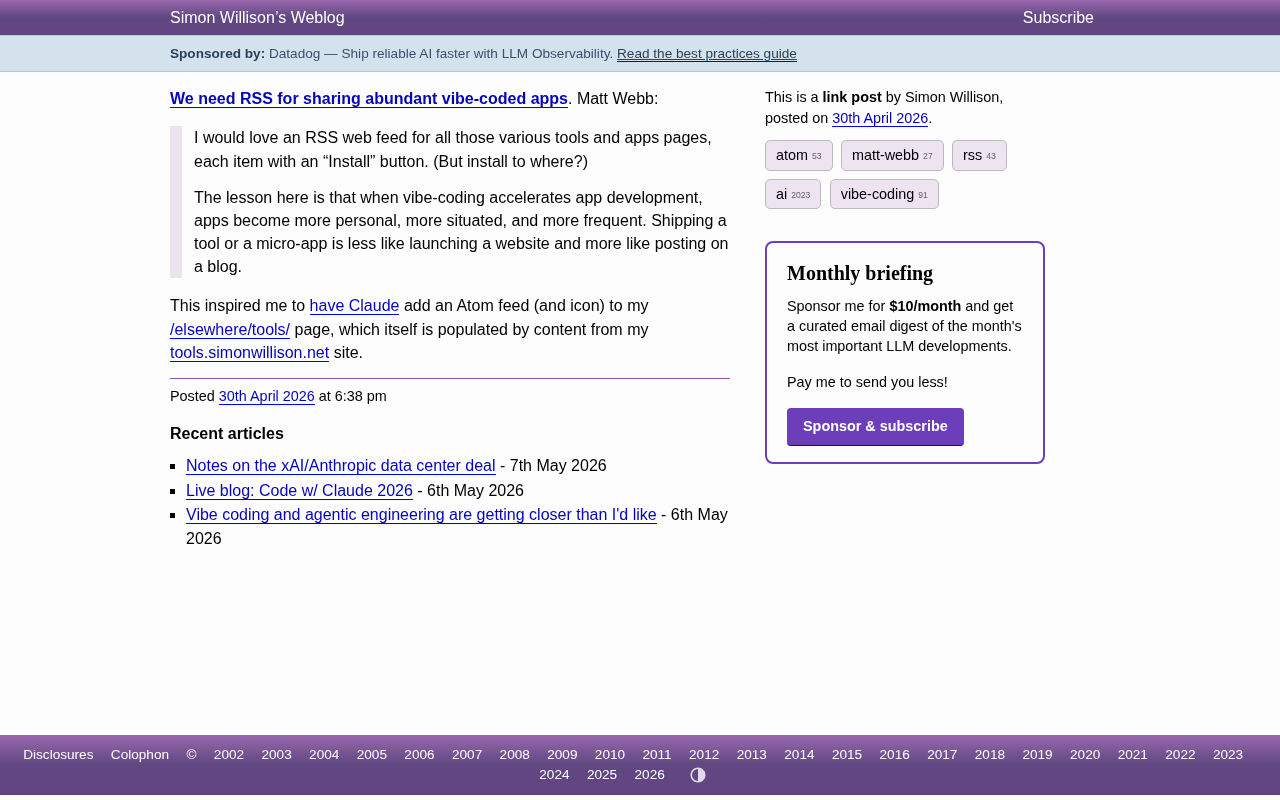
Matt Webb recently raised a fascinating point: as vibe coding accelerates app development, we need an RSS-like mechanism to share the flood of personalized micro-tools and applications that are emerging.
The idea seems simple, but it touches on a core question of the AI programming era — when everyone can rapidly generate tools and apps, how do we discover, share, and install these creations?
How Vibe Coding Has Changed the Nature of App Development
Matt Webb wrote in his article:
When vibe-coding accelerates app development, apps become more personal, more contextual, more frequent. Publishing a tool or micro-app is no longer like launching a website — it's more like posting to a blog.
This passage precisely describes the shift that's currently underway. Traditional app development is a heavyweight process — requiring planning, development, testing, deployment, and promotion. But under the vibe coding paradigm, a person might use AI to generate a small tool that solves a specific problem in just minutes. These tools are highly personal, potentially serving only a very specific scenario, yet they can be extremely valuable to anyone with similar needs.
Vibe Coding was coined by renowned AI researcher Andrej Karpathy in early 2025, describing an entirely new programming paradigm: developers no longer write code line by line, but instead describe desired functionality in natural language to AI tools (such as Claude, GPT-4, Cursor, etc.), which then generate the complete code implementation. The developer's role shifts from "writer" to "guide" and "reviewer." Karpathy described it as "fully surrendering to the vibes, embracing exponential growth, and forgetting that code even exists." This approach dramatically lowers the barrier to software development, enabling non-professional programmers to quickly build functional applications — giving rise to the "app explosion" phenomenon described in this article.
The problem is: these tools are scattered everywhere, lacking a unified discovery and distribution mechanism.
Why RSS Is the Ideal Solution for Personal AI App Distribution
Matt Webb's vision is:
I want all those tool and app pages to have an RSS web feed, with each entry having an "install" button. (But install where?)
This idea is appealing because RSS was originally designed as a protocol for "frequently updated content streams." RSS (Really Simple Syndication) and Atom are two XML-based web content syndication protocols that emerged during the blogging boom of the early 2000s. They allow content publishers to distribute update summaries in a standardized format, while subscribers automatically receive new content through RSS readers (such as Feedly or NetNewsWire) without having to visit each website individually. The core design philosophy of RSS is decentralization — it doesn't depend on any platform; anyone can publish a feed, and anyone can subscribe. Although the rise of social media once marginalized RSS, its open, standardized, algorithm-free characteristics have kept it alive in the tech community, and it has even seen a resurgence in recent years.
When the pace of app development shifts from "a few per year" to "a few per week" or even "a few per day," we truly need a lightweight subscription and distribution mechanism. RSS's decentralized nature is a natural fit for the distributed world of personal tools — each developer maintains their own feed, subscribers choose who to follow, and no centralized app store is needed as an intermediary.
However, Matt Webb himself identified the key challenge — "install where?" Blog posts can be read in a browser, but apps need a runtime environment. There's no perfect answer to this yet, but possible directions include browser extensions, local sandbox environments, or some standardized Web App container.
Several existing technologies are already exploring this space: Progressive Web Apps (PWA) allow web applications to be installed on a device's home screen and run offline; WebAssembly (Wasm) enables complex programs to execute with high performance in browser sandboxes; platforms like Val Town and Deno Deploy offer lightweight cloud-based code execution environments. Additionally, online IDEs like Replit and StackBlitz are exploring the experience of "one-click running someone else's code." But there is currently no unified standard that can seamlessly "install and run" a shared micro-app the way browsers render web pages — this is precisely the gap that needs to be addressed at the infrastructure level.
Simon Willison's Pioneering Implementation
Simon Willison (well-known developer and creator of Datasette), inspired by this article, immediately took action. He had Claude add an Atom feed and icon to his /elsewhere/tools/ page. This page aggregates the various tools he has published on tools.simonwillison.net.
Simon Willison is one of the co-creators of the Django web framework and the author of Datasette, a data exploration tool. Datasette is an open-source Python tool that instantly transforms any SQLite database into an interactive web API and data browsing interface. In recent years, Willison has become one of the most active practitioners and chroniclers in the AI-assisted programming space, continuously documenting his experiences using LLMs for development on his personal blog, and creating numerous small AI-generated web tools (hosted on tools.simonwillison.net). His approach — rapid prototyping, open sharing, and iterative improvement — is a quintessential example of vibe coding culture.
This serves as an excellent demonstration: using an AI tool (Claude) to solve the problem of AI tool distribution, with the entire process completed through a single GitHub PR — lightweight and efficient. It also validates the core principle of vibe coding: when the cost of creating and modifying code is low enough, the path from idea to implementation can be nearly instantaneous.
Future Trends in AI App Distribution: Lessons from Content Explosions
This discussion reflects a broader trend: AI is pushing software development from "industrial production" toward an "artisan craftsmanship" model. Just as blogging enabled everyone to become a publisher, vibe coding is enabling everyone to become a toolmaker.
But history tells us that explosive growth in content always demands supporting infrastructure:
- Blog explosion → RSS/Atom subscription protocols
- Podcast explosion → Podcast directories and distribution platforms (e.g., Apple Podcasts directory, Spotify)
- Short-form video explosion → Recommendation algorithms (e.g., TikTok's For You page)
Every explosion in content format has gone through a process from chaos to order. In the blogging era, people initially discovered new content through manually maintained blogrolls (link lists), before RSS readers and search engines like Technorati provided more systematic discovery mechanisms. Podcasts went through a similar evolution — from manually downloading MP3 files to iTunes' automatic subscriptions.
So what kind of infrastructure does the explosion of personal AI apps require? RSS may be part of the answer, but a complete solution also needs to include runtime environments, permission management, and some form of trust mechanism. Trust is particularly critical — when you "install" a tool generated by a stranger using AI, how do you ensure it won't access your sensitive data or execute malicious operations? This may require multiple layers of protection, such as browser sandboxes, code signing, or community reputation systems.
This is a direction worth watching closely. When the cost of creating tools approaches zero, discovery and distribution will become the new bottleneck — and the new opportunity. Just as the Web 2.0 era gave rise to RSS aggregators like Google Reader and Bloglines, the AI app era may spawn entirely new "tool aggregators" — platforms that let you subscribe, preview, and one-click run other people's micro-apps.
Key Takeaways
- Vibe coding makes app development as frequent and personal as blogging, creating a need for new distribution mechanisms
- Matt Webb proposes using RSS feeds to subscribe to and share personally developed micro-apps and tools
- The core challenge lies in "install where" — apps can't be consumed directly in a browser like articles can
- Simon Willison, inspired by the idea, used Claude to add an Atom feed to his tools page, leading by example
- The explosive growth of AI tools will make discovery and distribution a critical new infrastructure need
Related articles
 Expert Opinions
Rethinking Scaling Laws: Parameters Are Not the Only Answer
Deep analysis of Scaling Law evolution from Kaplan to Chinchilla to the MoE era, exploring why blindly stacking parameters is a mistake, and how GLM-5.3 proves scaling has multiple knobs.
When AI Treats Humans as Subagents: Ro…
When AI Treats Humans as Subagents: Role Reversal and Hidden Risks in Human-AI Collaboration
Exploring the paradigm shift where humans become "subagents" in AI Agent architectures. Analyzes human node design in LangChain and AutoGen, and the risks of ceding control and cognitive atrophy.
 Expert Opinions
The Lazy Person's Productivity Theory: Why Being 'Lazy' Actually Drives Peak Performance
Explore the engineering philosophy behind 'lazy people are most productive': how constructive laziness drives automation, AI tools amplify efficiency, and systems thinking eliminates wasted effort.