The Vibe-Coding Revolution: AI Programming Set to Sweep Across All Hardware Devices

AI vibe-coding is expanding from software to hardware, making natural-language device control possible—but risks remain.
According to The Verge's newsletter The Stepback, an observation led by David Pierce notes that "vibe-coding"—using AI to describe intent in natural language—is spreading from pure software into hardware devices. Hardware has long been constrained by closed firmware and limited configuration options, while large language models' improved understanding of code and device protocols is moving "controlling hardware with a single sentence" from demo to usable; this phenomenon is called experimental "vibe-hacking." For ordinary users, makers, and small hardware teams, the customization barrier is greatly lowered; however, AI-generated code or configuration may introduce security vulnerabilities, and device behavior uncertainty may exceed expectations. The article argues that its greater significance lies in programming transforming from a professional skill into a universal way of expression, though the trend is currently based mainly on a single source and still needs more independent reporting and product cases for verification.
From Software to Hardware: The Boundaries of Vibe-Coding Are Disappearing
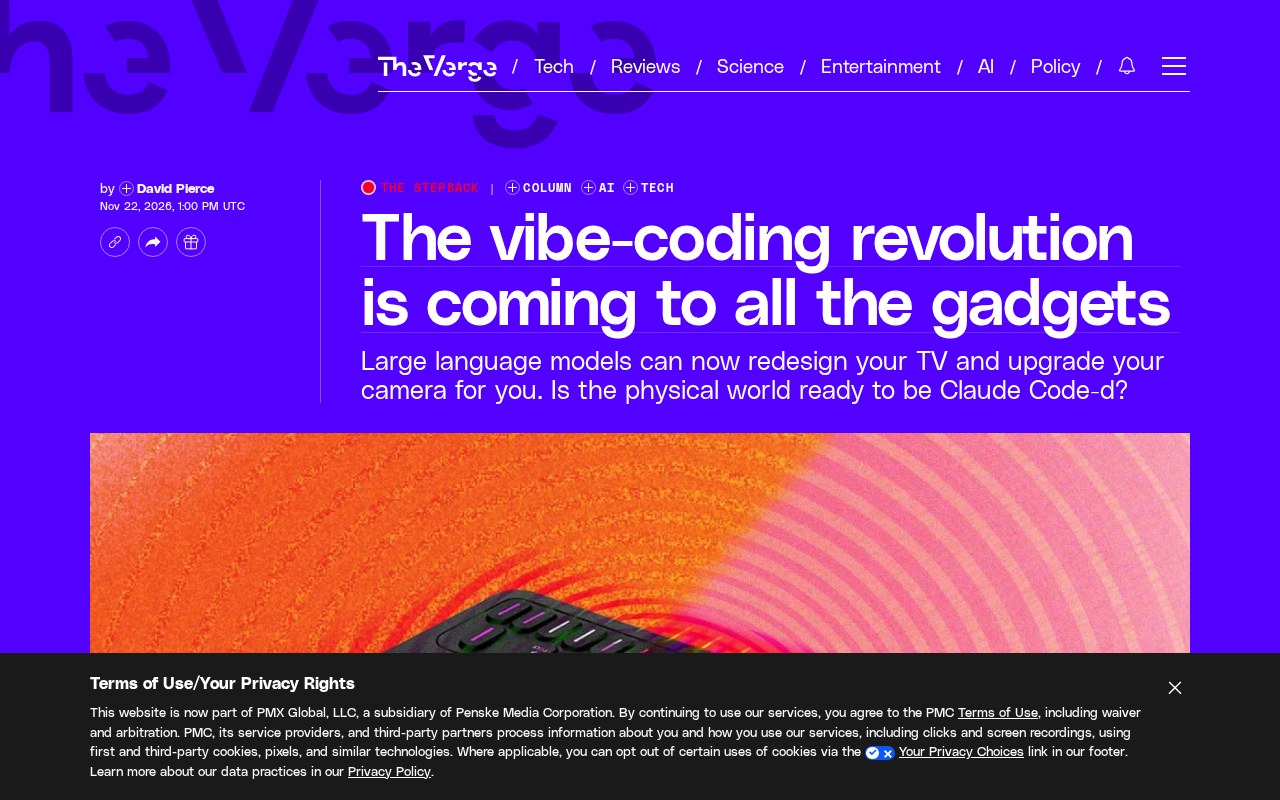
According to The Stepback, the weekly newsletter from tech media outlet The Verge, an AI-driven "vibe-coding" revolution is spreading from the pure software domain into all kinds of hardware devices. The newsletter is written by veteran tech journalist David Pierce, who has long tracked how AI is changing the way things are created and developed.
"Vibe-coding" is not a rigorous technical term; it describes a way of creating things by using AI to "describe intent" in natural language rather than writing code line by line. Users simply say what they want, and the AI generates runnable code or configuration. This mode first became popular in software developer communities and is now being transplanted into the control and customization of hardware devices.
Why Hardware Is the Next Target
Hardware devices have long been constrained by closed firmware and limited configuration options. For ordinary users who want to adjust the behavior of a smart home device, they often have to rely on the app provided by the manufacturer, and what the app can do is decided by the product manager. Vibe-coding opens up a possibility: issuing commands directly to a device in natural language, with AI translating them into low-level operations the device can understand.
The Stepback points out that this trend is inseparable from the overall evolution of AI capabilities. Large language models' understanding of code and device protocols continues to improve, making "controlling hardware with a single sentence" move from demo to usable. In the newsletter, David Pierce calls this phenomenon "vibe-hacking," implying that it has an experimental and exploratory character rather than being mature engineering practice.
Firmware is the low-level software written into a hardware device's non-volatile memory, responsible for directly managing hardware resources and providing basic functionality to upper-layer applications. Unlike application software, which can be freely installed and uninstalled on a device, firmware is usually pre-flashed by the manufacturer, and updates often depend on specialized tools or officially released firmware packages, making it difficult for ordinary users to modify. It is precisely this layer of closure that limits the room for customizing device behavior. The approach of vibe-coding is to let AI act as a "translation layer," converting user requirements expressed in natural language into operational instructions for specific device firmware interfaces or communication protocols, thereby expanding the controllable scope of the device without rewriting the firmware.
Device protocols refer to the set of rules that govern communication between hardware devices or between applications and devices, such as Wi-Fi, Bluetooth Low Energy (BLE), Zigbee, and Matter commonly found in smart homes, as well as various manufacturers' proprietary control command formats. Different protocols vary greatly in data formats, authentication methods, and capability scope; traditionally, developers need to consult protocol documentation and write adaptation code. The reason large language models can take on the task of "controlling hardware with a single sentence" is partly due to their exposure during training to a large amount of protocol documentation, open-source drivers, and sample code, enabling them to infer the forms of instructions that a certain type of device may accept. However, this inference is based on statistical patterns rather than rigorous verification; whether the generated instructions are correctly executed by the device and whether there are unauthorized operations still require actual testing.
Cross-Verification of Multi-Source Information
At present, public information about this trend still mainly comes from The Stepback newsletter. The newsletter is subscription content under the tech media outlet The Verge and is often cited by other tech media. Because the original material is limited, the trend described in this article is based on observation from this single source and still requires more independent reporting and actual product cases to verify its scale and depth.
Creator Perspective: Lower Barriers Coexist with Risks
For ordinary users, vibe-coding means a substantial lowering of the barrier to hardware customization. There is no need to learn programming languages or consult device protocol documentation; describing requirements is enough to obtain results. This is attractive to smart home enthusiasts, maker communities, and small hardware teams.
The risks are equally obvious. AI-generated code or configuration may introduce security vulnerabilities, and the uncertainty of device behavior may also exceed user expectations. The Stepback report does not discuss these risks in depth, but the term "vibe-hacking" itself already implies its informal nature and the need for caution.
Prompt injection is a security risk worth noting in vibe-coding scenarios. When users describe hardware operation intent to AI in natural language, status information returned by the device, protocol documentation fragments, or third-party content may all be mixed into the prompt. If malicious instructions are embedded within, the model may treat them as legitimate requests and execute them. Compared with pure software scenarios, the consequences in hardware scenarios are harder to roll back—a single incorrect configuration may put door locks, thermostats, or security devices into unexpected states. Therefore, when letting AI generate device control instructions, practices such as least privilege, manual confirmation before operations, and prior testing in isolated environments are necessary means to reduce risk.
Signals Worth Watching
The penetration of vibe-coding into hardware reflects a larger trend: AI is transforming "programming" from a professional skill into a universal way of expression. When devices can understand human intent rather than fixed instructions, the logic of product design will change accordingly. The Stepback will continue to track this field, and its follow-up reports are worth watching.
Related articles

Prompt Engineering for Beginners: From Writing Prompts to Engineering Thinking
Starting from the essence and four functions of prompts, this article systematically explains the six-step process, four success criteria, learning value, and practical limitations of prompt engineering to help you build a complete understanding.

Anthropic Launches Nasdaq IPO: AI Giant's Listing and Risk Disclosures
Anthropic officially launches its Nasdaq IPO under ticker ANT, with market valuation expected to potentially exceed SpaceX's record. The prospectus devotes nearly 100 pages to AI risks, while first-half revenue grew over 14x but net losses widened sharply, reigniting the AI bubble debate.

Rust cURL Clone Uses 4,832 unsafe Blocks—Is the Memory Safety Myth Broken?
A Rust cURL clone uses 4,832 unsafe keywords, challenging Rust's memory safety narrative. We analyze what unsafe really means, compare Fil-C, and examine rewrite motives.