The White House Arcade Game Controversy: A Full Analysis of Racism Allegations and Copyright Disputes
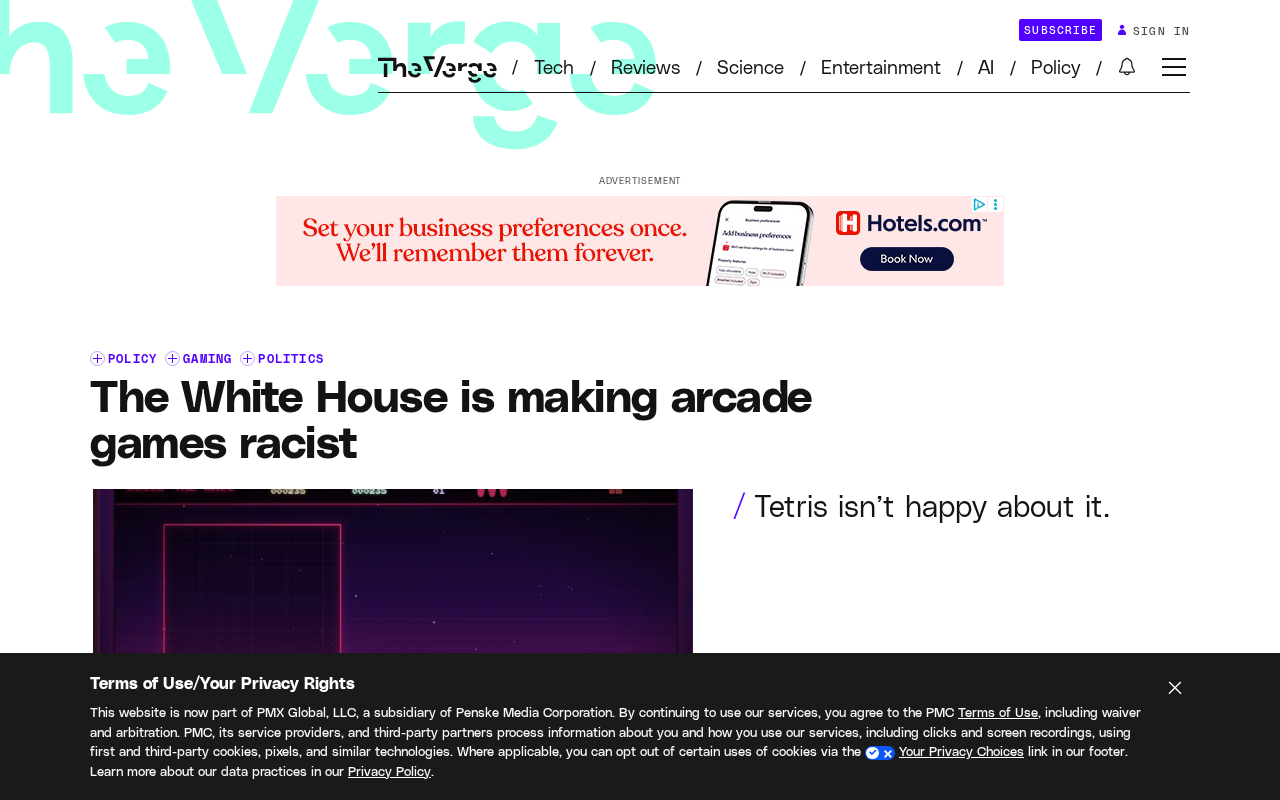
White House arcade games face racism allegations and copyright disputes over unauthorized use of Tetris-style design.
The White House launched policy-themed arcade games to engage the public, but the initiative backfired spectacularly. The "Build the Wall" game was widely criticized for racist undertones that stigmatize immigrants, while The Tetris Company objected to the unauthorized borrowing of its iconic gameplay. The controversy highlights the ethical and legal risks of gamifying sensitive political issues.
Why the White House Arcade Game Marketing Sparked a PR Crisis
The White House recently launched a series of policy-themed arcade games, attempting to communicate its political agenda to the public in a lighthearted way through the nostalgic aesthetics of retro gaming. Arcade games emerged in the 1970s and 80s, representing the collective memory of an entire generation. Classics like Pac-Man and Space Invaders were more than entertainment products — they became icons of popular culture. In recent years, Retro Gaming Aesthetic has made a comeback in marketing, with brands leveraging pixel art, 8-bit sound effects, and other elements to evoke nostalgia and forge emotional connections with Millennials and Gen Z. Political communications have also begun experimenting with this approach — from campaign mini-games to interactive policy explainers — all attempting to break down the perceived distance of serious politics. However, the Gamification of Politics carries inherent risks: it can oversimplify complex issues, trivialize serious matters, and even unintentionally reinforce ideological biases through its interactive design mechanics.
Yet this marketing experiment quickly devolved into a PR disaster — the game content was criticized for racial overtones, while alleged plagiarism of classic games drew the initiative into copyright disputes.
When official institutions borrow popular culture symbols, they often underestimate the complex cultural context and legal boundaries behind them. This White House incident exposed many blind spots in the execution of such marketing strategies.
Racism Allegations: The Controversy of Gamifying Immigration Policy
Among the batch of games was one called "Build the Wall," with gameplay mechanics directly tied to the MAGA political agenda. MAGA (Make America Great Again) was the core slogan of Trump's 2016 presidential campaign and later became his political brand identity. "Build the Border Wall" is one of the signature policy proposals of the MAGA agenda, aimed at constructing a physical barrier along the U.S.-Mexico border to prevent illegal immigration. This policy has been highly controversial from the start: supporters see it as a symbol of national security and sovereignty, while opponents criticize it as xenophobic and a form of symbolic discrimination against the Latino community. Turning such a highly politicized, ethnically sensitive issue into a game essentially converts a policy position into a playable entertainment experience. In this conversion process, players are placed in the role of "defenders," with immigrants metaphorically framed as objects to be "blocked." This narrative framework inherently carries value-laden assumptions and easily reinforces an "us vs. them" adversarial narrative. This approach of gamifying and trivializing immigration policy has been widely criticized as stigmatizing specific ethnic groups.
Packaging serious social issues into a "defeat enemies and clear levels" gaming experience carries moral risks. It not only oversimplifies the complexity of immigration issues but may also reinforce antagonism and stereotypes. When the nation's highest executive institution presents policy positions in this manner, the signal it sends is far more alarming than the game itself.
Copyright Disputes: Unauthorized Use of Classic Game IP
Beyond the content controversy, these games also face real legal risks. Some were adapted from actual classic games, and the copyright holders may not be willing to have their properties associated with the MAGA agenda.
The Tetris Company Issues a Clear Statement
The Tetris Company, which holds the copyright to Tetris, has responded to the "Build the Wall" game. Judging from the game's name and its core "stacking" gameplay, the game clearly draws from Tetris's classic design — players stack blocks to "build a wall."
Tetris was created in 1984 by Soviet programmer Alexey Pajitnov and is one of the most successful video games in history. After a complex series of international copyright disputes, the rights are now held and strictly managed by The Tetris Company. The company maintains extremely high standards for brand protection: not only are the game mechanics protected, but the visual presentation, sound design, and other elements of the core "falling and stacking blocks" gameplay all fall under intellectual property protection. Historically, The Tetris Company has filed numerous lawsuits against unauthorized clones and adaptations. More critically, as a neutral entertainment product, the Tetris brand has always avoided association with any political stance. If the White House games used its gameplay design without authorization, it would constitute not only copyright infringement but could also be seen as forcibly dragging the brand into political controversy — an unacceptable brand risk for any commercial IP.
As a globally recognized intellectual property, the Tetris copyright holder has always been strict about brand image protection. Any unauthorized commercial or politicized use could trigger legal action. For the White House, using protected game designs without permission has pushed this PR crisis into even more difficult territory.
The Boundaries of Political Marketing: Balancing Creativity and Compliance
In recent years, governments and political organizations worldwide have been experimenting with new media, gamification, and other tools to close the gap with younger demographics. This trend is perfectly reasonable in itself, but the key lies in exercising proper judgment during execution.
First, content must withstand scrutiny on values. When marketing tactics touch on sensitive topics like race and immigration, the slightest misstep can turn "creativity" into "offense." Gamification enhances user engagement through points, levels, competition, and other mechanics, and is widely applied in education, health, and business. However, in political communications, gamification faces unique ethical challenges. Games naturally feature "simplified rules, clear friend-or-foe dynamics, and instant feedback" — characteristics that fundamentally conflict with the complexity and ambiguity of real-world politics. When immigration policy is reduced to "stacking bricks to build a wall," when policy debate is converted into "clearing levels and defeating enemies," audiences may unconsciously adopt a singular narrative framework through the entertainment experience. Academics call this "Procedural Rhetoric" — the game rules themselves convey ideology. More seriously, when games involve sensitive topics like race and immigration, their "Othering" narrative mechanisms may deepen social divisions. This is why organizations like UNESCO and the EU, when promoting gamified public communications, emphasize the need for rigorous ethical review and diverse perspective testing.
Second, legal compliance is a non-negotiable baseline. Using someone else's intellectual property requires authorization regardless of purpose, and official institutions should lead by example.
This incident once again demonstrates that popular culture symbols are not "public resources" to be freely appropriated. Behind every classic game lies specific cultural memories and brand value. Forcibly grafting them onto controversial political agendas not only invites legal disputes but also provokes fierce backlash from the original fan communities.
Content Ethics and Legal Boundaries in Political Communications
The White House's failed arcade game marketing campaign is a textbook case of dual failure in content ethics and legal compliance. It serves as a reminder to all institutions attempting to use gamification and entertainment-driven approaches for communications: technology and creativity can make messaging more vivid, but never at the expense of fundamental values and legal boundaries. When political marketing tries to ride the coattails of popular culture, it must maintain sufficient respect and caution.
Related articles

The End of .name Domains: Why Personal Brand Digital Assets Are So Fragile
Developer Neil Fraser's .name domain faces extinction, sparking deep discussion in the tech community about digital asset fragility. This article analyzes .name domain history, the rental nature of domains, niche domain risks, and lessons from decentralized identity for personal brand protection.

Lovable CTO's Vision: The Future of SaaS Is Apps That Agents Can Call
Lovable CTO Fabian Hedin argues SaaS will shift from human-facing interfaces to agent-callable capability platforms. Learn how MCP connects AI agents to apps.
OpenAI Declares the AGI Era Has Arrived: Conceptual Controversies and Technical Realities
OpenAI launches GPT-6 Astra claiming the AGI era has arrived, sparking controversy. Deep analysis of AGI definition ambiguity, technical progress realities, industry standards battle, and practical impacts on users and developers.