The zai adapter package for AI SDK gets an update: the dependency governance logic behind a patch release
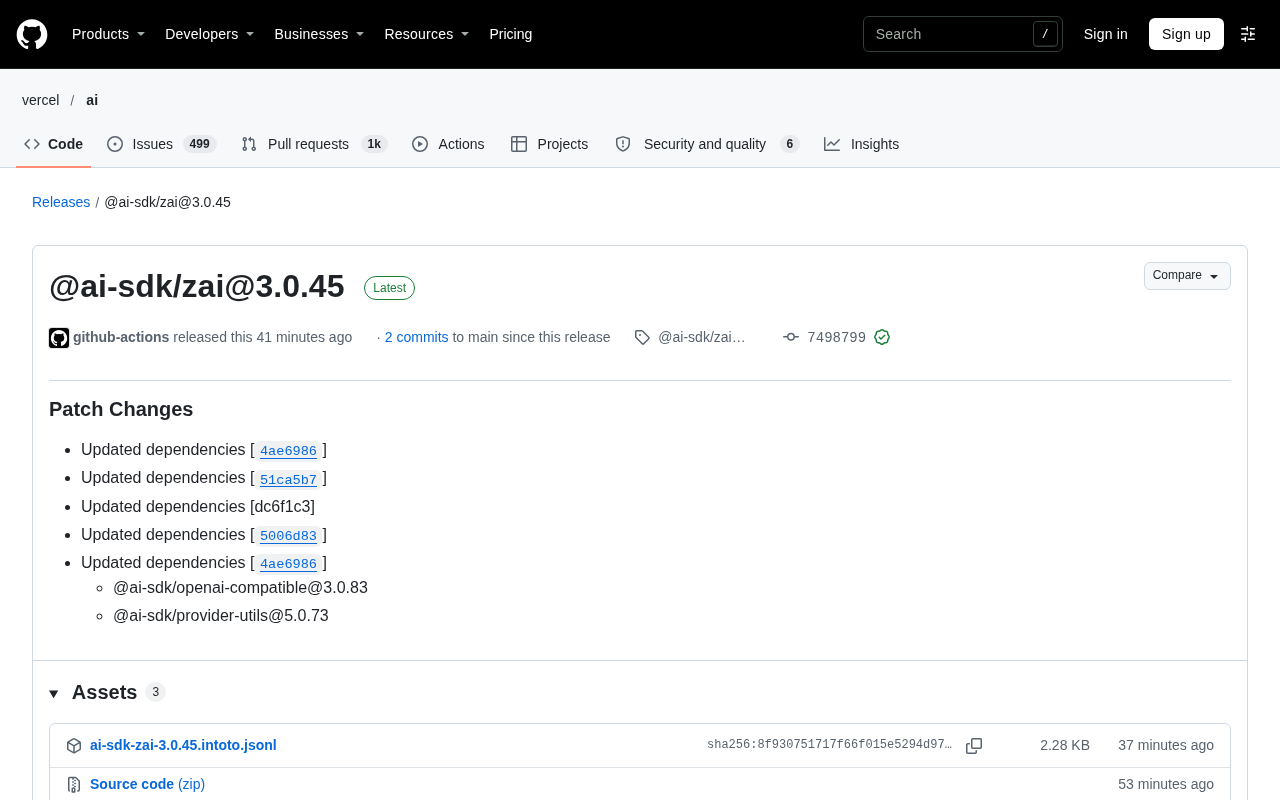
@ai-sdk/zai@3.0.45 is a pure dependency-sync patch with no functional changes, but compatibility deserves attention.
The article analyzes the patch release of @ai-sdk/zai@3.0.45, noting that its entire content is synchronization of upstream dependency versions, involving @ai-sdk/openai-compatible@3.0.83 and @ai-sdk/provider-utils@5.0.73, with no new features or behavioral change claims. The release was automatically triggered by GitHub Actions, aggregating multiple dependency update commits with signature verification, reflecting a highly automated release pipeline. The article notes that while patch upgrades are low-cost, dependency updates may indirectly affect streaming response parsing and request parameter assembly, and production environments should focus regression testing on multi-provider switching scenarios. In addition, the author emphasizes that the patch number itself has limited signaling value—the specific dependency versions in the release notes are the first-hand clues for troubleshooting compatibility issues—and recommends that teams establish observability of dependency versions and pin key foundational package versions in CI.
A seemingly ordinary patch release
@ai-sdk/zai@3.0.45 was released on GitHub as a patch version (Patch Changes), automatically triggered by github-actions and associated with 2 commits. Judging from the release notes, this version introduces no new features and makes no claims of behavioral changes—everything is "Updated dependencies," i.e., following up on upstream dependency versions.
Releases like this are extremely common in the SDK ecosystem and easy to overlook. But for developers who depend on @ai-sdk/zai, they determine the actual versions of foundational packages such as @ai-sdk/provider-utils installed in the project lockfile, which in turn affects the consistency of type definitions and runtime behavior.
The specific changes along the dependency chain
The two foundational packages that were updated
The release notes explicitly list two dependencies that were bumped: @ai-sdk/openai-compatible@3.0.83 and @ai-sdk/provider-utils@5.0.73. The former is the adapter layer in the AI SDK that is compatible with the OpenAI API specification, while the latter is the collection of utility functions shared by all providers.
As a provider adapter package, zai does not reimplement the underlying logic itself; instead, it relies on the openai-compatible layer and provider-utils to handle common work such as request construction and streaming parsing. Therefore, whenever the upstream utility packages receive a patch, zai needs to publish a new version to raise the pinned dependency versions, preventing users from encountering version mismatches across different providers.
@ai-sdk/provider-utils is the underlying shared library of the Vercel AI SDK, providing utility functions shared by all provider adapter packages, including standardized assembly of request headers, parsing of streaming responses (Server-Sent Events) and incremental JSON processing, encapsulation of error objects and retry logic, and conversion from zod or JSON Schema to model parameter structures. Individual provider packages rarely reimplement these logic pieces themselves and instead reference it directly, so a single patch to provider-utils can affect the runtime behavior of all providers at once.
@ai-sdk/openai-compatible, meanwhile, is an adapter layer targeting "APIs compatible with the OpenAI Chat Completions interface": many vendors (including zai) expose APIs that match the shape of OpenAI's /chat/completions, and this package abstracts out these commonalities—handling message formats, tool calling, streaming chunking, and other details in a unified way—from which specific provider packages are then derived. Understanding the division of labor between these two layers makes it clear why zai's release notes almost always appear as "Updated dependencies."
What multiple commit references indicate
The release notes contain multiple occurrences of Updated dependencies, accompanied by different commit hashes (such as 4ae6986, 51ca5b7, dc6f1c3, 5006d83). This indicates that the release aggregates several dependency update commits, which is a typical automated batch follow-up rather than a targeted fix for a specific issue.
A detail worth noting: these 2 commits went directly into the main branch, and GitHub Actions completed the release and signature verification. There is no trace of manual intervention in the entire pipeline, reflecting the project's high standards for release process automation.
The commit hashes following Updated dependencies in the release notes are part of the Changesets working mechanism. Changesets is a version management and release tool commonly used in the JavaScript ecosystem: developers write change description files alongside their code commits, and at release time the tool aggregates these files, automatically increments version numbers, generates CHANGELOG entries, and triggers npm publishing. When a repository uses a monorepo structure to manage multiple packages, a version bump in a foundational package cascades to trigger patch versions for all packages that depend on it, so the CHANGELOG ends up containing multiple dependency update records with different hashes.
This also explains why 2 commits can produce multiple records—each record corresponds to a dependency version bump event rather than an independent code change. GitHub Actions plays the role of executor here, responsible for completing the build, release, and provenance signing after merging, making the entire process require no manual intervention.
Practical significance for users
Upgrade cost and risk assessment
Patch versions usually mean no breaking changes, so the upgrade cost is low. However, dependency updates still require attention to indirect effects: a patch to provider-utils may have adjusted the boundary handling of utility functions, and a patch to openai-compatible may affect request parameter assembly. For teams using the AI SDK in production, it is recommended to focus regression testing on two scenarios after upgrading: streaming response parsing and multi-provider switching.
If the project pins dependencies via a lockfile, you can follow up at a regular pace; if it uses floating version ranges, you need to confirm whether the new version is compatible with your existing provider combination.
The signaling value of version numbers
A patch number increment like 3.0.45 conveys limited information on its own—it only indicates that upstream changes need to be synchronized. What is truly valuable is the specific dependency package versions listed in the release notes; they are the first-hand clues for troubleshooting compatibility issues. Developing the habit of reading patch release notes is more effective at spotting potential dependency conflicts early than staring at major version numbers.
The npm ecosystem follows semantic versioning (SemVer) conventions: a major version change indicates incompatible breaking changes, a minor version indicates backward-compatible new features, and a patch number indicates only backward-compatible bug fixes. Under this convention, 3.0.45 is a patch-level release and theoretically contains no breaking changes.
However, note that SemVer is only a convention, not an enforcement, and "dependency update" releases are semantically in a gray area—a patch to an upstream foundational package may change function boundary behavior or type definitions, creating de facto behavioral differences for downstream consumers. Therefore, treating a patch number as a signal of "absolute safety" is unreliable; what is truly verifiable remains the specific dependency versions listed in the CHANGELOG, along with the commit records in those dependencies' own repositories. This is precisely why the article emphasizes that "the signaling value of version numbers is limited."
SDK maintenance patterns as seen from release cadence
@ai-sdk/zai uses high-frequency patch-level releases, with dependency updates driven by automated processes—this matches the characteristics of rapid iteration in the current AI SDK ecosystem: upstream provider interfaces change frequently, and the adapter layer must stay in sync.
Under this pattern, users' response strategies should also adjust—there is no need to chase every patch, but you should establish observability of dependency versions, for example by pinning key foundational package versions in CI and checking them item by item against the dependency list in release notes when upgrading. For projects that use the zai provider only in specific scenarios, the follow-up frequency can be appropriately reduced, with effort focused instead on business-side multi-model orchestration.
Frequently asked questions
Do I need to upgrade immediately for this update? Patch versions contain no functional changes, so you can decide according to your project's own pace; if you have recently encountered dependency-related type errors, try upgrading to this version first.
Why do the release notes contain only dependency updates? Because the entire content of this change is synchronizing the patch versions of upstream foundational packages, with no code logic changes.
How can I confirm exactly which packages changed? Check the @ai-sdk/openai-compatible@3.0.83 and @ai-sdk/provider-utils@5.0.73 listed in the release notes, and compare them against the commit records in their respective repositories.
Related articles

Skykea Showdown: A Hilarious Variety Show Experience of a Minecraft Airship Building Competition
Skykea Showdown is a Minecraft airship building racing variety show. This article analyzes its two-phase build + hole race format, airship mod lift physics, secret mission design, and team confrontation dynamics—ideal for game content creators.

Did the US Midterms Vote No to AI Data Centers? A Map Reveals the Truth
After the US midterms, media claimed voters rejected AI data centers, but a map shows restrictive votes are concentrated in a few Ohio townships, affecting less than 1% of US towns—the national anti-AI wave is exaggerated.

ApexW Optimizer Benchmark: Matches 8-bit AdamW in Unsloth with Lower Memory Usage
Developer shares benchmark of ApexW optimizer in Unsloth: ApexW 8bit has lower optimizer state memory (47.101 MB) and slightly better final loss than 8-bit AdamW, but similar speed. Needs independent reproduction.