Theoretical Limits of Learning Unconstrained Interatomic Potentials: The Sampling Reliability Crisis in Machine Learning Potential Models

Unconstrained MLIPs show exponentially ill-conditioned energy-force prediction error versus sampling accuracy; local accuracy does not guarantee globally correct distributions.
This theoretical study reveals that for the unconstrained hypothesis class, the relationship between energy and force prediction errors and sampling accuracy in machine learning interatomic potentials (MLIPs) is exponentially ill-conditioned: even if prediction error decays exponentially with dimension, the total variation distance between the learned distribution and the target distribution may still approach its maximum. The study identifies two failure mechanisms—kinetic trapping causes exponentially long relaxation times, and equilibrium mismatch causes the stationary distribution itself to deviate from the target. Even in local, symmetry-preserving models with small per-atom error, the distribution difference still approaches its maximum as system size increases. The study further establishes global energy control conditions that guarantee equilibrium accuracy and identifies additional conditions required for fast relaxation, providing theoretical guidance for MLIP design: relaxing physical inductive biases may come at the cost of sampling reliability.
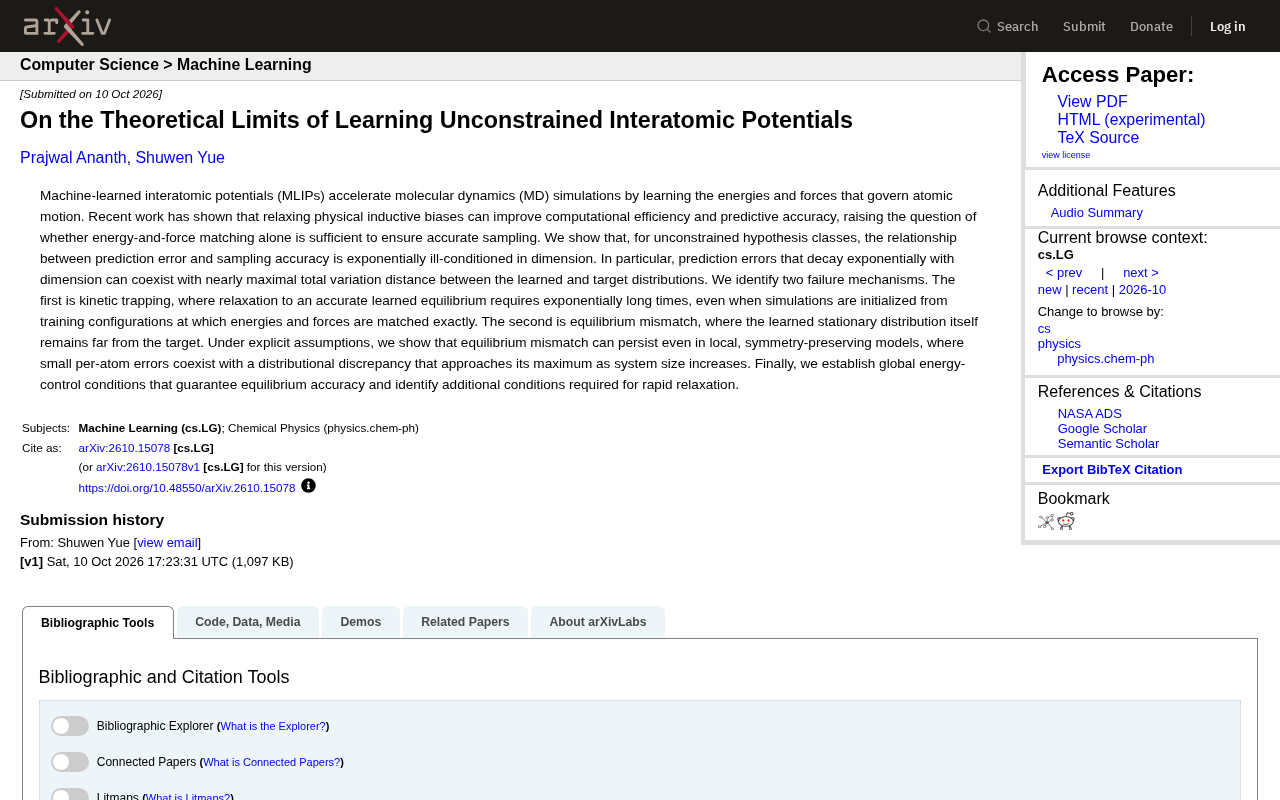
Machine learning interatomic potentials (MLIPs) have become an important tool in computational chemistry and materials science by predicting the energies and forces needed for atomic motion to accelerate molecular dynamics simulations. However, a recent theoretical study reveals a troubling fact: for the unconstrained hypothesis class, the relationship between prediction error and sampling accuracy is exponentially ill-conditioned in dimension. This means that even if the prediction errors of energies and forces decay exponentially with dimension, the total variation distance between the learned distribution and the target distribution may still approach its maximum value.
Why Prediction Accuracy Does Not Equal Sampling Reliability
In recent years, researchers have found that relaxing physical inductive biases can improve the computational efficiency and prediction accuracy of MLIPs, which raises a fundamental question: Is matching energies and forces alone sufficient to guarantee accurate sampling?
The study gives a negative answer. For the unconstrained hypothesis class, the relationship between prediction error and sampling accuracy is exponentially ill-conditioned—even if prediction error decays exponentially with dimension, the total variation distance between the learned distribution and the target distribution may still approach its theoretical maximum. This means that a model can perfectly match energies and forces on the training set while producing completely wrong statistical behavior when sampling.
Concrete Manifestation of the Curse of Dimensionality
In molecular dynamics, sampling accuracy directly determines the physical meaning of simulation results. If a model can accurately predict the force on each atom but cannot reproduce the correct thermodynamic ensemble distribution, then simulations based on that model lose their reliability. The study proves that this failure is not accidental but a structural problem of the unconstrained learning framework.
Total variation distance is a common measure of the difference between two probability distributions, defined as the maximum difference in probability assigned to an event, with values ranging from 0 to 1. A total variation distance of 0 means the two distributions are identical, while 1 means they are completely disjoint on some region. Therefore, the phrase “approaching the maximum” in the original text means that the learned distribution and the target distribution are almost completely separated, and any statistic based on that distribution is unreliable. In molecular dynamics, the target distribution is usually the Boltzmann distribution, where the probability of high-energy configurations decays exponentially. If the learned potential energy model shows a huge deviation on this distribution, then key physical quantities such as free energy and phase transition temperature obtained from the simulation will be severely distorted. Total variation distance is chosen rather than metrics such as KL divergence because it is sensitive to any local difference in the distribution and does not rely on absolute continuity assumptions, making it more suitable for characterizing the severity of sampling failure.
Curse of dimensionality refers to the phenomenon that as the system dimension (here, the number of atoms multiplied by 3) increases, the sample size or computational resources required by many algorithms or theoretical guarantees grow exponentially. In MLIP research, dimension usually refers to the degrees of freedom of the atomic configuration space. The “exponential ill-conditioning” in this study means that even if the prediction error of energy and force at each atomic position decreases exponentially with dimension, the error at the distribution level (total variation distance) may not decrease or may even approach its maximum. This is different from the common “error accumulation,” which is usually polynomial. More precisely, it is a concentration phenomenon caused by dimension: in high-dimensional spaces, a locally accurate potential energy surface can assemble into a completely wrong probability distribution globally, because most of the volume in high-dimensional space lies in “corner” regions, and local matching cannot control the probability measure of these regions. This phenomenon is especially fatal for molecular dynamics, because MD relies on long-time ergodic sampling of configuration space.
Two Failure Mechanisms: Kinetic Trapping and Equilibrium Mismatch
The study identifies two core mechanisms that lead to sampling failure.
Kinetic Trapping: Exponentially Long Relaxation Times
The first mechanism is called kinetic trapping. Even if the simulation starts from a training configuration—that is, an initial point where energy and force match perfectly—relaxation to the accurate learned equilibrium state still requires exponentially long time. In other words, the model may be trapped in a local region of the potential energy surface and cannot explore the correct statistical distribution within a reasonable time. For practical molecular dynamics simulations, this means that even if force field predictions are precise, the simulated trajectory may not traverse the correct configuration space.
Equilibrium Mismatch: Locally Accurate but Globally Wrong
The second mechanism is equilibrium mismatch, which refers to the fact that the learned stationary distribution itself is far from the target distribution. Under certain explicit assumptions, the study proves that equilibrium mismatch persists even in local, symmetry-preserving models—the error per atom is small, but the distribution difference approaches its maximum as system size increases. This finding challenges the intuition that “local accuracy accumulates into global accuracy.”
Theoretical Significance of Global Energy Control Conditions
Faced with these negative results, the study does not stop at criticism but further establishes global energy control conditions that can guarantee equilibrium accuracy and identifies additional conditions required for fast relaxation.
This provides theoretical guidance for the design of MLIPs: to ensure sampling reliability, one cannot rely solely on pointwise matching of energies and forces; appropriate inductive biases or constraints must be introduced to guarantee the correctness of the global distribution.
Implications for MLIP Development
This theoretical result sounds a warning for the current trend of pursuing “larger, more flexible, and less physically constrained” model designs. Relaxing inductive biases can indeed improve fitting accuracy and computational efficiency, but it may come at the cost of sampling reliability—which is precisely the core purpose of molecular dynamics simulations.
Global energy control conditions refer to a set of theoretical inequalities that constrain the behavior of the energy function over the entire configuration space, rather than focusing only on local fitting near the training data. In this context, such conditions usually require the learned potential energy function to satisfy some uniform lower bound or Lipschitz continuity, so that the density ratio of the Boltzmann distribution is bounded over the whole space. Sufficient conditions for guaranteeing equilibrium accuracy often involve uniform deviation control between the energy function and the true potential energy: when this deviation is uniformly smaller than some threshold, the total variation distance between the two Boltzmann distributions can be explicitly bounded. The additional conditions for fast relaxation are usually related to energy barriers and curvature of the potential energy surface, for example requiring that the learned model does not contain artificial deep local minima. These conditions provide testable criteria for MLIP design: the model must not only fit forces but also guarantee global geometric properties of the energy function, such as smoothness and the absence of spurious barriers.
Reexamining the Boundaries of Unconstrained Learning
The core contribution of this work is revealing the intrinsic theoretical limits of learning unconstrained interatomic potentials: there is an exponential gap between energy-force matching and distribution sampling accuracy. For application fields that rely on molecular dynamics simulations, such as materials science and drug discovery, this means that model evaluation cannot only look at the RMSE of force prediction; it also needs to focus on correctness at the distribution level.
The study also points to a constructive direction: by identifying sufficient conditions that guarantee equilibrium accuracy and fast relaxation, it provides a theoretical foundation for designing MLIPs that are both expressive and sampling-reliable. Future potential energy model development may need to find a new balance between flexibility and physical constraints.
One-line Summary
For unconstrained MLIPs, energy-force prediction error and sampling accuracy are exponentially ill-conditioned; local accuracy does not guarantee globally correct distributions.
Paragraph Summary
This theoretical study reveals that for the unconstrained hypothesis class, the relationship between energy and force prediction errors and sampling accuracy in machine learning interatomic potentials (MLIPs) is exponentially ill-conditioned: even if prediction error decays exponentially with dimension, the total variation distance between the learned distribution and the target distribution may still approach its maximum. The study identifies two failure mechanisms—kinetic trapping, which leads to exponentially long relaxation times, and equilibrium mismatch, which causes the stationary distribution itself to deviate from the target. Even in local, symmetry-preserving models, where per-atom error is small, the distribution difference still approaches its maximum as system size increases. The study further establishes global energy control conditions that guarantee equilibrium accuracy and identifies additional conditions required for fast relaxation, providing theoretical guidance for MLIP design: relaxing physical inductive biases may come at the cost of sampling reliability.
Related articles

Python 3.15 New Feature: Is the sentinel Type Better Than None?
Python 3.15 adds the sentinel type, using named unique sentinel objects to replace None and bare object(), resolving confusion among missing values, explicit emptiness, and invalid input while avoiding type hint failures.

Deep Learning's Three Architectures and the Universal Approximation Theorem: A Complete Guide to MLPs, CNNs, and Transformers
Explaining the inductive bias differences among MLP, CNN, and Transformer, the existence meaning of the Universal Approximation Theorem (UAT), and the role of Taylor expansion in approximation analysis, while clearing up common misconceptions.

GitLab Emergency Patch Release: Analysis of Critical Security Fixes
GitLab releases critical patch 19.5.1, sparking 355 points of discussion on Hacker News. This article analyzes the background, upgrade steps for self-hosted instances, and verification points to help DevOps teams respond quickly to security updates.