They Turned the ESP32-S3 Into a Conference Badge — and Developers Ran DOOM on It

init() conference used 500 ESP32-S3 badges to spark developer creativity, from DOOM to voice assistants.
init() conference gave 500 attending developers ESP32-S3-based microcomputers as badges, turning an identity marker into a programmable embedded dev board. Developers ran DOOM, built Tamagotchi pets, voice assistants, and flight trackers. The team completed procurement, flashing, and testing of 500 devices before the event, demonstrating small-batch hardware deployment skills. With low cost, integrated Wi-Fi/Bluetooth, and rich framework support, the ESP32-S3 proved ideal for such creative projects.
When a Badge Becomes a Handheld Computer
Most tech conference badges are nothing more than a plastic card printed with a name and a QR code. But init() took a completely different approach — they handed every attending developer a ESP32-S3-based microcomputer as their badge.
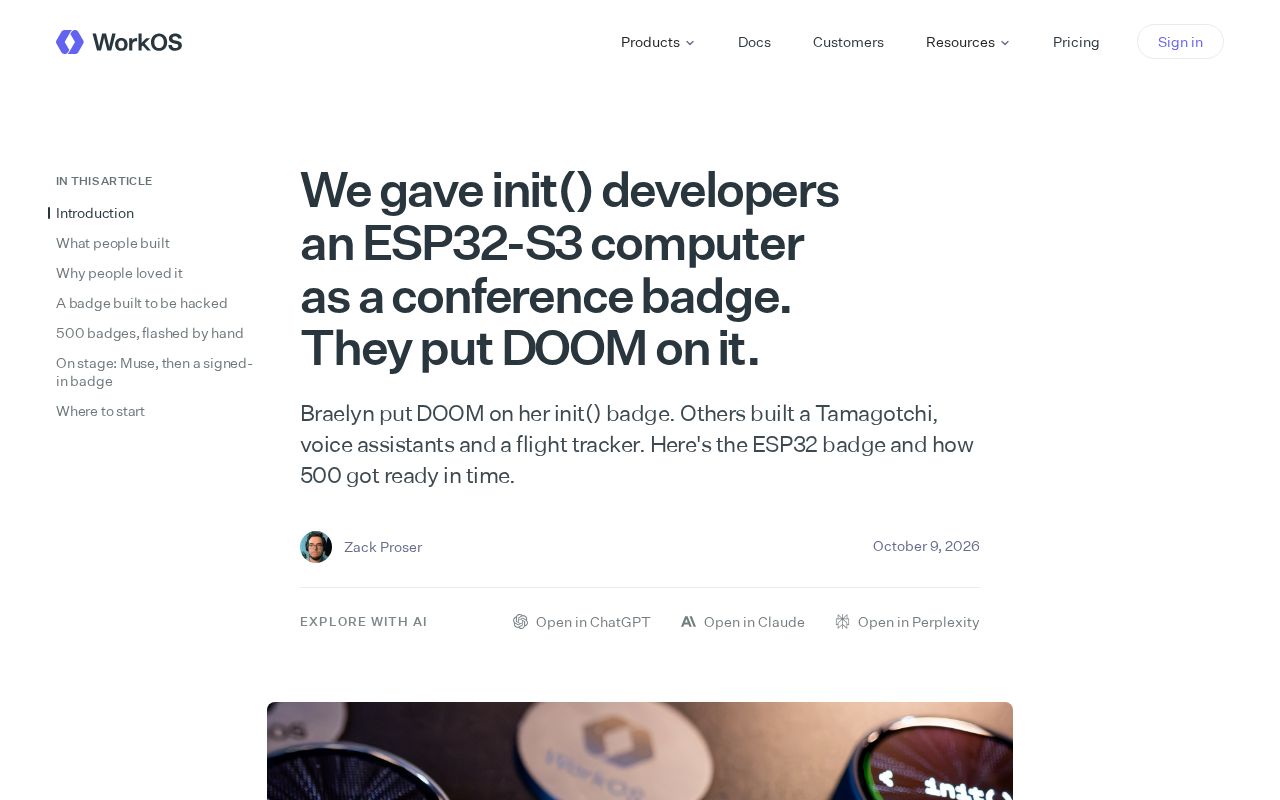
This badge packs an ESP32-S3 chip, which means it has a dual-core processor, Wi-Fi and Bluetooth connectivity, and enough GPIO pins to drive a screen and sensors. Essentially, it's an embedded dev board you can wear around your neck.
The result was predictable: the first thing developers did after getting their hands on it wasn't to study the conference schedule — it was to start tinkering with the hardware.
ESP32-S3 is the third-generation Xtensa-architecture microcontroller SoC from Espressif Systems, an upgraded model in the ESP32 family aimed at AIoT scenarios. It features a dual-core Xtensa LX7 processor running at up to 240 MHz, 512 KB of built-in SRAM, and support for up to 16 MB of external PSRAM and 384 KB of ROM. Compared to the classic ESP32, the S3 adds vector instruction extensions that can accelerate neural network inference and digital signal processing. For wireless connectivity, it integrates 2.4 GHz Wi-Fi (supporting 802.11 b/g/n) and Bluetooth 5 (LE), with up to 45 programmable GPIOs. These features allow it to both drive LCD screens and sensors and run lightweight game engines, making it a hot platform among makers and embedded developers.
The DOOM Porting Tradition: Since id Software released DOOM's source code as open source in 1993, it has been continuously ported to all sorts of unconventional platforms — from calculators and printers to refrigerator displays. Its streamlined engine architecture and low reliance on floating-point operations have made it a grassroots benchmark for embedded device performance. Running DOOM on the ESP32-S3 typically requires community-maintained ports, rendering through an SPI screen and using PSRAM to store game assets.
What Developers Actually Built
According to the init() team, attendees' creativity far exceeded expectations. Braelyn successfully ran DOOM on the badge — this classic shooter, jokingly said to "run on anything," once again proved its porting potential. The ESP32-S3's computing power and memory are limited, but sufficient to drive a game engine as old yet elegantly structured as DOOM.
Other developers' projects were equally interesting:
- Tamagotchi: Someone implemented a full virtual pet experience on the badge, using the onboard screen and buttons for interaction
- Voice Assistant: Some developers integrated voice recognition, turning the badge into a portable voice interaction terminal
- Flight Tracker: Connected to a flight data API via Wi-Fi to display real-time information about planes flying overhead
These projects showcase the ESP32-S3's flexibility as an IoT development platform — the same piece of hardware, used by some to play games, by others to build practical tools, and by others purely for fun.
How 500 Badges Were Rushed Out
Before the conference began, the team needed to prepare 500 fully functional badges. This wasn't a small-batch prototype — it was a real production challenge.
The init() team revealed that the entire preparation process involved hardware procurement, firmware flashing, functional testing, and packaging and distribution. Each badge needed to have working Wi-Fi, proper screen display, and adequate battery life. Given the uncertainties of supply chains and logistics, getting everything ready before the conference opened was itself a significant engineering achievement.
This approach also reflects init()'s core philosophy: rather than having attendees passively receive information, give them a platform they can actually work with. The badge is no longer just an identity marker — it's a starting point for creativity.
Small-Batch Hardware Production (hundreds to thousands of units) sits between handmade prototyping and large-scale contract manufacturing, facing unique challenges: component procurement rarely gets volume discounts, supplier lead times fluctuate significantly, and firmware flashing and functional testing often must be done in-house. Common practices include using jigs for batch flashing, writing automated test scripts to verify Wi-Fi, screens, and batteries, and adopting standardized packaging processes to reduce labor costs. The engineering experience from this phase is especially valuable for teams moving from prototype to product.
Why This Matters
The ESP32-S3 wasn't chosen as the badge's core by accident. This chip's popularity in the embedded community keeps growing, for straightforward reasons:
Outstanding value. Compared to single-board computers like Raspberry Pi, ESP32-S3 modules cost far less, making them suitable for large-scale deployments like 500 units. They also integrate Wi-Fi and Bluetooth, eliminating the need for extra modules.
Low barrier to entry. It supports Arduino, ESP-IDF, MicroPython, and other development frameworks, so developers can quickly get started using whatever they're familiar with. The fact that Braelyn could get DOOM running also shows that existing community ports can be directly reused.
Active community ecosystem. From Tamagotchi to voice assistants, these projects could be built quickly thanks to the wealth of libraries and example code accumulated by the open-source community.
From a broader perspective, this "hardware-as-badge" approach is becoming a trend at tech conferences. It transforms attendees from spectators into creators, and gives the conference itself discussion momentum that far outlasts a few days — after all, who would want to throw away a computer that can run DOOM?
ESP32-S3 Development Frameworks include: Arduino (great for rapid prototyping and reusing community libraries), ESP-IDF (Espressif's official native framework, offering low-level control and FreeRTOS support), MicroPython (great for scripted interaction), and CircuitPython. What these frameworks share is a massive ecosystem of example code and driver libraries, so developers don't need to write peripheral drivers from scratch. Community projects like the LVGL graphics library and ESP32 audio libraries further lower the barrier to implementing complex interactions on a badge.
Implications for Embedded Development
The init() badge project is more than just a conference gimmick. It proves that when hardware is cheap enough and development is convenient enough, people will spontaneously discover unexpected uses.
For embedded developers and product teams, this case offers several points worth considering: giving users an open hardware platform sparks more engagement than giving them a closed finished product; choosing a chip solution with a mature ecosystem can dramatically shorten the distance from idea to prototype; and the experience of producing 500 units also provides a reference for small-batch hardware deployment.
The ESP32-S3 itself isn't a new chip, but every creative application like this expands its boundaries.
Related articles

JobRunner MCP Server: AI Agents Can Now Fix Failed Java Jobs
JobRunner launches an open-source MCP server enabling AI agents to view cluster status, diagnose failures, and recover Java jobs—incident response from any cloud coding environment or existing agent.

MLAI Digital Launches 9 Security Agents: MCP Server Safeguards the Full Lifecycle of Agentic AI
MLAI Digital launches Security MCP Server with nine built-in specialized security agents covering vulnerability discovery, attack simulation, prompt injection detection, API and infrastructure assessment, and accelerated remediation—embedding security validation across the full Agentic AI lifecycle from development to production.

Running Isaac Lab on H100 GPUs: Exploring Better Approaches
Exploring optimization methods for running Isaac Lab on NVIDIA H100 GPUs, including MIG configuration, mixed precision, TensorRT acceleration, and community experience to improve robotics simulation and reinforcement learning efficiency.