Thinking Machines Releases Its First Open-Weight Model: Inkling

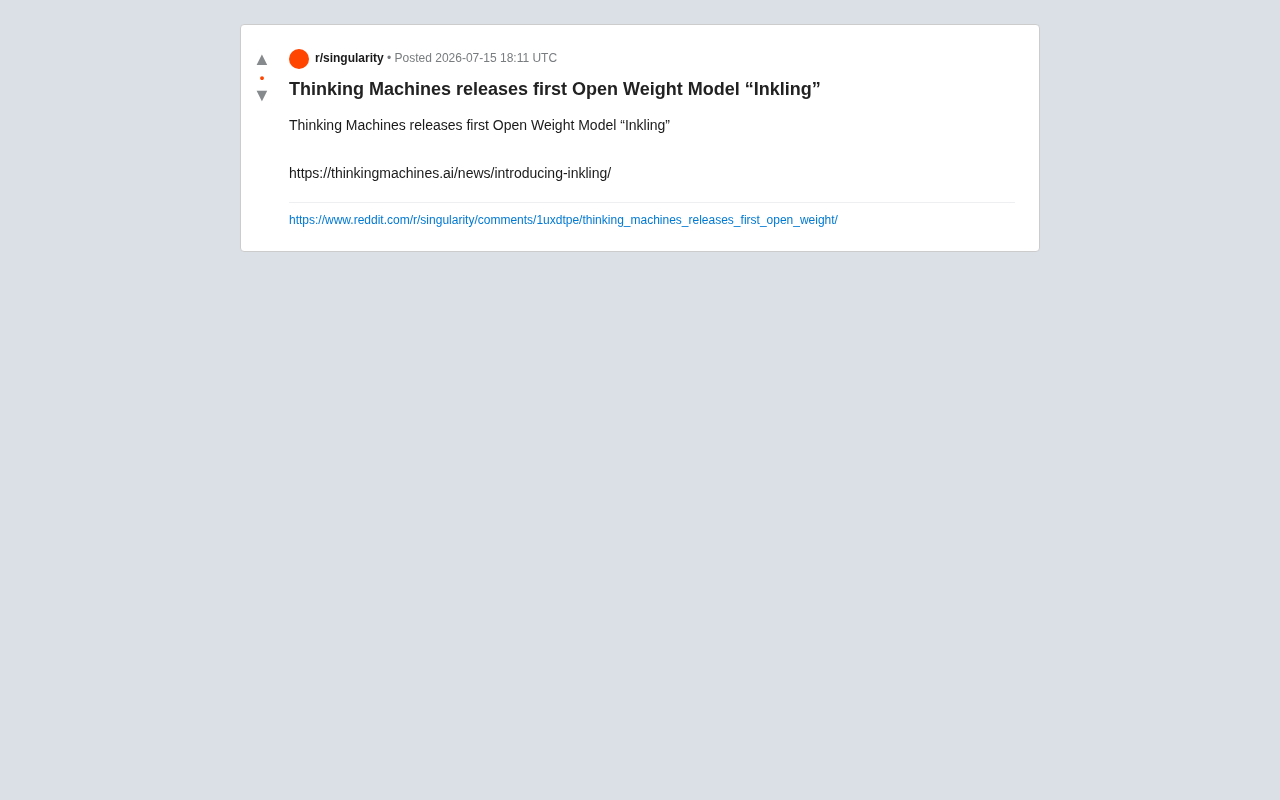
Thinking Machines Lab launches Inkling, its first open-weight LLM, built by ex-OpenAI founders.
Thinking Machines Lab, founded by former OpenAI core members, has released Inkling — its first open-weight model. The move signals a strategic bet on community-driven growth, allowing developers to deploy and fine-tune the model locally while the company retains key IP. The release positions Thinking Machines within the growing open-weight LLM ecosystem alongside Meta's Llama, Mistral, and others.
From Stealth Startup to the Open-Source Camp
Thinking Machines Lab has officially released its first open-weight model — Inkling — marking a pivotal step toward productization for this AI startup founded by former core members of OpenAI. As a company that has drawn intense industry attention since its inception, every move Thinking Machines makes is closely watched. Choosing to release its first model as an open-weight offering is a strategic signal worth careful consideration.
The term "open weight" refers to publicly releasing a model's trained weight parameters for the community to download and use, without necessarily disclosing the training data, training code, or full technical details. This approach sits between fully closed-source and fully open-source — it allows developers to deploy and fine-tune models locally, while giving the company a degree of moat around its core technology. It's worth noting that open-weight models differ fundamentally from truly "open-source" models: genuine open source requires disclosing the training dataset, training code, evaluation framework, and all technical documentation, so that anyone could theoretically reproduce the entire model from scratch. Open-weight releases, by contrast, only expose the trained parameter files — providing a "black-box result" rather than the "manufacturing process." This distinction carries significant weight in commercial competition: companies can retain critical IP such as data pipelines, RLHF tuning strategies, and system prompts, while still reaping the brand exposure and ecosystem benefits that come with open-source community engagement. In recent years, Meta's Llama series, Mistral, and several leading Chinese model teams have all adopted similar strategies.
Inkling's Strategic Positioning and Industry Significance
For Thinking Machines, the release of Inkling is not just a technical product launch — it's a public statement of the company's values. In the fiercely competitive large model landscape, OpenAI, Anthropic, Google, and other leading players have largely moved toward closed-source commercialization, while teams choosing the open-weight path are betting on community ecosystems to build differentiated competitive advantages.
Founded by former core members of OpenAI, Thinking Machines has deep expertise in large-scale model training, alignment, and inference optimization. "Alignment" is a central topic in AI safety — it refers to the technical and methodological framework for ensuring that an AI system's behavior, objectives, and values align with human intentions. Alignment research spans multiple dimensions: capability alignment ensures models accurately understand and follow user instructions; value alignment prevents models from generating harmful or misleading content; intent alignment enables models to infer a user's true needs when given ambiguous instructions. The primary technical approaches include Reinforcement Learning from Human Feedback (RLHF), Constitutional AI, and Direct Preference Optimization (DPO) — all areas in which the Thinking Machines team was deeply involved during their time at OpenAI.
Releasing their first model as an open-weight offering serves a dual purpose: on one hand, it rapidly builds community credibility and attracts developers and researchers to the ecosystem; on the other, it may lay the groundwork for a more powerful closed-source commercial model down the line — establishing technical trust through open products, then monetizing through premium models and API services.
In fact, this "open source for traffic, premium services for revenue" dual-track business model has been well validated across the industry: Meta used the Llama series to strengthen its influence in AI infrastructure; Mistral AI built its reputation with open-source small models before launching closed-source high-performance flagship models with API services; HuggingFace generates revenue through enterprise private deployment solutions and hosted inference services. Thinking Machines will very likely follow a similar trajectory.
Opportunities and Challenges of the Open-Weight Approach
While the open-weight model helps expand influence quickly, it also introduces challenges that cannot be ignored. First, there are safety and misuse risks — once weights are made public, they cannot be recalled, and there is a risk of them being used to generate harmful content or bypass safety restrictions. Second, there is commercial pressure — finding the right balance between open sharing and sustainable profitability is a long-term challenge every company in the open-source camp must face. Thinking Machines' choice to take this path speaks to its confidence in its own technical iteration speed and ecosystem-building capabilities.
Inkling's Place in the Open-Source LLM Landscape
From a broader perspective, the release of Inkling comes at a pivotal moment for the open-source AI community. With a wave of high-quality open models like Llama, DeepSeek, and Qwen emerging in rapid succession, the open-source camp is quickly closing the performance gap with — and in some tasks surpassing — closed-source models. Thinking Machines' entry injects fresh energy into the open-source ecosystem and further intensifies the competition between open and closed technical approaches.
For the developer community, having another high-quality open-weight option means a broader experimental space and lower deployment costs. Enterprises and research institutions can perform private deployment and domain-specific fine-tuning on top of Inkling without worrying about data flowing to third-party API services. This kind of autonomy and control is precisely what many privacy-sensitive and cost-conscious use cases urgently need.
Key Details to Watch
Currently, the information officially disclosed is still relatively limited — critical details such as the model's parameter size, benchmark performance results, and license terms have yet to be fully announced. These factors will directly determine the model's practical value and community adoption.
The licensing question in particular deserves close attention. Different license terms have vastly different implications for commercial use: Apache 2.0 and MIT licenses are the most permissive, allowing nearly unrestricted commercial use and redistribution; Meta's Llama series uses a custom license that imposes additional requirements on companies with more than 700 million monthly active users and prohibits using model outputs to train other large models; licenses such as CC BY-NC or RAIL (Responsible AI License) embed explicit usage restriction lists into their terms. Whether Thinking Machines opts for a fully permissive open license or a custom license with commercial use restrictions will significantly influence developer adoption — for enterprise users, license review is often the first hurdle in the adoption decision, and can carry even more weight than the model's technical performance.
Conclusion
The launch of Inkling by Thinking Machines is both a first step toward productization for this high-profile startup and a reflection of the company's strategic calculus between open-source ideals and commercial viability. In an increasingly competitive large model market, entering with an open-weight model is a pragmatic and astute choice — it helps quickly establish technical credibility, gather a developer community, and build momentum for the company's future development.
Ultimately, however, a model's true value must be validated through real-world performance benchmarks, community ecosystem vitality, and commercial traction. For developers and researchers tracking the AI frontier, Inkling is worth watching closely — it could become a significant new force in the open-source LLM camp, or serve as a critical stepping stone in Thinking Machines' larger strategic vision.
Related articles

The Truth Behind Codex 'Build a Website in 5 Minutes': AI Isn't Creating Sites—It's Helping You Copy Them
Exposing the truth behind viral Codex 5-minute website videos: creators aren't building original sites with AI—they're copying shared prompts or scraping others' work. Learn AI coding tools' real limits.

Getting Started with AI Agent Development: A Complete Guide from Concept to Practice
A comprehensive guide to AI Agent architecture and development, covering automated marketing, intelligent customer service, and investment analysis scenarios with single and multi-agent collaboration.

The Truth Behind Codex 'Build a Website in 5 Minutes': AI Isn't Creating Sites — It's Helping You Copy Them
Exposing the truth behind viral Codex 5-minute website videos: creators aren't building original sites with AI — they're copying shared prompts or scraping others' work.