Thinking Orbs: Animated AI Status Indicator Component Library for React

Open-source React animated status orbs for AI Agents: Thinking, Searching, and Compacting states.
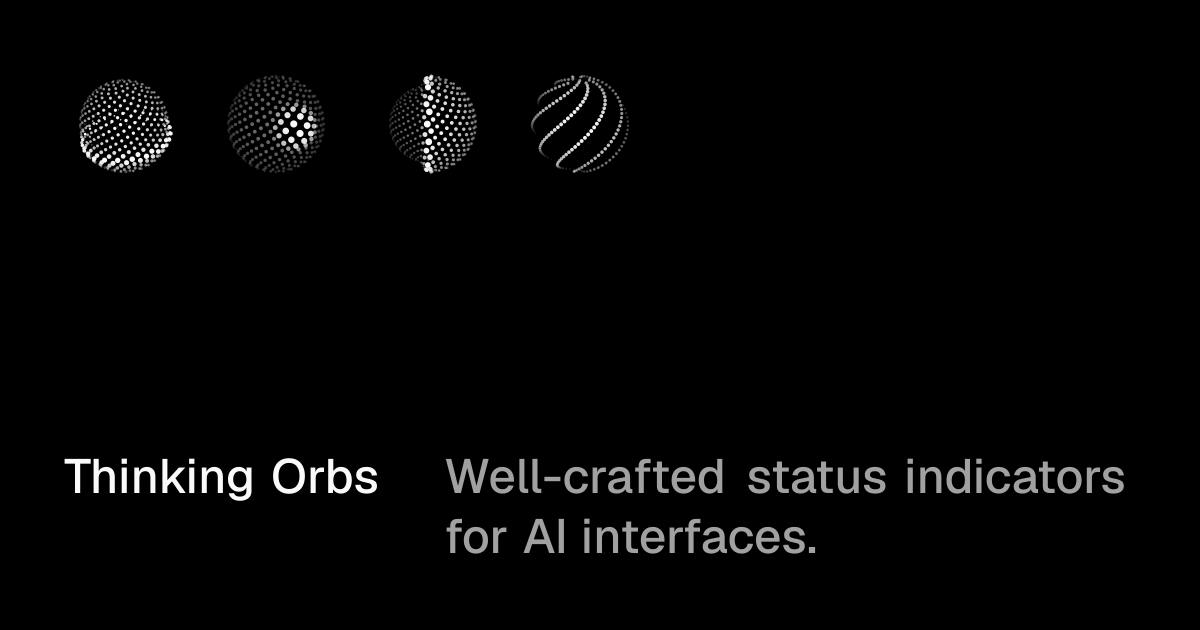
Thinking Orbs is an open-source React component library focused on AI interaction details, providing semantic animated status orbs for Thinking, Searching, and Compacting states to visually represent what an AI Agent is doing at each stage. As Agent workflows grow more complex, a single loading spinner no longer communicates enough — and building high-quality micro-animations from scratch is costly. Thinking Orbs packages these needs into plug-and-play components that balance developer efficiency with visual polish. The project earned 75 upvotes on Product Hunt, reflecting a clear industry shift from model capability toward interaction quality.
In the interaction design of AI applications, one often overlooked yet critically important detail is: what does the user see while the AI is "thinking"? A silent, blank interface breeds anxiety, while a well-crafted animated status indicator can turn the wait into something elegant. Thinking Orbs is an open-source React component library built precisely for this need.
What Problem Does It Solve
Thinking Orbs is a collection of animated status indicator (status orbs) components designed specifically for AI Agents. It provides animated orbs for states such as "Thinking," "Searching," and "Compacting," offering a visual way to communicate what an AI is doing at any given moment.
As conversational products like ChatGPT and Claude have become mainstream, users have grown accustomed to some form of visual feedback while an AI processes their request. For indie developers and teams, however, hand-crafting these micro-animations from scratch is time-consuming and prone to subtle quality issues. Thinking Orbs packages these common needs into plug-and-play components that developers can reuse immediately.
According to the project's author, Yogesh, the library was "built with attention to detail on every state and variant" — and that's precisely where animated UI components live or die. Smoothness, natural transitions, and visual consistency often define a user's first impression.
Core Features and Use Cases
Multi-State Coverage
Rather than offering a single generic "loading" animation, the library provides distinct visual treatments tailored to different phases of an AI Agent's workflow:
- Thinking: Indicates the model is reasoning or generating a response
- Searching: Indicates the Agent is retrieving external information or calling a tool
- Compacting: Indicates the Agent is consolidating context or processing data
This kind of semantic state differentiation becomes increasingly important as Agent applications grow more complex. When an AI product involves multi-step tool calls, letting users know exactly which step is happening builds far more trust than a generic spinning icon.
Compacting corresponds to a specific context management mechanism in AI Agents. Large language models have a finite context window, and when conversation history or tool call records grow too long, the Agent needs to summarize and compress past content to make room for new input. In Claude's Agent mode, this process is known as "context compaction," and the pauses users notice in the interface often happen during this phase. Surfacing this technical detail as a recognizable visual state helps users understand why things suddenly slowed down, rather than assuming the app has frozen or crashed.
Built for the React Ecosystem
As a React component library, Thinking Orbs fits naturally into today's mainstream frontend stack and can be quickly integrated into Next.js, Vite, and similar projects. For teams building AI chat interfaces, Agent dashboards, or copilot-style features, ready-made components like these can significantly cut development time.
AI Agent, as used here, refers specifically to AI systems capable of autonomously planning, executing multi-step tasks, and calling external tools — distinct from simple single-turn chatbots. A typical Agent workflow might look like: understanding user intent → breaking down subtasks → invoking tools like search, code execution, or database queries → aggregating results → generating a final response. This entire process can take anywhere from a few seconds to tens of seconds, and the reason for waiting varies at each stage. That's exactly why a single "loading" spinner no longer meets the communication needs of Agent applications, and why semantically distinct status indicators for each phase have real practical value.
Open Source and Design Resource Positioning
Thinking Orbs is listed on Product Hunt under three tags: Open Source, Artificial Intelligence, and Design Resources — a combination that neatly captures where its value lies. It serves both as a developer tool and as a reference resource for designers.
Being open source means developers can freely inspect the implementation, customize components to their needs, and even contribute new state variants. For product teams who care about brand consistency, this kind of extensibility is far more appealing than a black-box paid component.
The project earned 75 upvotes on Product Hunt and ranked #10 on its launch day. While comment engagement was minimal (just 1 comment), the vote count itself reflects genuine community demand for tooling around the finer details of AI interaction.
A Closing Observation
The emergence of Thinking Orbs reflects a broader trend: competition in AI products has shifted from model capability down to experiential detail. As the underlying large language models become increasingly commoditized, differentiation is increasingly found at the interaction layer — how to make waiting feel less anxious, how to make AI states perceptible, how to make interfaces feel more human.
A tiny animated orb may seem trivial, but it's precisely the bridge that "humanizes" an otherwise cold inference process. From this perspective, open-source projects like Thinking Orbs that focus on polishing micro-interactions are quietly filling a gap in the AI application design toolchain. For teams looking to quickly elevate product quality without sinking hours into animation details, it's well worth a try.
Related articles

Chain of Thought Isn't Just for AI: How Humans Can Use CoT to Improve Thinking Quality
Chain of Thought isn't just a prompt trick for large models. Starting from a Hacker News discussion, this article analyzes why CoT works for human thinking too, breaks down actionable ways to transfer it, and highlights the key differences between human CoT and machine CoT.
Cloudflare Teams Up with OpenAI: Closi…
Cloudflare Teams Up with OpenAI: Closing the Loop from Vulnerability Discovery to Defense with AI
Cloudflare uses OpenAI Daybreak to investigate security vulnerabilities and generate reviewable remediation plans, while developers use Codex to boost coding efficiency and quality.

Orca Multi-Agent Orchestration in Practice: A Guide to Parallel Collaboration with Claude and Codex
Orca is Stable AI's free open-source agent workbench supporting 34 agents like Claude Code and Codex in parallel. Learn its Git worktree isolation, multi-model orchestration, and mobile management.