This Electric Screwdriver Has a Camera and AI to Auto-Identify the Right Bit

Arrowmax adds a camera and AI to its electric screwdriver to auto-identify screws and recommend bits.
Arrowmax introduces a concept electric screwdriver with a built-in camera and AI that identifies screw type and size by capturing an image of the screw head, telling users which bit to use and eliminating trial-and-error bit hunting. The design is described as convenient and practical, lowering the barrier for unfamiliar users. Key specs like accuracy and battery impact remain undisclosed.
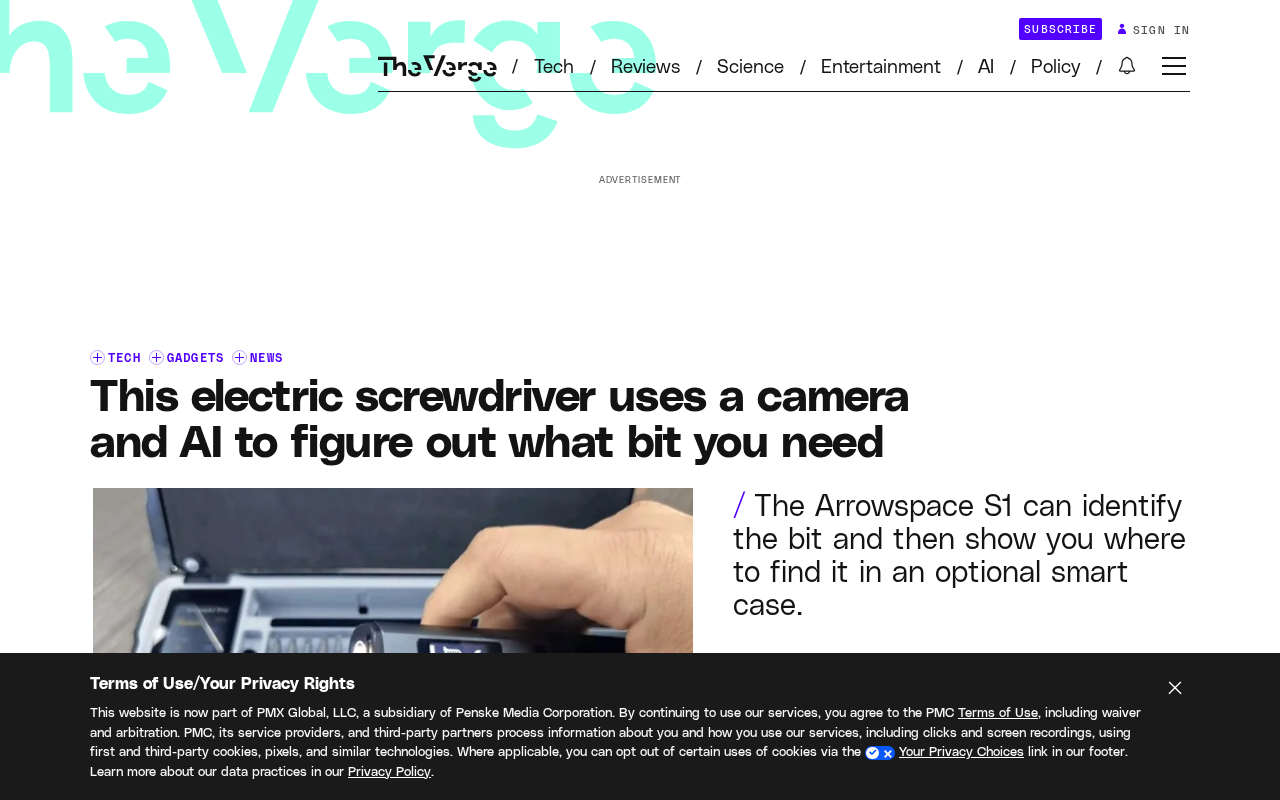
Electric screwdriver design and functionality have been evolving thanks to brands like Hoto and Fanttik, but Arrowmax wants to go further: it's adding a camera and AI to the screwdriver so it can figure out which bit you need on its own.
From "Manual Trial and Error" to "Automatic Identification"
When using an electric screwdriver, the most time-consuming part is often not the driving itself, but finding the right bit. With different specs like slotted, Phillips, hex, and Torx, users typically have to try each one until they find a match — wasting time and risking damage to the screw. Arrowmax's approach is to integrate a camera into the screwdriver, capture an image of the screw head, and let AI identify the screw type and size, telling the user exactly which bit to use. According to the original report, this design is meant to eliminate "the trial-and-error process of finding the required bit type and size."
Screwdriver bits are the interchangeable working ends of an electric screwdriver, categorized by slot type into slotted, Phillips/Pozidriv, Hex/Allen, and Torx, each with different sizes (such as PH0, PH1, PH2). When a bit doesn't match the screw's slot type and size, it can slip and spin at best, or wear down the slot into a "stripped" screw at worst — making it impossible to tighten or remove. Correct bit selection is therefore a prerequisite for using an electric screwdriver, which is exactly why Arrowmax is trying to replace human judgment with visual recognition.
Combining Convenience and Practicality
The original article describes this design as "both convenient and practical." It's convenient because it eliminates the steps of searching for and test-fitting bits; it's practical because, for ordinary users unfamiliar with tool specs, AI recognition lowers the barrier to use and reduces the risk of stripped screws or tool damage caused by using the wrong bit. Hoto and Fanttik have already proven that electric screwdrivers can combine design appeal with functionality, and Arrowmax is trying to differentiate itself through "smart" features.
The Next Step for Smart Tools
Packing a camera and AI into hand tools reflects a broader trend: AI is moving from screens into the physical world, into everyday tools and hardware. However, the original article does not disclose key details such as recognition accuracy, the number of supported screw types, or impact on battery life — factors that will determine whether this feature is a "gimmick" or a "must-have." If recognition is accurate enough and fast enough, this approach is likely to be adopted by more tool manufacturers.
Implementing screw recognition in hardware typically relies on lightweight computer vision models: first capturing an image of the screw head with the camera, then outputting the slot type and size category through object detection or image classification models. Since the screwdriver has limited onboard computing power, models often need to be quantized and compressed or rely on a paired smartphone for inference, which directly affects recognition speed and accuracy. At the same time, the camera module, lighting, and inference computation all add power consumption, placing extra demands on battery life — a key engineering constraint for evaluating whether such a solution is viable.
Conclusion
Arrowmax's AI electric screwdriver uses a camera plus AI to identify screw types, eliminating the hassle of trial-and-error bit hunting. The concept is practical, but the actual experience depends on recognition precision and response speed, and needs more real-world testing data to verify.
One-line Summary
Arrowmax adds a camera and AI to its electric screwdriver to automatically identify screw types and recommend the right bit.
Paragraph Summary
This article introduces a concept electric screwdriver from Arrowmax: as brands like Hoto and Fanttik continue to push the evolution of electric screwdriver design and functionality, Arrowmax goes further by integrating a camera and AI to identify screw type and size by capturing an image of the screw head, directly telling users which bit to use and eliminating the trial-and-error process of repeatedly test-fitting bits. The original article describes the design as both convenient and practical, lowering the barrier for users unfamiliar with specs and reducing stripped screws and tool damage. It also notes that key parameters such as recognition accuracy, the number of supported types, and impact on battery life have not been disclosed, and whether the feature is a gimmick or a must-have remains to be verified through real-world testing.
Related articles

AI Tools Quietly Altering Settings: Postman Silently Installs Plugin, Codex Sharing Option Auto-Resets
AI Daily reports: Postman silently installs a Mac plugin and self-approves startup hooks, logged as auto-existing upgrade; Hacker News developers say Codex data-sharing opt-out flips back. Plus Simon Willison's raw float weight experiment with QEN 3.8-27B.

AI Learns to Rewrite AI: MIT's "Weightspace Programming" Redraws the Path to Recursive Self-Improvement
MIT team proposes weightspace programming: GPT-6 Astra reads and edits AI model weights directly. Math scores jump several-fold, hand-written networks beat trained models. Eight experiments analyzed, plus Anthropic's same-day warning and the real boundaries of recursive self-improvement.

Running Qwen 3.8 on a Laptop to Read Raw Weights: 46 Minutes Per Answer
Simon Willison reproduced weight space programming with Qwen 3.8 27B on a laptop: a 17GB model file, 46 minutes per answer, 43,506 reasoning tokens, Pong over an hour, Freeway failed. Suited for interpretability researchers.