THOT: Solving Long-Context Dilution with Topology Hub Optimal Transport
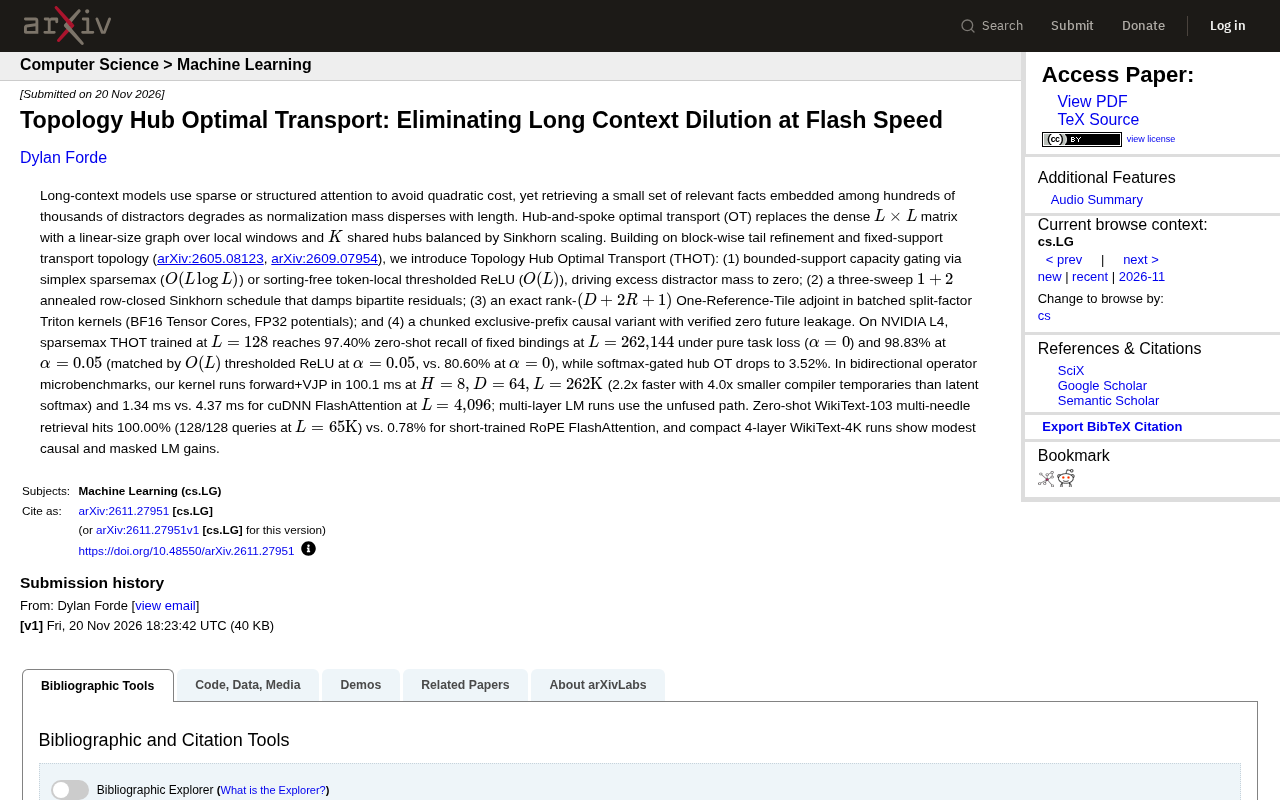
THOT uses linear hub graphs and sparse gating to replace dense transport matrices, mitigating long-context attention dilution at the transport-capacity level.
The article interprets the paper's Topology Hub Optimal Transport (THOT), arguing that long-context retrieval degradation stems from softmax normalization mass dispersing onto distractor tokens as sequences grow. THOT replaces the dense L×L transport matrix with a linear-scale graph of local windows plus K shared hubs, combined with bounded-support gating, annealed Sinkhorn scheduling, and a Triton kernel. Sparsemax gating achieves 97.40% zero-shot recall at L=262K versus 3.52% for softmax gating, and kernels are 2.2× faster than latent softmax on long sequences. The article notes the 100% vs 0.78% WikiText-103 comparison is out-of-distribution, and multi-layer LMs use a non-fused path, adding deployment complexity.
A hidden bottleneck in long-context models is being re-examined: when key information is buried among hundreds of thousands of tokens of distractors, the normalization quality of attention mechanisms degrades with length, causing retrieval accuracy to plummet. A new paper proposes Topology Hub Optimal Transport (THOT), which attempts to solve this problem at the level of transport topology rather than continuing to make incremental patches to sparse attention patterns.
The Essence of Long-Context Dilution: Dispersal of Normalization Mass
Although sparse or structured attention avoids the quadratic computational cost, the task of retrieving a few relevant facts does not become easier as a result. The core problem identified by the paper is that as sequence length grows, the mass of softmax normalization spreads across a large number of distractor tokens, and the truly relevant signal is diluted during normalization.
This explains why some long-context models perform inconsistently on "needle-in-a-haystack" tasks—it is not that the model fails to see the key information, but that the attention weights are spread too thin to form a sufficiently sharp focus. THOT's entry point is to replace the dense L×L transport matrix with a linear-scale graph structure: local windows plus K shared hubs, balanced through Sinkhorn scaling. This approach builds on prior work on block-level tail refinement and fixed-support transport topologies (arXiv:2605.08123, arXiv:2609.07954).
Sinkhorn Algorithm and Optimal Transport: Optimal Transport studies how to move the mass of one probability distribution to another at minimum cost; in the attention context, it treats the attention weights from query to key as a transport plan that must satisfy row and column marginal constraints. Sinkhorn iteration alternately performs row normalization and column normalization on the transport matrix (i.e., multiplying by diagonal scaling matrices), causing any positive matrix to converge to a doubly stochastic form that satisfies the marginal constraints; it is essentially a first-order iterative solution to the entropy-regularized optimal transport problem. Its advantages are differentiability and ease of embedding into neural networks; the cost is that multiple passes are needed for convergence, and the longer the sequence and the denser the transport plan, the harder it is to control the iteration overhead and numerical residuals. THOT replaces the dense L×L transport matrix with a linear-scale hub graph and designs an annealing schedule for row closure, precisely to retain Sinkhorn's differentiable properties while suppressing bipartite-graph residuals and convergence instability on long sequences.
Three Core Mechanisms
THOT's design contains three cooperating components, all aimed at driving excess distractor mass to zero.
Bounded-support capacity gating: Implemented via simplex sparsemax (complexity O(L log L)) or order-free token-local thresholded ReLU (O(L)). The role of gating is to actively truncate the transport capacity of distractors rather than letting them take a share during normalization.
Three-scan 1+2 annealed row-closure Sinkhorn schedule: Used to suppress bipartite-graph residuals. Sinkhorn iteration is common in transport problems, but the schedule here is annealed specifically for row closure, making convergence more stable.
Exact-rank (D+2R+1) single-reference tile adjoint: Implemented in a batched split-factor Triton kernel, using BF16 Tensor Cores and FP32 potentials. There is also a block-exclusive prefix causal variant, empirically verified to have no future-information leakage.
Sparsification differences between sparsemax and thresholded ReLU: Ordinary softmax assigns non-zero probability to all candidates during normalization, even when most candidates are irrelevant to the query; sparsemax replaces softmax's entropy regularization with a Euclidean projection onto the probability simplex, whose solution naturally has sparse support—exact zeros appear in the output, and it can be implemented via O(L log L) sorting. Thresholded ReLU is a more aggressive approximation: scores are truncated with a token-local threshold, passed through ReLU, and then normalized, reducing complexity to O(L) with no global sorting; however, the threshold is local and lacks global competition, so under pure task loss (α=0) it is more prone to losing key signals. This explains the difference in the paper where sparsemax maintains 97.40% recall at α=0 while thresholded ReLU drops to 80.60%: whether the gating function has global sparse competition directly determines whether distractor mass can truly be driven to zero.
Performance Data: The Gap Between Sparse Gating and Softmax
The comparison presented in the paper is quite convincing. On an NVIDIA L4, after training at L=128, sparsemax THOT achieves 97.40% zero-shot fixed-binding recall at L=262,144 (pure task loss α=0), and 98.83% at α=0.05. O(L) thresholded ReLU performs comparably at α=0.05 but drops to 80.60% at α=0.
The gap versus the control group is stark: hub OT with softmax gating falls to 3.52% under the same conditions. This shows that the choice of gating function is not an engineering detail but a key variable determining whether long-context retrieval can work at all—softmax's global normalization is precisely the source of dilution.
On kernel microbenchmarks, the bidirectional operator forward plus VJP takes 100.1ms at H=8, D=64, L=262K, 2.2× faster than latent softmax, with 4.0× smaller compiler temporaries. At L=4,096, it is 1.34ms versus 4.37ms for cuDNN FlashAttention. It should be noted that multi-layer language model runs use the non-fused path.
VJP and Triton kernels: VJP (vector-Jacobian product) is the core operation in reverse-mode automatic differentiation that computes the product of gradients and vectors; whether a forward operator can efficiently support VJP determines whether it can be embedded in end-to-end training rather than used only for inference. The reported "forward plus VJP" timing therefore reflects training usability better than forward-only timing. Triton is a Python-like kernel programming language for GPUs that allows developers to hand-write tile-level parallel kernels and reuse Tensor Cores; "batched split-factor" in the text refers to splitting the transport operator along batch and factor dimensions and completing multiple computation steps within a single kernel to reduce memory round-trips. Using BF16 Tensor Cores for matrix multiplication and FP32 for potentials is a trade-off between throughput and numerical stability—if Sinkhorn's scaling factors are accumulated in low precision, residuals can easily be amplified over long sequences.
Extreme Contrasts on Retrieval Tasks
Zero-shot WikiText-103 multi-needle retrieval reaches 100.00% at L=65K (128/128 queries), while short-trained RoPE FlashAttention reaches only 0.78%. This comparison should be interpreted cautiously: the latter is trained on short sequences and directly extrapolated to long sequences, which is an out-of-distribution setting rather than a fair comparison under equal training conditions. Nevertheless, it still reveals the fragility of RoPE positional extrapolation in ultra-long contexts.
Compact 4-layer WikiText-4K experiments show moderate gains for causal and masked language modeling, indicating that the method is not limited to retrieval-type tasks, though the magnitude of the gains is far less significant than in long-context settings.
Trade-offs Worth Noting
THOT's value lies in reframing the long-context dilution problem from "attention pattern design" to "transport capacity allocation." The hub structure reduces computational complexity to linear, while sparsemax or thresholded ReLU gating directly cuts off the transport channels of distractors. The cost is the introduction of additional hyperparameters (number of hubs K, gating temperature, Sinkhorn scan schedule), and multi-layer LMs must use the non-fused path, so the engineering complexity of actual deployment is not low.
Another point to watch is the relationship between training length and extrapolation length. In the paper, training at L=128 is sufficient to maintain high recall at L=262K; if this extrapolation capability can be reproduced on more task types, it would be highly significant for long-context training costs. Currently, public validation is concentrated on retrieval and language modeling microbenchmarks, and performance on larger-scale real tasks still requires more evidence.
One-line Summary
THOT replaces dense transport matrices with linear hub graphs and sparse gating, mitigating long-context attention dilution at the transport-capacity level.
Paragraph Summary
This article interprets the paper's proposed Topology Hub Optimal Transport (THOT), pointing out that the root cause of long-context retrieval degradation is not that the model fails to see key information, but that softmax normalization mass disperses onto a large number of distractor tokens as sequence length grows, preventing attention from forming a sharp focus. THOT replaces the dense L×L transport matrix with a linear-scale graph structure of local windows plus K shared hubs, combined with bounded-support capacity gating, a three-scan annealed Sinkhorn schedule, and a Triton kernel implementation to actively truncate distractor transport capacity. Experiments show that sparsemax gating achieves 97.40% zero-shot recall at L=262K, while the softmax-gated version reaches only 3.52%; the kernel is 2.2× faster than latent softmax on long sequences. The article also cautions that the WikiText-103 comparison of 100% versus 0.78% is an out-of-distribution setting, and that multi-layer LMs use the non-fused path, with additional hyperparameters increasing deployment complexity.
Related articles

AI Daily: OpenAI and Anthropic Both Publish VP≠VNP Proofs on the Same Day
AI Daily roundup: OpenAI and Anthropic both publish machine proofs of VP≠VNP on the same day, Anthropic breaks below its IPO price, GPT-6 achieves a 10.9% wet-lab hit rate in native protein design, Magic 2 and SWE 2.1 launch, Google Workspace MCP opens, agent safety tests and the purge of pure AI songs advance together.

GPT-6 Protein Design Sparks Debate: Can General Models Replace Specialized Biological Models?
OpenAI preprint shows GPT-6 series attempts protein design via general reasoning—about 10% of 300+ designs show binding signs, but screening still relies on specialized models. Plus Anthropic Siren evaluation, Meta assistant as entry point, and TIDAL removing pure AI music.
Anthropic Breaks IPO Price, GPT-6 Designs Proteins Autonomously: AI Bubble Alarm Sounds
Anthropic falls below its $83 IPO price four days after listing, wiping out all gains from the largest IPO ever; OpenAI paper shows GPT-6 autonomously designing proteins validated in labs; Claude Ship can fix code and approve. A quick look at key AI industry moves and capital signals.