ThoughtDAG: Reimagining LLM Conversation Context Management with DAG Graph Structures

ThoughtDAG uses DAG structures to make LLM conversation context editable, branchable, and mergeable.
ThoughtDAG is an open-source project that reimagines LLM conversation management by replacing linear message chains with editable Directed Acyclic Graphs (DAGs). This approach enables users to branch, prune, and merge context nodes, offering fine-grained control over what information the model sees. It represents a concrete step toward structured Context Engineering at the interaction layer, addressing limitations of linear conversations like attention dilution and context pollution.
When Linear Conversations Hit a Bottleneck
Today's mainstream large language model (LLM) interaction paradigms are built almost entirely on a simple assumption: conversations are linear. The user types a message, the model responds, and so on. The entire context is organized as an ever-growing chain of messages, stuffed into the model's context window. This design is intuitive and easy to understand, but it reveals obvious limitations in complex thinking scenarios.
An LLM's Context Window refers to the maximum number of tokens the model can process in a single inference pass. Early GPT-3.5 supported only 4K tokens, while today Claude supports 200K and Gemini supports million-level tokens. But even as windows continue to expand, linearly stacking all historical messages still causes attention dilution—research shows that models' attention to information in middle positions drops significantly (the "Lost in the Middle" problem), causing critical context to be buried in lengthy histories. Moreover, token consumption under linear structures is cumulative: every request requires retransmitting the entire history, increasing both inference latency and API call costs significantly.
When you're discussing a multi-branch technical approach with a model, or repeatedly switching topics and correcting assumptions in a long conversation, the linear structure falls short. Early incorrect assumptions pollute all subsequent outputs; wanting to return to a key node and branch off again often requires manually rebuilding context by scrolling through history or copy-pasting. ThoughtDAG, a project that recently appeared on Hacker News, addresses precisely this pain point—using an editable Directed Acyclic Graph (DAG) to manage LLM conversation context.
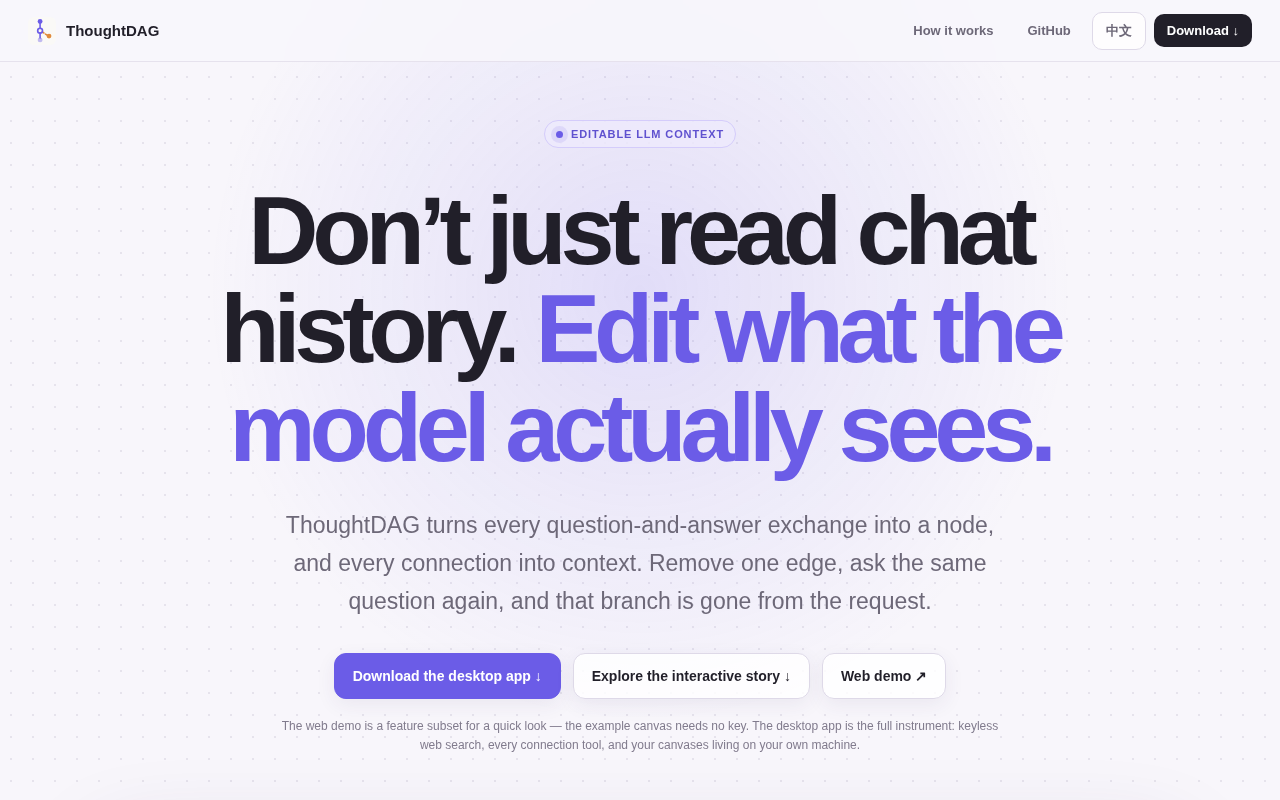
What Is ThoughtDAG: From Message Lists to Context Graphs
The core concept is evident from the name: ThoughtDAG = Thought + DAG (Directed Acyclic Graph). It restructures an LLM conversation from a traditional "message list" into an editable context graph. In this graph, each node represents a thought, a message, or a context fragment, and nodes are connected by directed edges expressing their dependency and derivation relationships.
A Directed Acyclic Graph is a fundamental data structure in graph theory, consisting of vertices and directed edges, with no cycles. DAGs have extremely broad applications in computer science: Git's version control system uses DAGs to manage commit history, making operations like branching, merging, and cherry-picking possible; Apache Airflow uses DAGs to orchestrate task dependencies in data pipelines; compilers use DAGs for common subexpression elimination and optimization. The core advantage of DAGs is their support for Topological Sort—arranging all nodes into a linear sequence such that for every directed edge (u, v), u appears before v. This property guarantees orderly processing of dependencies without deadlocks or circular dependencies—and it's the key reason ThoughtDAG chose DAGs as its foundational structure.
The project was published on the Hacker News community in "Show HN" format, a typical way for developers to showcase their work. Show HN is a special posting category on Hacker News that requires the poster to be the project's creator or core contributor, and the project must be a concrete result that can be experienced or viewed. This mechanism has incubated many later-successful products (Dropbox, for example, initially gained early attention through the HN community). The community's technical discussions are high-quality, feedback is usually direct and sharp, making it an important channel for indie developers to validate idea feasibility. While ThoughtDAG's community traction is still in its early stages, the problem it addresses is a direction of widespread concern in the current LLM application layer.
Why DAG Rather Than a Tree or General Graph
Choosing a DAG over a regular tree or graph reflects clear engineering considerations:
- Directedness: Clearly expresses the flow direction and dependency relationships of context—which content serves as a prerequisite for which is immediately apparent.
- Acyclicity: Prevents circular references between context fragments, ensuring the graph structure can be topologically sorted and linearized when fed to the model.
- Branchability: A single node can spawn multiple child nodes, naturally supporting the thinking pattern of "exploring multiple approaches from the same premise."
- Mergeability: Unlike tree structures, a node in a DAG can have multiple parent nodes, meaning conclusions from different exploration branches can converge into a single node, expressing the cognitive pattern of "synthesizing multiple threads to reach a new conclusion."
Compared to linear chains, DAG structures more closely mirror how humans actually think—our thinking is rarely purely linear, but rather filled with branching, backtracking, and merging.
Core Value: Making LLM Conversation Context Editable
The most noteworthy keyword for ThoughtDAG is editable. In traditional conversations, context is a read-only historical record, and users have almost no way to intervene in what the model "remembers." ThoughtDAG transforms context into a directly manipulable object.
Fine-Grained Context Control
Leveraging the graph structure, users can theoretically perform the following operations:
- Pruning nodes: Delete outdated or erroneous context fragments to prevent them from continuing to influence generated results.
- Reorganizing branches: Merge thinking outcomes from different branches, or fork anew from an intermediate node.
- Selective injection: When making a request to the model, select only relevant nodes as context rather than indiscriminately stuffing in the entire history.
This capability is especially important for long conversations and complex reasoning tasks. It essentially transforms "Context Engineering" from a black-box operation inside the model into an explicit operation that is visible and controllable by the user.
Context Engineering is a concept that has rapidly gained traction in LLM application development since 2024, promoted by figures like Shopify CEO Tobi Lütke in public discussions. It refers to systematically designing, selecting, and organizing the context information fed to a model to maximize output quality. Unlike Prompt Engineering, which focuses on instruction wording, Context Engineering addresses the more fundamental question of "what information the model sees." RAG (Retrieval-Augmented Generation), memory systems, and dynamic context compression all fall under Context Engineering. The industry generally believes that as base model capabilities converge, the quality of context management will become the core differentiator for AI applications. ThoughtDAG can be seen as a concrete attempt at Context Engineering at the interaction layer—returning the context orchestration logic that was previously hidden in the system backend directly to user control.
Comparison with Mainstream Interaction Paradigms Like ChatGPT and Claude
Most current LLM products (such as ChatGPT and Claude's web interfaces) support branching conversations (regenerate, edit message), but these features are often shallow capabilities hidden behind the interface, making it difficult for users to have a clear grasp of the overall context structure. Specifically, ChatGPT's edit message feature creates a new branch from the edit point, but users can only switch between different branches at the same node via arrows—they cannot merge content from two branches or introduce one branch's conclusions into another. Claude's interface is similar, supporting regeneration but not exposing the complete branch tree structure. Some third-party tools like TypingMind and Lobe Chat offer more flexible conversation management but still rely on tree structures—in a tree structure, each node has only one parent, making it impossible to express the merge semantics of "an idea that simultaneously depends on conclusions from two different branches."
ThoughtDAG's approach is to fully expose this "mind map," letting users edit conversation context like editing a mind map. DAGs allow multiple parent nodes, enabling expression of more complex thought convergence relationships—a fundamental upgrade over existing branching conversation features.
Potential Use Cases for ThoughtDAG
Although the project is still in its early stages, its design philosophy points to several concrete use cases:
Multi-approach exploration of complex problems: When doing architecture design or product decisions, you often need to evaluate multiple approaches in parallel based on the same background. The DAG structure allows each approach to exist as an independent branch without mutual interference, with comparison or merging at the end. For example, when evaluating microservices vs. monolithic architecture, you can branch from the same requirements description node into two paths, have the model analyze the pros and cons of each in depth, and ultimately merge key conclusions from both branches into a decision node.
Long document and research workflows: When writing research reports or long-form content, you can organize different chapters and arguments as nodes, dynamically adjusting the context fed to the model to circumvent context window limitations. This approach is similar to the Zettelkasten method in academic writing, where each card is an independent knowledge unit linked together to form a network.
Prompt iteration and debugging: When debugging prompts, developers can precisely control which context is injected at each step, making it easier to locate the root cause of anomalous model outputs. When the model produces unexpected output, you can remove or replace parent nodes one by one, performing "binary search"-style debugging to quickly identify which context fragment caused the problem.
Team collaboration and knowledge management: In multi-person collaboration scenarios, different team members can contribute their thinking nodes on the same DAG, forming a structured expression of collective intelligence while avoiding redundant conversations and information silos.
Significance and Limitations: From Conversational UI to Structured Context Management
ThoughtDAG represents an emerging trend: moving from "conversational UI" to "structured context management." As models become more capable and individual tasks grow more complex, simple linear chat boxes can no longer support real knowledge work. Making context explicit, structured, and editable is a natural path toward improving LLM usage efficiency.
This trend is highly aligned with the development direction of AI Agents. In Agent architectures, task planning, tool calls, and intermediate results all need to be organized into structures with dependency relationships, rather than simple sequential execution. Tools like LangGraph (the graph-structured orchestration framework in the LangChain ecosystem) and CrewAI already use graph structures to manage Agent workflows on the backend. ThoughtDAG's unique contribution is pushing this structured management capability to the frontend interaction layer, letting human users directly participate in constructing and editing the graph structure.
Of course, as an early-stage project that just appeared on Hacker News, ThoughtDAG is currently more of a concept validation than a mature product. It faces significant real-world challenges:
- Interaction complexity: Editing graph structures is inherently more complex than linear conversation. How to reduce the user's cognitive burden is key. This may require drawing on interaction design experience from visual programming tools (such as Node-RED, Unreal Blueprint), using drag-and-drop, auto-layout, and collapsing to reduce cognitive load.
- Cognitive threshold: Whether ordinary users are willing to invest effort in "managing" a context graph, or prefer the simplicity of out-of-the-box chat, remains to be validated by the market. Perhaps the ultimate form will be hybrid—linear conversation by default, but with the ability to switch to a graph view for fine-grained operations when needed.
- Ecosystem integration: Whether it can seamlessly integrate with existing model APIs and workflow tools determines its practical ceiling. Specifically, it needs to solve DAG-to-linear-prompt serialization strategies, compatibility with streaming output, and integration with emerging protocols like MCP (Model Context Protocol).
Conclusion
ThoughtDAG's value lies not in its current maturity, but in the question it raises: As LLM conversations become increasingly complex, should we still cling to linear message lists? Reorganizing context with directed acyclic graphs and making "the structure of thought" explicit—this approach has inspirational significance for the entire LLM application layer. Regardless of how far ThoughtDAG itself goes, this kind of exploration into context management approaches is worth continued tracking by developers focused on LLM engineering and production deployment.
Related articles

Chain of Thought Isn't Just for AI: How Humans Can Use CoT to Improve Thinking Quality
Chain of Thought isn't just a prompt trick for large models. Starting from a Hacker News discussion, this article analyzes why CoT works for human thinking too, breaks down actionable ways to transfer it, and highlights the key differences between human CoT and machine CoT.
Cloudflare Teams Up with OpenAI: Closi…
Cloudflare Teams Up with OpenAI: Closing the Loop from Vulnerability Discovery to Defense with AI
Cloudflare uses OpenAI Daybreak to investigate security vulnerabilities and generate reviewable remediation plans, while developers use Codex to boost coding efficiency and quality.

Orca Multi-Agent Orchestration in Practice: A Guide to Parallel Collaboration with Claude and Codex
Orca is Stable AI's free open-source agent workbench supporting 34 agents like Claude Code and Codex in parallel. Learn its Git worktree isolation, multi-model orchestration, and mobile management.