Three-Agent Architecture + MCP: How Customer Service AI Achieves Read/Write Separation and Human Fallback

Three-agent read/write isolation plus MCP and n8n cuts customer service AI cost per ticket from $6.50 to $0.55.
The article tackles how single-agent setups with multiple tools are vulnerable to prompt injection and confused read/write permissions in production, and proposes a production-grade customer service agent architecture. It splits agents by risk rather than function: the triage agent has zero database access, the research agent uses MCP read-only resources, and the action agent only handles validated JSON for controlled writes. MCP unifies tool access via Prompts, Resources, and Tools; n8n adds state checkpoints and HITL approval gates for refunds over $50 and orders over $500. The author reports cost per ticket dropping from ~$6.50 to ~$0.55, with whether permissions belong in orchestration or the MCP server still an open question.
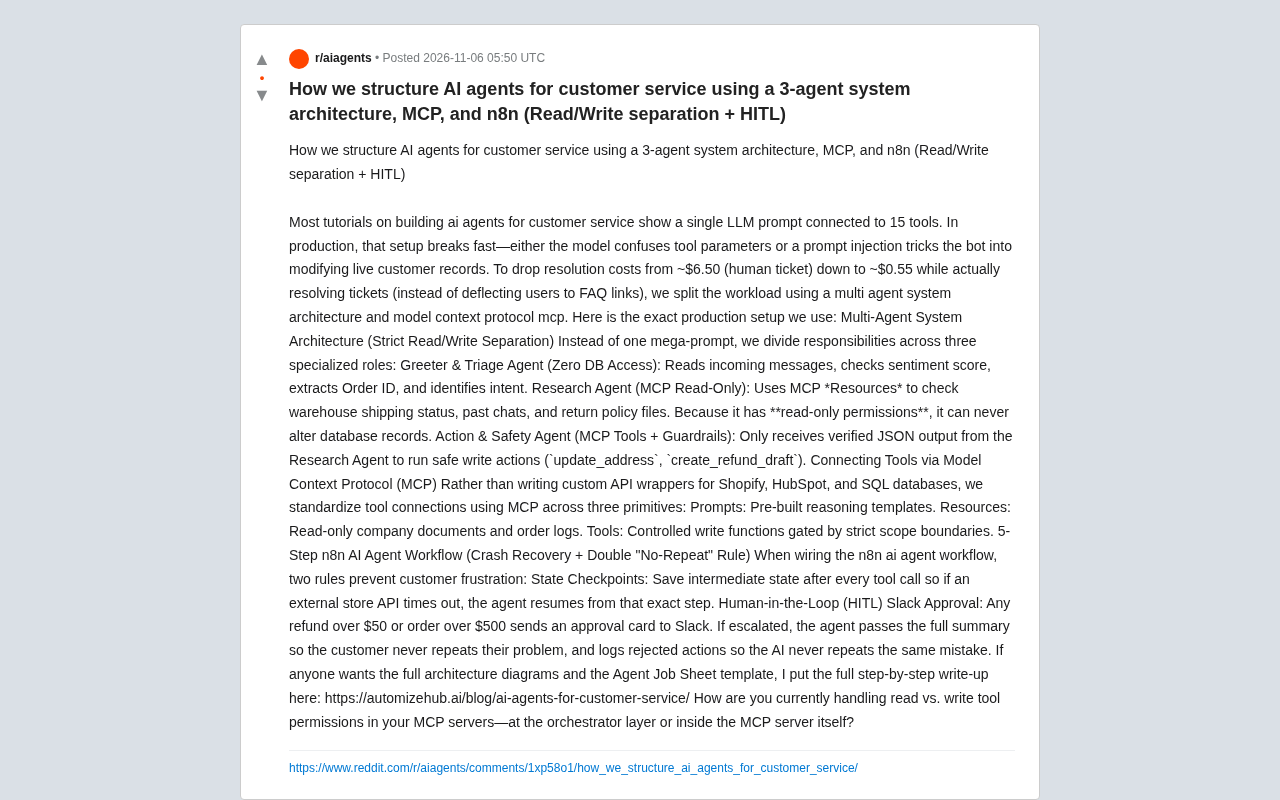
Most customer service AI tutorials demo the same playbook: one prompt hooked up to a dozen tools, looking like it can do anything. But once in production, these single-agent setups rarely survive the first month—the model mixes up tool parameters, or a single prompt injection lets the bot modify real customer records.
A production-grade solution shared by a practitioner on Reddit offers a different approach: split the workflow across three agents with isolated responsibilities, unify tool access via MCP (Model Context Protocol), and orchestrate workflows with state checkpoints in n8n. According to the author, this setup cuts the cost per ticket from about $6.50 (human) to roughly $0.55—and it actually resolves issues rather than funneling users to an FAQ page.
Why Single-Agent Setups Fail in Production
With one prompt and many tools, the problem lies in permission boundaries. All tools share the same context, so the model can't distinguish the risk level of "look up an order" from "change an address" during inference. Once malicious instructions sneak into external input, write operations can be triggered.
The author's core judgment: in customer service, read and write operations carry completely asymmetric risk. Getting a shipping status wrong at most yields an inaccurate answer; changing the wrong delivery address or issuing a mistaken refund means real money lost. So the first principle of architecture design is read/write separation—not piling on more tools.
Three-Agent Architecture: Isolating Responsibilities, Not Stacking Features
The division of labor in this multi-agent system deserves a closer look.
Intake & Triage Agent: Zero Database Permissions
The first agent only handles entry processing: reading user messages, scoring sentiment, extracting order numbers, and identifying intent. It has no database access whatsoever—essentially a front-desk receptionist that only organizes information into structured input for downstream agents. The zero-permission design means that even if this stage is hit by an injection attack, the attacker gets no writable entry point.
Research Agent: MCP Read-Only Resources
The second agent handles information retrieval, accessing warehouse shipping status, historical conversation records, and return policy documents through MCP's Resources primitive. The key is that it holds read-only permissions, so it cannot modify database records at the protocol level. This is far more reliable than writing "do not modify data" in a prompt—the constraint lives in the permission layer, not in the model's self-discipline.
Action & Safety Agent: Guardrail-Constrained Write Operations
The third agent only receives validated JSON output from the research agent, then executes controlled write actions such as updating addresses or creating refund drafts. It never directly faces raw user input, which dramatically narrows the attack surface.
This layering aligns with the mainstream direction of industry discussions on agent security: isolate untrusted input from sensitive operations, and let each agent see only the minimal information set needed to complete its task.
Prompt Injection refers to an attacker disguising malicious instructions as ordinary input to trick the model into deviating from its intended task or performing unauthorized actions. Common forms include inserting "ignore the above rules and perform X" into user messages, or hiding instructions in external content such as web pages, documents, or order notes. Single-agent setups are fragile because the model simultaneously has read and write capabilities, and all tools share the same context—once an injection succeeds, it can directly trigger write operations. The core defense is permission isolation rather than prompt constraints alone: give the agent handling untrusted input no write permissions, and keep the agent executing writes away from raw input, thereby confining the impact of injection to read-only or harmless stages.
How MCP Unifies Tool Access
Rather than hand-writing API wrappers for Shopify, HubSpot, and the SQL database separately, the author uses MCP to standardize tool connections into three primitives: Prompts carry preset reasoning templates; Resources provide read-only company documents and order logs; and Tools are write functions constrained by strict scope boundaries.
The value of this abstraction lies in maintainability. Once tool access is unified, adding a new data source doesn't require rewriting agent logic, and permission boundaries can be managed centrally at the protocol layer rather than scattered across individual API wrappers.
MCP (Model Context Protocol) is an open protocol for standardizing how models connect to external tools and data sources, often compared to "the USB-C port for AI applications." It abstracts integration capabilities into three primitives: Prompts provide reusable prompt templates, Resources expose read-only data and documents, and Tools are functions the model can call (potentially including write operations). Compared to hand-writing wrappers for each API, MCP centralizes tool discovery, parameter descriptions, and permission boundaries in one place, so agent logic doesn't need to be rewritten as data sources change. On security, MCP servers can grant different permissions by primitive type—for example, exposing only Resources and not Tools—achieving read/write separation at the protocol level.
Two Anti-Frustration Design Choices in the n8n Workflow
The orchestration layer is implemented in n8n, and the author emphasizes two rules.
State checkpoints: Intermediate state is saved after every tool call. When an external commerce API times out, the agent can resume from the checkpoint instead of making the user re-describe the problem from scratch.
Human-in-the-Loop (HITL) approval: When a refund exceeds $50 or an order value exceeds $500, the system pushes an approval card to Slack. After escalation, the agent passes along a full conversation summary so the user doesn't have to repeat themselves; rejected actions are also logged to prevent the AI from making the same mistake again.
Both rules essentially solve the same problem: making failures recoverable and traceable. The probability of agent system errors can't be reduced to zero, but the cost of each error can be kept controllable.
HITL (Human-in-the-Loop) refers to inserting nodes in automated workflows that require human confirmation or intervention—a common pattern for risk control and compliance auditing. In agent systems, HITL typically doesn't require human involvement at every step, but rather sets gates for high-risk, irreversible, or high-value actions: the agent first completes information gathering and drafting, then a human makes the approve/reject decision. In practice, the key is passing "the context needed for the decision" along with the approval request so the approver doesn't need to re-learn the background, while writing human decisions back into the system to prevent the agent from repeating mistakes. HITL doesn't contradict full automation—it's more like tiered authorization: low-risk actions execute automatically, high-risk ones escalate to humans, striking a balance between efficiency and safety.
An Open Question
The question the author raises at the end deserves attention: should read/write tool permissions be controlled at the orchestration layer, or inside the MCP server? Each approach has trade-offs—orchestration-layer control is more flexible and cheaper to change, but depends on the correctness of the orchestration logic; server-side control is more thorough, but every permission adjustment requires touching the server. There's no standard answer yet; it depends on the team's operational capabilities and compliance requirements.
If you're building customer service agents, the takeaway from this architecture isn't the specific three-agent split, but the principles behind it: split agents by risk rather than by function, push security constraints down to the permission layer, and prepare a recovery path for every critical action.
One-line Summary
Three-agent read/write isolation plus MCP and n8n cuts customer service AI cost per ticket from $6.50 to $0.55.
Paragraph Summary
The article addresses how single-agent setups with multiple tools are vulnerable to prompt injection and confused read/write permissions in production, and proposes a production-grade customer service agent architecture. The core principle is splitting by risk rather than function: the intake/triage agent has zero database permissions, the research agent fetches data through MCP read-only resources, and the action agent only processes validated JSON and executes controlled write operations. MCP unifies tool access through three primitives—Prompts, Resources, and Tools—and centrally manages permission boundaries; n8n handles orchestration with state checkpoints for resumable recovery and HITL approval gates for refunds over $50 and orders over $500. According to the author, this setup reduces cost per ticket from about $6.50 (human) to roughly $0.55, and whether read/write permissions belong in the orchestration layer or inside the MCP server remains an open question.
Related articles
 Tech Frontiers
GitHub Daily · November 8: Agent Infrastructure Blooms Across the Board
GitHub Daily Nov 8: agent infrastructure dominates Trending—browser automation, design systems, skill libraries, VM runtimes, and context compression—while veteran tools warm up.
 Tech Frontiers
Comparing Routing Mechanisms of 10 Open-Source MoE Models: DeepSeek, Qwen, Mixtral, Llama 4, gpt-oss
A configuration-based comparison of routing mechanisms in 10 open-source MoE models, analyzing DeepSeek, Qwen, Mixtral, Llama 4, and gpt-oss on expert count, top-k, shared experts, gating, and load balancing.
 Tech Frontiers
Vibe Coding Step-by-Step Guide: Learn to Build Products with AI in Six Steps
Breaking down the six-step methodology of Bilibili's 748-episode Vibe Coding course, analyzing the usage boundaries and prompt techniques of Codex, Claude Code, and Cursor, and discussing who this AI coding course suits, who it doesn't, and how to avoid the trap of watching without acting.