Three AI Giants Tested: Seedream 5.0, GPT-Live, and Grok 4.5 — A Comprehensive Breakdown

Hands-on breakdown of Seedream 5.0 Pro, GPT-Live, and Grok 4.5 across image, voice, and coding AI.
ByteDance's Seedream 5.0 Pro brings improved photorealism and editing flexibility to Chinese image generation, though complex layouts still lag behind top international models. OpenAI's GPT-Live redefines voice interaction with full-duplex audio and integrated tool-calling. xAI's Grok 4.5 targets coding and agent workflows with claimed 2× speed and 4.2× token efficiency gains over Anthropic's Opus 4.7.
Three major AI releases landed in quick succession: ByteDance unveiled its multimodal image generation model Seedream 5.0 Pro, OpenAI dropped the full-duplex voice model GPT-Live, and Elon Musk's xAI delivered Grok 4.5 on schedule. These three products cover image generation, voice interaction, and coding agents — representing three distinct frontiers in today's AI landscape. Here's a hands-on breakdown of what each one gets right, and where it still falls short.
ByteDance Seedream 5.0 Pro: A Step Forward for Chinese Image Generation
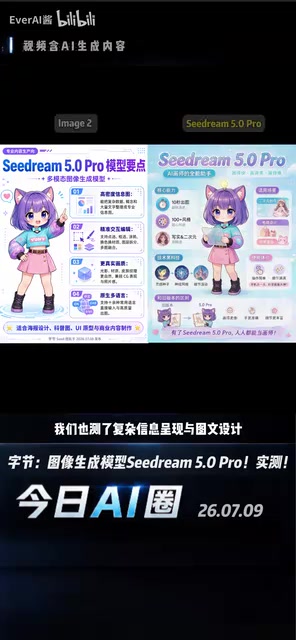
Seedream 5.0 Pro is ByteDance's latest multimodal image generation model. "Multimodal image generation" refers to AI systems that can understand and integrate multiple input signals — text, images, layout, and more — to produce visual output. Today's dominant architectures typically fall into two camps: diffusion models, which progressively denoise random noise into high-quality images, and autoregressive Transformers, which generate content token by token or pixel by pixel. Seedream 5.0 Pro continues down this technical path, and hands-on comparisons show clear improvements in photorealistic quality and stylistic range — portrait naturalness and lighting are both visibly better, making it a capable tool for everyday design work among Chinese creators.
That said, in high-complexity scenarios like infographic design and text-heavy layouts, Seedream 5.0 Pro still lags considerably behind leading international models such as Midjourney, Flux, and Ideogram. These tasks demand precise alignment across visual aesthetics, typographic rules, and natural language semantics — mastering layout hierarchy, visual structure, and information density simultaneously remains one of the inherent challenges of diffusion model architectures, and an area where Chinese image models broadly still need to catch up.
Text Rendering and Image Editing
In multilingual text generation, real-world accuracy sits at around 80%, with occasional character errors still appearing. Text rendering consistency still has room for improvement — 80% accuracy is workable, but falls short of the "zero-error" standard required for commercial production.
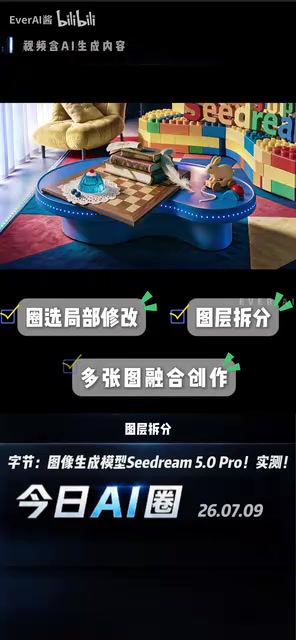
The real highlight is the flexibility of its editing features. Seedream 5.0 Pro supports region-based inpainting, layer separation, and multi-image composition. This level of fine-grained control elevates it beyond a simple "one-click image generator" into a genuine productivity tool that can integrate into real creative workflows.
OpenAI GPT-Live: A Paradigm Shift in Voice Interaction
If image model upgrades feel incremental, OpenAI's full-duplex voice model GPT-Live feels more like a leap in interaction paradigm. "Full-duplex," a concept borrowed from communications, means both parties can send and receive signals simultaneously — as opposed to half-duplex, where communication alternates between speaker and listener. Traditional voice assistants like Siri or Xiaomi's Xiaoai typically use a half-duplex architecture: voice activity detection (VAD) first determines when the user has finished speaking, then triggers recognition and response, resulting in latency of anywhere from several hundred milliseconds to several seconds per turn. That delay makes conversations feel stilted and mechanical.
GPT-Live achieves full-duplex through an end-to-end speech language model design — the model processes raw audio streams directly rather than transcribed text, enabling real-time interruption, simultaneous comprehension, and streaming output. The result is conversation that genuinely approaches the feel of talking to another person.
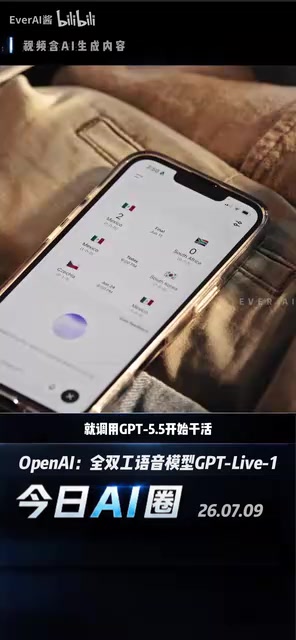
More importantly, GPT-Live isn't a standalone voice system. When faced with complex questions, it dynamically calls upon GPT-5.5 for deep reasoning, including web search and even on-the-fly generation of charts and maps. This technical direction was previewed in OpenAI's GPT-4o voice mode last year; GPT-Live takes it further by deeply integrating tool use into the conversational flow, enabling a full chain of search, analysis, and data visualization — all within a single voice conversation rather than simple Q&A.
A Real Challenge to Traditional Voice Assistants
In hands-on testing, GPT-Live maintained fluid, natural conversation throughout — the interaction experience closely approximates talking to a real person, posing a genuine challenge to traditional assistants like Siri and Xiaoai. Conventional assistants are constrained by fixed command sets and high latency, leading to fragmented user experiences. GPT-Live deeply fuses large model reasoning, tool-calling capabilities, and natural speech, effectively raising the ceiling for what an "AI voice assistant" can be.
It's reasonable to expect that full-duplex combined with tool use will become the baseline for the next generation of AI voice products, potentially elevating voice interaction from a peripheral input method to one of the primary human-computer interfaces.
Grok 4.5: Built for Coding and Agent Workflows
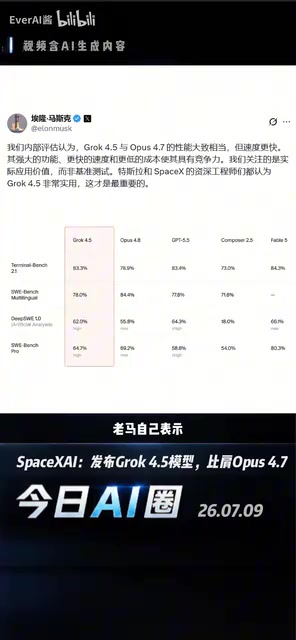
xAI released Grok 4.5 on schedule. According to Musk himself, Grok 4.5 performs on par with Anthropic's Opus 4.7 but runs roughly twice as fast and consumes 4.2× fewer tokens. To appreciate why these numbers matter, it helps to understand the economics of token usage in AI inference: tokens are the fundamental unit of inference cost, with roughly 1,000 Chinese characters equating to 1,500–2,000 tokens. In coding and agent workflows, models often need to make dozens or even hundreds of inference calls — token consumption grows exponentially, and latency compounds with each step. So the core message behind these numbers is efficiency: dramatically lower inference cost and response time while maintaining top-tier capability.
An Efficiency-First Product Positioning
Grok 4.5 is explicitly positioned as "built for coding and agents." Agent workflows refer to operating modes where AI models autonomously plan and execute multi-step tasks — for example, a full loop of code generation, debugging, and testing. The business logic behind this positioning is clear: in these scenarios, cost and speed advantages can matter just as much as raw capability. If the "4.2× lower token consumption, 2× faster" claims hold up, it means agents can complete significantly more task steps within the same budget — making large-scale automation use cases that were previously cost-prohibitive genuinely viable.
If Musk's published figures are accurate, the combination of 2× speed and 4.2× cost reduction would give Grok 4.5 a compelling price-performance advantage in agent workflows and large-scale code generation. This also reflects the broader strategic logic at play: as capability gaps between top models begin to narrow, efficiency and cost are becoming the new competitive dimensions. That said, these numbers still await independent third-party verification, and real-world performance will depend on broader developer feedback.
Conclusion: Three Parallel Fronts in AI Progress
These three near-simultaneous releases reflect three key directions in today's AI race:
- Image generation is pushing toward greater photorealism and editability. Chinese models are making steady progress, but complex design scenarios still reveal a gap with international leaders.
- Voice interaction is converging on full-duplex and tool-use integration, with experiences approaching human naturalness — reshaping the AI voice assistant landscape in the process.
- Coding agents are making efficiency the core competitive advantage, with inference speed and token cost emerging as the new benchmarks.
From incremental optimization to paradigm shifts, from capability stacking to efficiency gains — AI products are advancing on multiple fronts simultaneously. For creators and developers, this means both a richer toolkit and a greater need to critically assess each product's real capabilities and the scenarios where it truly excels.
Key Takeaways
Related articles

Qwen3 27B In-Depth Review: A Powerful Reasoner That Overthinks — and How to Fix It
In-depth review of Qwen3 27B's reasoning capabilities and overthinking problem. Analyzes performance advantages, causes of overthinking, and provides practical optimization solutions.

RL for Reasoning Only Changes 1-3% of Tokens? The Truth and Controversy Behind the Claimed 1000x Compute Savings
RL training for LLM reasoning only changes 1-3% of output tokens, with researchers claiming 1000x compute savings. We analyze the deep implications, non-uniform token distribution issues, and the gap between benchmarks and real usability.

AI Algorithm Engineer Self-Study Roadmap: A Complete Plan from Zero to Landing Your First Offer
A detailed AI algorithm engineer self-study roadmap covering foundations, core algorithms, CV/NLP direction selection, and career transition strategies for landing offers.