Three AI Pricing Shifts: Who Wins and Who Loses with Microsoft, Gemini, and Cursor

Microsoft, Gemini, and Cursor密集调整计费,AI 定价从席位转向用量。
The article reviews three billing changes occurring almost simultaneously at Microsoft, Google Gemini 4 Argon, and Cursor, noting their common direction: billing units migrating from "seats" to "usage." Starting December 1, Microsoft allows partners to sell new Copilot plans without a base subscription and enables usage billing by default; Gemini 4 Argon entered at a low price of $2 per million input tokens and $10 per million output tokens, then doubled after November 13; Cursor converged to a single plan ranging from free to $200 per month, using a shared weekly usage pool. The author argues that winning or losing does not depend on which product is chosen, but on whether billing units, price effective dates, and usage pool rules are rechecked before renewal, and recommends that teams build usage-based cost attribution capabilities.
AI tool pricing structures are undergoing a round of intense adjustments. Microsoft, Google's Gemini, and Cursor have all changed their billing methods almost simultaneously, affecting not some abstract "market price" but the bill each team will pay next month. According to a YouTube channel's review of these three changes, the core of the shift points in the same direction: billing units are migrating from "seats" to "usage," and who wins or loses depends on whether teams recheck their bills before renewal.

Microsoft: Partners Can Sell Copilot Without a Base Subscription
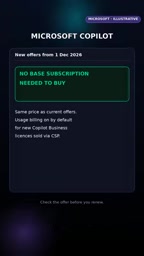
The first change comes from Microsoft. Starting December 1, Microsoft allows partners to sell new Copilot plans without requiring customers to first purchase a base subscription, while usage-based billing is enabled by default.
The significance of this change is that it removes the bundling threshold. In the past, for enterprises to access Copilot capabilities, they often had to first land on a base subscription, with a cost structure of "fixed seat fees + add-on capabilities." Now partners can directly enter with usage-based billing, reducing customers' upfront commitments but increasing bill volatility—pay more if you use more, and using less does not automatically save money, because the billing logic has shifted from "how many seats were purchased" to "how much was called."
For buyers, this means the focus of contract negotiations shifts from unit price to usage caps and alert mechanisms. For Microsoft's channel partners, sales messaging needs to shift from "bundled discounts" to "usage predictability," otherwise customers will push back after the first billing cycle.
Gemini 4 Argon: Low-Price Entry, Then Doubles
The second change is the pricing of Gemini 4 Argon. Its starting price was $2 per million input tokens and $10 per million output tokens, but the price doubled after November 13.
This is a typical "low-price window" strategy: early adopters get a lower unit cost, and after the window closes, the bill for the same call volume directly doubles. For teams that have already integrated it into production environments, this is not an adjustment that can be ignored—if usage scale is large, doubling the unit price will directly change the project's cost model and may even affect whether certain features continue to launch.
There are two approaches to respond. One is to treat the doubling point as a time for cost reassessment, recalculating the unit economics of each feature and cutting scenarios with high call volume but unclear output; the other is to retain multi-model switching capability in the architecture to avoid being locked in by a single vendor's price curve. The original text does not give the specific reason for the doubling, but from industry convention, the low-price period is usually used to accumulate usage data and lock in customers, while price reversion occurs after adoption stabilizes.
Token and per-million-token billing
In the billing context of large model APIs, a token is the smallest processing unit obtained after text is split, roughly corresponding to a word or part of a word; input tokens are the content submitted to the model, and output tokens are the content generated by the model. Because output requires token-by-token generation, computational cost is higher, so the output unit price is usually several times the input unit price—$2 input and $10 output in this article reflect that ratio. "Per million tokens" is the industry-standard quotation unit, used to compress unit prices to a magnitude that is easy to compare: an ordinary conversation may consume only a few thousand tokens, making the cost look extremely low, but once integrated into production and daily call volume reaches the million level, small decimal changes in unit price are amplified into considerable monthly spending. Understanding this is necessary to judge the real impact of a price doubling on a project's cost model.
Cursor: Converging from Multiple Tiers to a Single Plan
The third change comes from Cursor. It now runs on a single plan, with pricing ranging from free to $200 per month, and adopts a shared weekly usage pool.

Plan convergence usually brings two consequences. The good side is lower choice cost, as teams no longer need to repeatedly weigh multiple tiers; the side to watch is that a "shared weekly pool" means usage is centrally managed within the team, and a few heavy users may exhaust the entire group's quota early.
This exactly echoes the original text's definition of "losers": paying for idle seats. When billing shifts from per-head to usage pools, seats that are purchased but unused are no longer just waste—they directly encroach on the available quota of others. Teams need to re-examine members' actual usage frequency rather than continuing past seat-allocation habits.
The difference between shared usage pools and seat-based systems
A shared usage pool means the total quota purchased by the team is consumed jointly by all members, rather than each person having a fixed quota. The key difference from the traditional seat-based system lies in cost attribution: under the seat system, an idle seat is merely a wasted fixed fee and does not affect others; under a shared pool, quota is a limited resource shared by the team, and one heavy user's excess calls directly reduce the remaining balance available to others. This creates two management needs—first, usage attribution by member or project to identify who is consuming the budget; second, setting quota alerts and caps to prevent individual scenarios from exhausting the entire week's quota early. For buyers, the shared pool turns the question of "how many copies to buy" into "how much total volume to buy and how to allocate it internally," and both contract terms and usage policies need to be adjusted accordingly.
Who Wins and Who Loses: Recheck the Bill Before Renewal
Looking at the three changes together, the dividing line between winners and losers is not which vendor's product was chosen, but whether the billing method is rechecked before renewal.

Winners do this: before contract renewal, they confirm item by item the billing unit, price effective date, and usage pool rules, and incorporate the doubling point, default-enabled usage billing, and shared quota allocation into the cost model. Losers continue old habits—purchasing by seat count, continuously paying for unused seats, and only discovering after the bill arrives that the structure has already changed.
This round of adjustments also points to a longer-term trend: AI product pricing is evolving from a "subscription system" to a hybrid structure of "subscription + usage." For teams, the finance side needs to build usage-based attribution capability, otherwise it cannot determine which feature is consuming the budget; the procurement side needs to manage price terms' effective dates as contract elements rather than forgetting them after signing.
One-line Summary
Microsoft, Gemini, and Cursor密集调整计费,AI 定价从席位转向用量。
Related articles

LangChain Retry Middleware Configuration: Practices and Selection Guide
Based on Reddit community discussion, this article analyzes LangChain ModelRetryMiddleware retry parameter configuration practices, covering the selection logic and alternatives for key options like max_retries, backoff_factor, and jitter.

Texas Senate Race in Trouble: Why Are Republicans Nervous?
Texas Senate race stirs Republican anxiety. Based on street interviews, this article analyzes the Democratic offensive in funding, organization, and running everywhere, and how Republicans are defending "Texas, Texas" amid the political pendulum effect.

Gemini Chat Now Generates and Edits Google Docs Directly, a New Breakthrough in Office Productivity
Google Gemini's chat interface now generates and edits PDF, Google Docs, Sheets, Slides, Markdown, TXT, and code files. Available to all users; web supports all formats, mobile only PDF for now.