Three API Alternatives After DeepSeek's Price Hike: A Hands-On Comparison

Three tested alternatives to DeepSeek's expensive API: relay platforms, local models, and free APIs.
After DeepSeek-V4's significant API price increase, this article compares three cost-effective alternatives: OpenCodeGo commercial relay platform, local deployment of Qwen3 32B, and free API platforms like Xiaohongshu's DOS model. It also covers how to use tools like A4API to seamlessly switch between providers, with practical combination recommendations for different user scenarios.
How Much More Expensive Is DeepSeek-V4 Now?
DeepSeekAd-V4 Flash and Pro API prices have seen significant increases recently, hitting high-volume developers the hardest. According to hands-on data from a Bilibili content creator: before the price hike, roughly 380 million tokens cost only about 10 RMB, but after the increase, fewer than 6,000 tokens already cost 8.34 RMB — a staggering difference.
Based on the creator's daily usage patterns, even limiting heavy use to just a two-hour window from 2 PM to 4 PM, the costs are already substantial. Running at full intensity all day could push expenses beyond 40 RMB/day. For users who rely on APIs for daily office work and coding assistance, these costs are clearly unsustainable in the long run.
Finding more cost-effective alternatives has become an urgent priority. The creator identified three viable paths: commercial relay platforms, local deployment, and free API platforms. Let's break down each one.
Option 1: OpenCodeGo — A Commercial Relay Platform
The first approach is using a third-party commercial relay platform. There are plenty of these on the market, varying widely in quality and reliability. The creator specifically recommended OpenCodeGo for two reasons: reasonable pricing, and the platform is relatively reputable — unlikely to take your money and disappear.
The platform bills by number of requests, which in practice closely approximates token-based billing. It offers broad model coverage, from top-tier models like Grok to the DeepSeek-V4 series.
Taking DeepSeek-V4 as an example, the plan includes 7,600 requests per 5-hour window, roughly 37,000 requests per month. Pricing is approximately $5 for the first month and $10 for renewals. The creator did the math: a $5 allocation covers roughly 4 to 5 days of his usage.
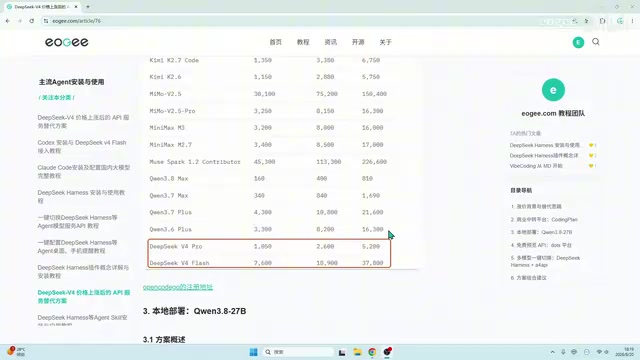
Converted out, this still offers a meaningful cost advantage over DeepSeek's official pricing. Although OpenCodeGo itself has gone through price increases, the creator believes it remains one of the cheapest Coding Plans available and is worth prioritizing as a subscription.
Option 2: Local Deployment of Qwen3 32B to Eliminate API Costs
The second option is downloading and running a model locally, completely eliminating API costs. The biggest barrier here is hardware — you need a GPU with sufficient VRAM.
The creator uses a modded 2080 GPU with 22GB of VRAM. With this setup, running Qwen3 series models locally achieves roughly 30 tokens/second. However, local deployment has several notable drawbacks:
- Limited context window: The original model supports 256K context, but local deployment is capped at 128K due to VRAM constraints.
- Lower inference efficiency: Local inference speed is far slower than cloud APIs.
- Noise issues: The GPU fan gets quite loud when running at full load.
It's particularly important to note that Qwen3 32B requires at least 16GB of VRAM to deploy. This option is better suited for users who already own a mid-to-high-end GPU — it's not recommended for those without the hardware foundation.
Option 3: Taking Advantage of Free API Platforms
The third approach leverages free quotas offered by new platforms during their promotional periods. Newly launched model platforms often provide free API access as part of their initial rollout.
The creator's example is Xiaohongshu's DOS model (DOS3 note preview), which opened free API access shortly after launch. Based on hands-on testing, the creator's verdict is: coding capabilities need improvement, but document processing and tool-calling abilities are solid enough, covering most daily office needs.
For users who don't do heavy programming and primarily need document and general office functionality, these free APIs are an extremely cost-effective choice. However, free platforms come with uncertainty around stability and long-term availability, making them better suited as a supplementary option rather than a sole dependency.
How to Flexibly Switch Between Multiple Solutions
With multiple alternatives in play, the next question becomes how to switch flexibly between different providers. The creator introduced two practical tools.
Switching Models in DeepSeek Hanis
In DeepSeek Hanis (DSH web), after launching the service, navigating to localhost:3080 and seeing the normal display confirms the service is ready.
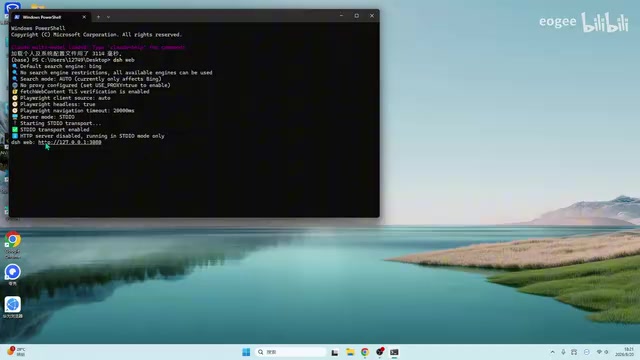
Go to Settings → Models in the lower left corner, where you'll find two buttons:
- Add Provider: Use pre-configured providers (such as OpenCodeGo).
- Custom Provider: Manually configure providers not yet listed.
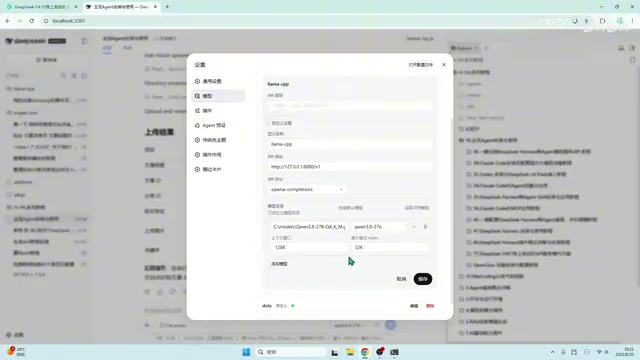
For custom configuration, you can enter any name, but the address must be verified as correct, and you need to select the right protocol — most providers support OpenAI-compatible interfaces. Using a local llama.cpp service as an example, you need to enter the model's service address (appending /v1 for the OpenAI-compatible endpoint), the model name or path, and the API key.
You also need to distinguish between two parameters: context window (total length of the entire conversation) and max output tokens (maximum output per single response) — the former is typically larger than the latter.
Using A4API Desktop Tool to Manage Multiple Models
For use outside of DSH, the creator also open-sourced a self-developed desktop management application called A4API (available as an .exe installer for local download). The configuration logic is straightforward:
- Edit Providers: Enter the name, set the correct baseurl, and select the protocol (OpenAI-compatible or Anthropic-specific endpoint).
- Configure Model Services: Set the model name (must be exact), enter the API key, and select the provider.
- Target Applications: A major advantage of A4API is that a single configuration can simultaneously cover three agents — just click save to apply.
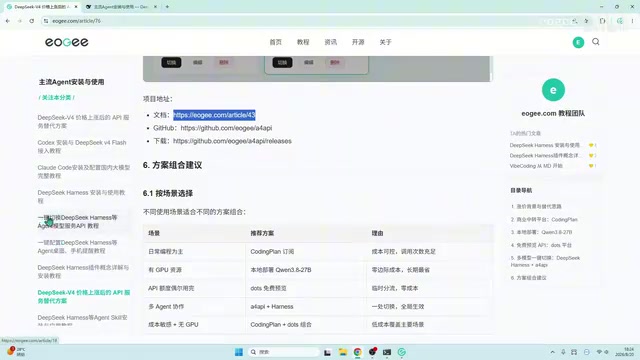
The creator currently uses A4API to call Xiaohongshu's DOS3 note preview model. Project documentation, the GitHub repository, and download links are all provided in the tutorial.
How to Choose Among the Three Options: Combination Recommendations
Finally, here are mix-and-match recommendations based on different user situations:
- Have a GPU with 16GB+ VRAM: Consider local deployment of Qwen3 32B, but be prepared to accept lower efficiency, limited context, and fan noise.
- No GPU or prefer convenience: Either use free APIs (like the DOS model) or subscribe to a cheaper Coding Plan.
- Overall recommendation: Prioritize subscribing to OpenCodeGo — despite price increases, it remains one of the most cost-effective options available.
Facing the broader trend of commercial price hikes across LLM APIs, rather than being locked into a single provider, it's better to build a multi-channel, switchable calling system. Using tools like A4API for unified management and making flexible trade-offs between cost, performance, and stability is the sustainable way to handle rising prices.
Related articles

Python 3.15 New Feature: Is the sentinel Type Better Than None?
Python 3.15 adds the sentinel type, using named unique sentinel objects to replace None and bare object(), resolving confusion among missing values, explicit emptiness, and invalid input while avoiding type hint failures.

Deep Learning's Three Architectures and the Universal Approximation Theorem: A Complete Guide to MLPs, CNNs, and Transformers
Explaining the inductive bias differences among MLP, CNN, and Transformer, the existence meaning of the Universal Approximation Theorem (UAT), and the role of Taylor expansion in approximation analysis, while clearing up common misconceptions.

GitLab Emergency Patch Release: Analysis of Critical Security Fixes
GitLab releases critical patch 19.5.1, sparking 355 points of discussion on Hacker News. This article analyzes the background, upgrade steps for self-hosted instances, and verification points to help DevOps teams respond quickly to security updates.