Three Bombs at Alibaba Cloud Expo: Qwen4, Zhenwei V900, and the 20GW Data Center Behind a High-Stakes Growth Bet

Alibaba's Cloud Expo unveiled three high-stakes "futures bombs": a trillion-parameter model, a self-developed AI chip, and a 20GW data center plan.
At the September 22 Cloud Computing Conference, Alibaba unveiled three major plans in a single day: Qwen4 targeting 5–10 trillion parameters (still in training), the Zhenwei V900 AI chip with 3x performance slated for 2027 mass production, and a 20GW global data center target by 2032 requiring an estimated 1.6–1.7 trillion RMB. Together they form a full-stack closed loop where models drive demand, chips provide supply, and data centers supply capacity. Yet all three are futures, not spot goods. Markets reacted coolly with under 2% gains, while a forward P/E of ~46x versus a trailing ~19x confirms the market views Alibaba as a high-investment growth stock, not a stable utility.
At the Hangzhou Cloud Computing Conference on September 22, Alibaba dropped three industry-shaking announcements in a single day: a next-generation Qwen large model targeting 5 to 10 trillion parameters, a self-developed AI chip called Zhenwei V900 with roughly three times the performance of its predecessor, and an infrastructure expansion plan to exceed 20GW of global data center capacity by 2032.
All three headlines pack a punch — but the real information is buried in the details. This article applies the same standard used to read financial reports: verify first, then assess the value. Let's examine whether these three bombs are spot goods or futures.
Bomb #1: Qwen4 Targets 10 Trillion Parameters
Alibaba CEO Wu Yongming stated on stage that future models will scale to 5 to 10 trillion parameters, corresponding to a next-generation Qwen model currently in full-scale training. Pay close attention to the tense here — "currently in training," not "already released." For investors, that distinction is the difference between a futures contract and a physical delivery.
What scale is 5 to 10 trillion parameters? For reference, Alibaba's own open-source flagship Qwen3.8 Max, released just this August, has 2.4 trillion parameters. Moonshot AI's Kimi K3 sits at around 2.8 trillion, and DeepSeekAd V3 — widely regarded as a domestic benchmark — has only 670 billion. If Qwen4 truly reaches 5 to 10 trillion, that would be 2 to 4 times Alibaba's own record set just last month.
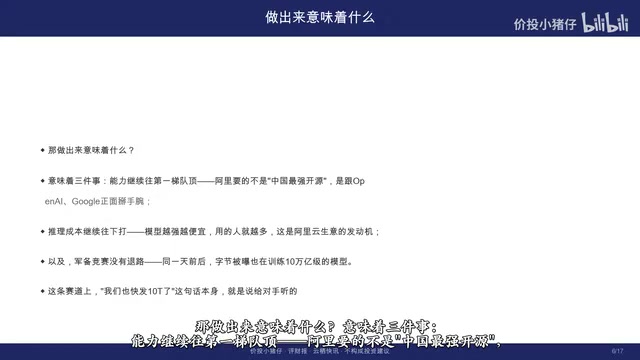
Of course, parameter count doesn't equal capability. In sparse models, total parameters and the activated parameters actually used per inference are two different things — a model with 10 trillion "potential" might only deploy 300 billion in "force" at any given time. But when the parameter race reaches these numbers, it at least signals that no one in the industry believes scaling laws have hit a ceiling yet. Reports suggest ByteDance is also training a 10-trillion-parameter-class model around the same period — in this race, the phrase "we're almost ready to ship" is a message aimed squarely at competitors.
Background: Sparse Models and MoE Architecture
Sparse models and Mixture of Experts (MoE) architecture are essential context for understanding these parameter numbers. Traditional "dense models" activate all parameters on every inference pass. MoE architecture splits a model into many "expert" sub-networks, routing each inference through only a small subset. This means a model nominally claiming 10 trillion parameters may only activate 100 to 300 billion per forward pass, with inference costs comparable to a dense model of the same activation size — while enabling far more parameters to learn more specialized knowledge representations during training. Both DeepSeek V3 (670 billion total, 37 billion activated) and the MoE variants of Qwen3 follow this approach. In any apples-to-apples comparison, "total parameters" is merely a capacity ceiling; "activated parameters" is the real bill for inference compute. When Qwen4 launches, the activated parameter ratio — if Alibaba discloses it — will be the core metric for evaluating the inference cost-performance tradeoff.
Bomb #2: Zhenwei V900 from T-Head
T-Head officially launched its next-generation AI chip, the Zhenwei V900, featuring a unified training-and-inference architecture with approximately three times the performance of the previous Zhenwei M890. It comes equipped with 216GB of memory, supports clusters scaling to 500,000 chips, and is scheduled for mass production in Q1 2027. Media headlines calling it "China's highest-performance self-developed AI chip" reflect official Alibaba language — no third-party benchmarks exist yet, so take that with a grain of salt.
The event also marked the first public disclosure of a CPU roadmap: the next-generation Yitian server chip delivers up to a 1.4x improvement in single-core performance. Cumulative Zhenwei chip shipments were updated from a previously cited 470,000 units to over 560,000, implying roughly 100,000 additional units shipped in the past six months.
The real value of the V900 isn't in the word "best" — it lies in three things: threefold performance improvement raises the cost-performance ratio of in-house chips versus external procurement; the Q1 2027 mass production timeline means this asset will remain "off the books" for the next year and a half; and with self-developed chips, self-developed models, and self-built data centers all in place, Alibaba is currently the only company in China with all three.
Background: Unified Training-and-Inference Architecture
The "unified training-and-inference" design philosophy is what most distinguishes the V900 from its predecessor. Historically, AI chips have been divided into training chips (e.g., NVIDIA A100/H100, optimized for high-throughput FP16/BF16 floating-point computation) and inference chips (optimized for INT8 low-precision, low-latency, and low-power operation). Training demands high-precision gradient computation and enormous memory bandwidth; inference prioritizes token throughput per watt. Running both workloads requires maintaining two separate hardware ecosystems, greatly increasing operational complexity. "Unified training-and-inference" means a single chip satisfies both use cases simultaneously across precision support, memory capacity, and interconnect bandwidth — simplifying procurement and reducing idle capacity. The V900's 216GB memory is designed precisely to support large-batch gradient storage during training and large model weight residency during inference. Whether it can truly avoid compromising performance on either end is exactly what third-party benchmarks should test first.
Bomb #3: 20GW Data Centers
First, let's get the framing right — Alibaba isn't building a single 20GW data center (that would be an energy catastrophe). What Wu Yongming said is that "by 2032, Alibaba Cloud's globally operated data centers will exceed 20GW in total capacity." Current Alibaba scale is approximately 3 to 4GW, meaning the company plans to multiply its compute infrastructure 5 to 6 times over the next six years.
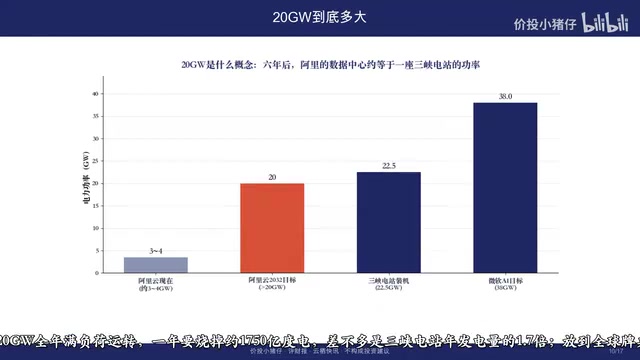
Media estimates on the day put the required investment at approximately 1.6 to 1.7 trillion RMB — a full order of magnitude larger than the "380 billion over three years" capex plan announced late last year. 20GW is roughly equivalent to the total installed capacity of the Three Gorges Dam (22.5GW); running at full load year-round would consume approximately 175 billion kWh of electricity — roughly 1.7 times the Three Gorges Dam's annual generation. For context, Microsoft's own target is 38GW — 20GW is neither outlandish nor conservative; it's Alibaba's line on the global AI arms race invoice.
Background: What "GW" Means in Data Centers
In the data center context, "GW" (gigawatt) refers to IT load power (or total power consumption adjusted for PUE), not floor space or rack count — it's the most widely used international metric for measuring hyperscale data center capacity. 1GW equals roughly one million kilowatts and can house approximately 100,000 to 200,000 high-end GPUs (depending on per-card TDP and rack density). Alibaba's current 3 to 4GW reflects the total power footprint of its existing cloud infrastructure; Microsoft's 38GW target and the tens-of-GW goals announced by Google and Amazon represent the long-term capacity plans that top global cloud providers have broadly disclosed under AI-driven demand. Notably, the 20GW figure is an "operational scale" target that includes both owned and leased facilities — not all of it represents greenfield construction. Actual capex will vary significantly based on the lease-to-own ratio, regional electricity costs, and construction timelines. The 1.6 to 1.7 trillion RMB estimate is a media rough calculation based on per-unit construction costs; Alibaba has not yet released a year-by-year capex breakdown.
Three Bombs, One Closed Loop
Put the three announcements together and they reduce to one sentence: the model is demand, the chip is supply, and the data center is capacity. The bigger Qwen4 gets, the more urgent V900 becomes; the more powerful V900 is, the more unavoidable the 20GW becomes. This is a tightly interlocked loop — and the embodiment of Alibaba's ambition to "build the full stack in-house and keep every layer of AI profit in its own pocket."
But investors have a blunt question: doesn't this transform Alibaba from a capital-light platform into a capital-heavy armaments manufacturer? Alibaba's free cash flow has been negative for several consecutive quarters. Cash on hand is approximately 470 billion RMB, while the next six years may require spending over 200 billion RMB per year. The confidence to make this bet exists — but it isn't unlimited.
Market reaction on the day was notably calm. Alibaba's Hong Kong shares closed at HK$114.8, up less than 2% — no celebration. The market's message was clear: the money goes out first, returns come later.
Why This Is a Growth Stock, Not a Utility
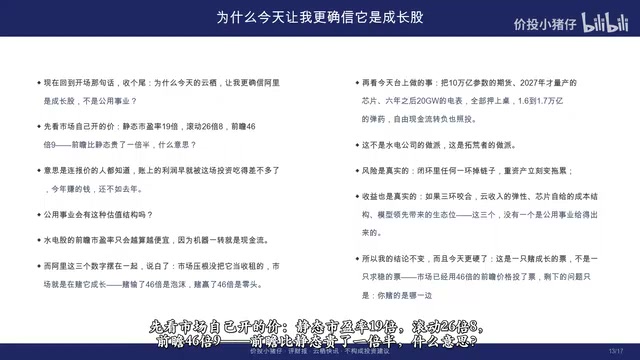
Many people treat Alibaba like a stable yield-generating "utility stock" and value it accordingly. But the valuation structure tells the opposite story: the trailing P/E is approximately 19x, while the forward P/E is approximately 46x. The forward multiple being 1.5 times more expensive than trailing means even the people setting the price know that reported earnings have been largely consumed by this investment cycle — this year's profits are lower than last year's.
Utilities don't have this kind of valuation structure. The forward P/E of a hydropower stock only gets cheaper over time, because once the turbines spin, the cash flows. But Alibaba has pushed all its chips onto the table — a 10-trillion-parameter "futures contract," a chip that won't enter mass production until 2027, a power target six years away, 1.6 to 1.7 trillion RMB in ammunition, and a free cash flow that has already turned negative. This isn't the posture of a landlord collecting rent. It's the posture of a pioneer breaking new ground. The market prices it at 46x forward earnings precisely because it's betting on growth.
Two Milestones to Watch
The risks in this bet are real: if any link in the loop breaks, heavy assets instantly become a drag. The potential rewards are equally real: if all three links mesh together, the elasticity in cloud revenue, the cost structure advantages from in-house chips, and the ecosystem position earned by model leadership are things no utility can ever deliver.
For investors, only two milestones need tracking going forward. First: when Qwen4 launches, how many capability tiers does it actually clear? That determines whether 20GW is an asset or a liability. Second: the yield rates and unit costs when V900 enters mass production in Q1 2027 — that's when T-Head's "off-the-books ledger" finally starts keeping score.
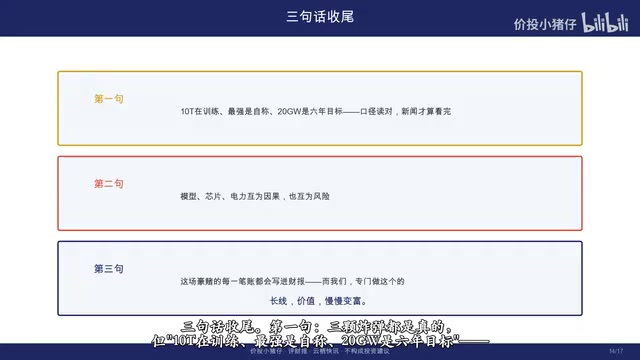
Three closing sentences: all three bombs are real, but the model is still in training, "best" is a self-declared title, and 20GW is a six-year target — reading the tense and framing correctly is what makes the news complete. Model, chip, and power are each other's cause and each other's risk — that's the formula for a growth stock. The person treating it as a utility collecting dividends and the person betting on it as a growth story are fundamentally looking at two different companies.
This article is a news analysis of publicly available information and a personal research record. It does not constitute investment advice. Company targets cited are management expectations and subject to uncertainty. Data as of September 22, 2026. Sources include Wu Yongming's Cloud Computing Conference keynote, T-Head product launch, and on-site reporting from China Securities Journal, Cailian Press, Sina Tech, and others.
Related articles

Workbuddy for Absolute Beginners: How a Desktop AI Agent Fits Into Real Workflows
A beginner's guide to the Workbuddy desktop AI agent: installation, claiming credits, file management, and building automated workflows—compared with CodeX for fit and cost, helping professionals shift from AI question-askers to AI managers.

OpenAI's New Agent Stack: Computer Use, Decisions API, and Ultra-Fast Workflows
OpenAI Dev Day unveiled a new agent stack: Computer Use outperforms humans, Decisions API delivers ultra-low-latency classification via Luna, Agents API opens the same Computer Use capabilities, and GPT-6.1 Sol costs only one-seventh of Astra. Core updates, benchmark data, and developer insights.

Liang Wenfeng Open-Sources DeepInfo Inference Framework, Takes On U.S. Ban
DeepSeek open-sources its DeepInfo inference framework after its models, featuring GPU/CPU cross-pipelining, small-model prediction with large-model verification, and full Huawei Ascend and NVIDIA chip support—facing the U.S. federal ban head-on. This article analyzes its significance for AI deployment and open-source strategy.