Three Core Principles of AI Prompt Engineering in 2026: Framework, Conciseness, and Iteration

Prompt engineering is still necessary; the core is the three methodologies of framework, conciseness, and iteration.
The article addresses whether prompt engineering is still worth learning as models grow more powerful. While the barrier to prompting has lowered from a natural language understanding perspective, it has become more important for task quality and collaboration cost. The author defines prompts as task briefs for a "senior AI colleague" and proposes three principles: framework (using COSTAR, DESC, AIDA to spot information gaps), conciseness (providing key information and cutting role-stacking noise, per OpenAI's guidance), and iteration (prompts have a lifecycle, requiring testing from 0 to 1 and fine-tuning from 1 to N, with AI reverse-questioning as an aid). The conclusion: techniques become obsolete with model updates, but methodology doesn't.
Are AI models getting so powerful that prompt engineering is no longer worth learning? This is a question many people are still wrestling with in 2026. A view from a Bilibili creator is worth considering: from the perspective of natural language understanding, prompts really aren't as critical as they used to be—you can say whatever you want, and large models will more or less figure out what you mean. But when it comes to task completion quality and collaboration efficiency, writing good prompts has actually become more important. The reason is straightforward: the more powerful the model, the higher the cost of using it. Get it wrong once, and you're wasting real money and communication time.
The Essence of Prompts: A Task Brief for Your Senior AI Colleague
The creator offers a very down-to-earth definition of prompts: a prompt is about making the AI understand "who you are, what I want to do, what I need, and what you can't do." In other words, it's a task brief that lets your "senior AI colleague" get to work immediately upon receiving it. This metaphor captures the key point—prompts aren't mystical incantations; they're the product of collaborative communication.

With that established, the next step is methodology. Drawing on their own practice, the creator distilled three core principles: framework, conciseness, and iteration.
Principle One: Framework—Structure First, Then Express
The first principle is framework. Many people are used to saying whatever comes to mind, and AI can indeed understand it—but for the person doing the writing, this approach makes it easy to overlook details. If you first structure the information fragments in your head, it becomes easy to spot where information is missing at a given node and what needs to be added.
The creator puts it precisely: structured expression isn't a requirement imposed on AI—it's a requirement we impose on ourselves. There are plenty of ready-made frameworks available to use directly, such as COSTAR for task briefs, DESC for image generation, TVSC for video, and AIDA for writing. With a framework as a foundation, you naturally know what explanations to fill in when facing complex tasks.
Frameworks like COSTAR, DESC, and AIDA essentially break a prompt into a set of fixed slots, forcing the user to fill them in one by one and thereby avoid missing key information. COSTAR typically stands for Context, Objective, Style, Tone, Audience, and Response (output format), and is suited to relatively complex task briefs. DESC is commonly used in image generation and emphasizes Description, Environment, Style, and Composition. AIDA was originally the Attention–Interest–Desire–Action model from marketing, borrowed here to organize the structure of writing prompts. The slot names differ across frameworks, but the underlying logic is the same: explicitly write out the task context, target audience, and output constraints first, then let the model perform within clearly defined boundaries. When choosing a framework, there's no need to aim for full coverage—just pick one that matches the task type and that you can remember. The key is to develop the habit of "fill the slots first, then express."
Principle Two: Conciseness—Provide Key Information, Cut the Fluff
The second principle is conciseness. Conciseness here doesn't mean fewer words. The creator gives a classic counterexample: "Help me optimize this PPT"—that's not concise, that's not writing anything at all. True conciseness means providing key information, clarifying the goal, and cutting the fluff.
Using the PPT example, the key isn't having the AI play the role of "PPT master"—it's clearly stating: who this PPT is for, where the data being reported is, and what you want the audience to take away after viewing it. Once this key information is clear, the quality of the AI's output naturally improves.
Why is conciseness effective? The creator cites OpenAI's official documentation: overly detailed prompts can introduce unnecessary noise, causing the AI's answers to become overly mechanical. So all that piling on of "you are an expert," "you've worked for X years," "you know this and that"—the official guidance explicitly says it's unnecessary.

"Noise" in a prompt refers to information that's irrelevant to the task goal but still occupies the model's attention weight. When generating a response, a large model integrates all the content in the prompt to infer intent. If role settings, credential descriptions, and emotional embellishments don't impose any substantive constraints on the final output, they may cause the model to spread its attention across these surface features, producing seemingly professional but hollow boilerplate. OpenAI's prompt engineering documentation repeatedly emphasizes that clear, specific instructions are more effective than lengthy role-playing. The reason is that modern models already possess strong instruction-following capabilities and no longer need phrases like "you are an expert in some field" to activate the relevant knowledge. To judge whether a piece of information is noise, use a simple test: if you delete it, will the output get worse? If not, it's fluff you can cut.
Principle Three: Iteration—Prompts Have a Lifecycle
The third principle is iteration, which can be divided into two levels.
Iteration from 0 to 1
The creator uses the example of making a Remuson animation: it was only usable after repeatedly testing the prompt and drawing an actual version. This shows that a first draft of a prompt almost never passes on the first try—it needs continuous adjustment based on actual output.
Iteration from 1 to N
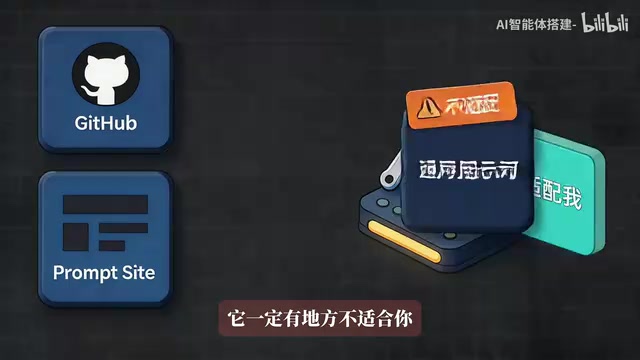
Business changes, and large models change too. Yesterday's viral structure may become ineffective tomorrow. So prompts have a lifecycle—they're not a one-time deal. From a scenario perspective, whether you get a template from GitHub or a prompt website, it belongs to someone else and will definitely have parts that don't fit you. Once you get it, you need to test it and fine-tune it based on results, turning a generic prompt into your own dedicated prompt.
If you don't have an iterative mindset, the creator offers a practical trick: let the AI interview you in reverse—use the AI's powerful reasoning ability to help you complete the prompt.
Having the AI help you write prompts in reverse is commonly called "meta-prompting." The specific approach is to tell the model your vague requirements, use case, expected output, and known constraints, then ask it to first raise several clarifying questions and generate a structured prompt based on that; you can also ask it to point out which information dimensions are missing from your current prompt. The value of this approach lies in treating the model as a collaborator rather than an executor: the model's follow-up questions often expose blind spots you hadn't considered, essentially giving you a free requirements review. In practice, you can have the model output multiple versions and explain the applicable scenarios for each, then filter and merge them based on actual test results. This iterates much faster than repeatedly trial-and-error on your own.
Methodology Outlasts Techniques
After covering the three principles, the creator concludes: this approach has been tested in practice and is an excellent structured creative thinking method—and prompts themselves are a form of creation. AI models are updating very quickly now, and technique-oriented things will soon be iterated away. Only methodology won't become outdated.
This judgment deserves serious consideration. Prompt templates will become obsolete with model versions, but the process of "think in a structured way first, then provide key information, and finally iterate continuously" holds true with any model. For those who want to truly integrate AI into their workflows, rather than collecting a pile of templates, it's better to first internalize these three principles as habits.
One-line Summary
Prompt engineering is still necessary; the core is the three methodologies of framework, conciseness, and iteration.
Paragraph Summary
The article responds to the question of whether prompt engineering is still worth learning as models grow more powerful. It argues that from the perspective of natural language understanding, the barrier to prompting has indeed lowered, but from the perspective of task quality and collaboration cost, it has actually become more important. The author defines prompts as task briefs for a "senior AI colleague," specifying identity, goals, needs, and constraints, and proposes three principles: first, framework—using structured templates like COSTAR, DESC, and AIDA to help yourself spot information gaps; second, conciseness—providing key information and cutting noise such as role stacking, citing OpenAI's official guidance that excessive detail leads to mechanical answers; third, iteration—prompts have a lifecycle and require repeated testing from 0 to 1, as well as continuous fine-tuning from 1 to N as business and models change, and you can also have the AI ask reverse questions to assist in writing. The final conclusion is that techniques will become obsolete as models update, but methodology won't.
Related articles
 Tech Frontiers
Coldframe: A Honeypot Disguised as a Supermarket Freezer Controller
Coldframe is a honeypot disguised as Danfoss AK-SM 800A and Dixell XWEB freezer controllers, built as a single Python file that detects CVE-2025-41450 attempts and is identified as real devices on Shodan.
 Tech Frontiers
GRFNet: A Lightweight PyTorch Model Designed for Multichannel Time-Series Classification
GRFNet is a lightweight PyTorch model for multichannel time-series classification, originating from EEG decoding research. With only 3,847 parameters, it is based on the ROCKET architecture, combining random convolution kernels with learnable spatial filters, supports arbitrary input lengths, and will soon be evaluated on the PhysioNet dataset.
 Tech Frontiers
CUDA-Accelerated Rocket League Simulator: A Player-Made Hardcore Experiment
A Reddit post shows a "100% Accurate" Rocket League simulator accelerated with CUDA. We analyze its technical context, CUDA's value in game physics simulation, and the significance and limitations of such community projects.