Three Free Tools to Cut Claude Code Token Waste

Three free tools each cut token waste from terminal output, verbose replies, and unused tool definitions.
The article introduces three free tools targeting Claude Code token waste, categorized by source: RTK compresses terminal output before it enters context (claimed up to 90% less content, though not a proportional bill cut); Caveman constrains reply style to reduce verbosity, only a small gain over simply writing "be concise"; Microsoft's Token Economizer learns your repo and past sessions to trim never-invoked tool definitions, delivering 18% to 31% cost reductions in testing. Together they cover input-side noise, output-side redundancy, and context baggage. The article stresses that micro skills are off by default and must be enabled manually.
In your Claude Code bill, only part of the cost may actually go toward "thinking"—the rest pays for redundant terminal output, verbose replies, and unused tool definitions. Three free tools mentioned in a short video happen to address these three different types of waste.

RTK: Slimming Down Terminal Output Before It Enters Context
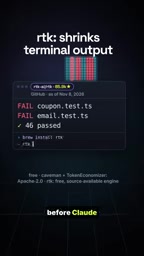
RTK's approach is straightforward: after Claude runs a command, the terminal's returned content enters the context window as-is, and much of that output is full of formatting noise, duplicate lines, and irrelevant information. RTK compresses terminal output before Claude reads it, and the official claim is that it can reduce content volume by up to 90%.
There's an easily misunderstood point here—the video specifically notes that "90% less" refers to reduced output content, not a direct 10% cut to your bill. Token consumption is also affected by input structure, cache hits, and conversation turns, but the waste at the terminal-output entry point is indeed largely plugged.
Basic mechanics of context windows and token billing
Understanding this type of tool requires distinguishing two concepts: the context window is the total number of tokens the model can see in a single request, including system prompts, conversation history, and tool return results; billing, meanwhile, prices input and output tokens separately. Once terminal command output enters the context, it becomes the input prefix for every subsequent request (unless trimmed or cached), so a verbose build log or test output may be billed repeatedly throughout the session. RTK compresses output before it enters the context, reducing the token base on the "input side" rather than the word count on the output side. This also explains why reducing terminal content by 90% doesn't equal a 10% cut to your bill—the bill is also jointly affected by cache hits, conversation turns, and output tokens.
Caveman: Making "Speaking Plainly" the Default Behavior
The second tool, Caveman, targets the problem of verbose replies. Models naturally tend to say everything, add explanations, and fill in context, but in many coding scenarios users just want the conclusion and the code. Caveman compresses output length by constraining reply style.
The author's assessment is fairly measured: compared with simply writing "be concise" in the prompt, the improvement Caveman brings is only "a small win." That judgment is quite honest—style instructions alone can solve most of the problem, and the value of tooling lies in stability and reusability rather than disruptive savings.

Token Economizer: Learning "What Not to Use" from Past Sessions
The most interesting of the three is Microsoft's Token Economizer. It isn't a static compression rule; instead, it learns from your repository and past sessions, identifies which tool definitions and capabilities you almost never invoke, and trims them from the context.
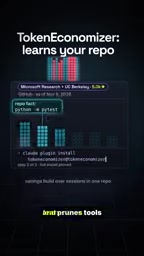
Tool definitions take up considerable space in the system prompt, especially after integrating a large number of MCP tools. In Microsoft's own testing, Token Economizer delivered an 18% to 31% cost reduction—a more substantial figure than Caveman's style compression, because it targets the fixed overhead carried in every request.
Context overhead of tool definitions and MCP
In coding agents like Claude Code, the system prompt embeds not only role instructions but also a large number of tool definitions (function calling schemas), each containing a name, description, and parameter JSON Schema. After integrating MCP (Model Context Protocol), the number of tools multiplies, because each MCP server may expose multiple tools. These definitions are repeatedly sent as a fixed prefix in every request—even if the current conversation doesn't need a particular tool at all, it still occupies input tokens. Since input tokens are typically billed by usage, and long system prompts also crowd the context window and reduce cache-hit efficiency, trimming never-used tool definitions is a direct way to lower fixed overhead. Token Economizer's value lies precisely in turning "which tools have actually been invoked" into observable data rather than relying on manual guesswork.
Turn On Micro Skills First—They're Off by Default
The video ends with a practical tip: turn on micro skills first, because these features are disabled out of the box. Many people install the tools and assume they're in effect, when in fact nothing has changed. This reminder is more worth remembering than the tools themselves—the first step to saving tokens is confirming that your token-saving switches are actually flipped to on.
The division of labor among the three tools can be understood this way: RTK handles noise on the input side, Caveman handles redundancy on the output side, and Token Economizer handles the historical baggage in the context. They don't replace each other; only used together do they cover the full chain of waste.
Related articles

Why Microsoft CEO Nadella Still Backs Nvidia After Jensen Huang's Departure
Microsoft CEO Nadella publicly expresses confidence in Nvidia interim CEO Colette Kress. This article analyzes Nvidia's power transition after Jensen Huang's departure, Microsoft's compute dependency, and the trust logic of the AI supply chain.

Nadella: Critical Infrastructure Is 'Unpatchable' as AI Cybersecurity Arms Race Escalates
Microsoft CEO Nadella addresses AI cyberattack fears, saying much critical infrastructure is unpatchable, downplaying the Outlook outage, and analyzing AI's dual role in cybersecurity.

Musk Backs Jensen Huang: Firing Him Is Like Cutting Jordan
Musk says Jensen Huang is loyal to the U.S. and likens firing him to cutting Michael Jordan—highlighting politicization anxieties in the AI chip industry and defending talent value.