Three Releases in 18 Hours: Strata Runs DeepSeek V4.1 Flash on a 12GB GPU
Strata ships three releases in 18 hours, running DeepSeek V4.1 Flash on a 12GB GPU.
The open-source project Strata iterated from 0.2.3 to 0.2.4 in 18 hours, with the highlight being DeepSeek V4.1 Flash running on a 12GB consumer GPU plus 46GB RAM. The three releases have distinct rhythms: 0.2.3 focuses on engineering optimization, speeding up tool calls by ~19%, cutting peak context usage from 83% to 61%, and officially supporting Intel Arc's SYCL backend; 0.2.3.1 fixes, within 21 hours, an installer bug that read the GPU support table character by character and crashed the Windows CUDA package; 0.2.4 achieves low-VRAM operation through three means—using RAM as VRAM, skipping redundant compute, and speculative decoding. The article also notes that speed doesn't depend on GPU price but on the CPU/memory ratio and SSD, and offers upgrade advice by user type.
The barrier to running large models locally often isn't the model itself, but the tedious engineering nobody wants to write. In the span of 18 hours, the open-source project Strata shipped three consecutive releases—from 0.2.3 to 0.2.4—turning "run DeepSeek V4.1 Flash on a single 12GB consumer GPU" from a slogan into reproducible installation steps. This release line isn't a benchmark war, but it takes apart the pain points of enthusiasts, people who can't get it installed, and those who want to run cutting-edge models—one by one.
Three Versions, Three Rhythms
Let's clarify the version relationships first: 0.2.3 is polish, 0.2.3.1 is plugging a leak, and 0.2.4 is a transfusion. According to a breakdown by a Bilibili creator, the most notable detail in these 18 hours is that the engine package stayed at 0.1.18 from 0.2.3 all the way to 0.2.4—not a single byte changed. What actually got upgraded was the outer Control layer.
This clean separation between application layer and engine layer is the precondition for daring to stack a new model family on top of a stable engine. Keep the engine stable, and new features have somewhere to land.
Layered Design of Engine Package and Control Layer
Strata's architecture is roughly split into two layers: the bottom is the engine package responsible for actual inference, and the top is the Control layer handling installation, updates, configuration, UI, and hardware detection. The two are versioned independently, meaning the engine can stay byte-identical for a long time while the application layer keeps iterating on new features. The benefit of this split: a stable inference core doesn't introduce regression risk from upper-layer changes, and adaptation for new model families and new hardware can be stacked on top of an already-validated engine. The article's statement that "the engine package stayed at 0.1.18 from 0.2.3 to 0.2.4" is a direct manifestation of this design, and also the precondition for understanding all subsequent version changes.
0.2.3: No New Models, All About Paying Off Engineering Debt
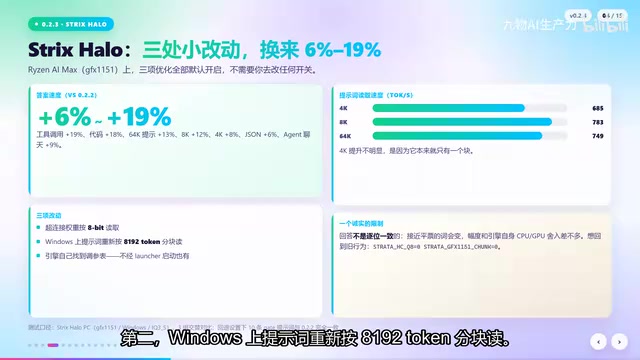
This release has no new models at all, and the verdict could be "faster where it should be fast, more stable where it should be stable." Two numbers are worth remembering: tool calls on Strix Halo got about 19% faster; peak usage when context is full dropped from 8x3 to 6x1, equivalent to an improvement from 83% to 61%.
The 19% comes from three things enabled by default: hyper-connection weights are now read at 8-bit; prompts on Windows are re-chunked at 8192 tokens; and the engine can find its own tuning table—even if you launch the engine directly without going through the launcher, performance doesn't drop. Behind this is an attitude: don't bury a trap where users "must enter through the front door." The cost must also be stated clearly: answers aren't bit-for-bit identical, and words close to the vote threshold will change, with magnitude comparable to the engine's own rounding. To revert to old behavior, two environment variables are enough.
The significance of Intel Arc isn't performance but the pipeline. After NVIDIA, AMD, and Apple, adding Intel's SYCL means all four backend lines now have officially named engine packages for the first time. Previously Arc was "you can try it yourself"; now startup and updates automatically pull and automatically verify signatures. The official team also states the boundaries clearly: this is Linux-only, and only an A750 was tested on real hardware; the B series is allowed through but not actually tested. When a project dares to write "we haven't run this card" in its release notes, it actually makes the numbers it has run more believable.
The D-Flash2 part is about restraint. Speculative decoding has a new path, but the default remains MTP, because the official team itself says no card has yet proven it comprehensively faster—it's only enabled when explicitly named in the terminal. Not giving a new feature a default value before you're confident is a valuable choice compared to products where new features are all on by default and problems are dealt with after the fact.
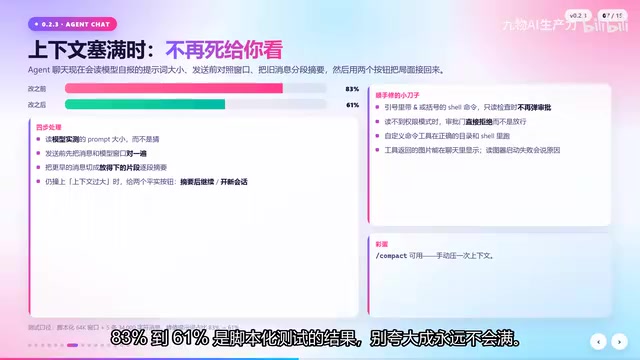
Context management is fixed as a product: read the prompt size the model reports, compare against the window before sending, cut old messages and summarize, and finally give two buttons—continue after summary, or happily draw. The 88% to 61% is the result of scripted tests; don't overstate it as never filling up. What's really worth discussing is those two buttons, which rescue people from "start over."
There are two more invisible things. On certificates: downloads behind corporate or school networks no longer throw certificate errors; the system now uniformly trusts the OS's own certificate validation, and failures give human-readable messages instead of a pile of stack traces. On defaults: answer speed on an RTX 5070 goes from 31% to 45% tok/s with the user changing nothing, thanks to 5 CPU workers plus reserving 1536MB of VRAM. The drawing cache sizes itself based on free memory, capped at 8GB; when two agents share one model, prompt reuse hits 91%, and follow-up questions go from 11 seconds to 3 seconds. What feels most noticeable is never the first answer—it's the follow-up.
Multi-Backend and SYCL
CUDA, HIP, Metal, and SYCL correspond to the compute interfaces of NVIDIA, AMD, Apple, and Intel GPUs, respectively. SYCL is a cross-platform open standard through which Intel Arc GPUs connect to the inference engine. Previously Arc users had to compile or configure manually, a "you can try it" situation; starting with 0.2.3, Strata provides an officially named engine package for SYCL, supporting automatic pulling and signature verification, elevating non-mainstream hardware from experimental support to a maintainable release line. The official team also notes it's Linux-only and only an A750 was validated on real hardware; this honesty about testing boundaries is an important signal for judging a project's credibility.
0.2.3.1: One Character Caused the Failed Install
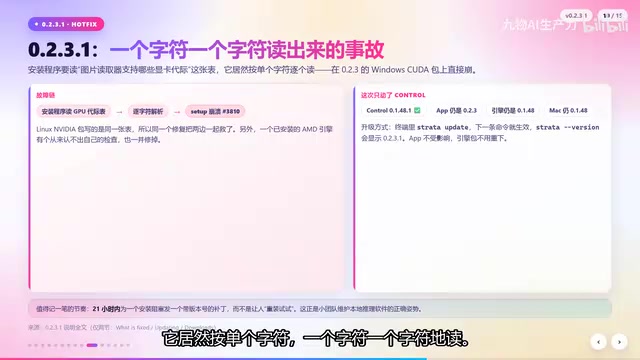
This version deserves its own section because it's a story. The installer needs to read a table listing which GPU codenames the image reader supports—and it reads it character by character, literally one char at a time. On the Windows CUDA package in 0.2.3, it crashed halfway through, installation failed, everything reset to zero. The Linux package wrote the same table, so one fix saved it twice. 0.2.3.1 was released 21 hours later, touching only Control, App, and the engine package—none of the three. The point isn't how dumb the bug was, but how fast the response was and how precise the patch was.
0.2.4: DeepSeek V4.1 Flash on a 12GB GPU
Let's state the thresholds first: disk 239–274GB, RAM 46GB minimum, GPU 12GB minimum. On quantization choices: IQ1M saves 18GB but is noticeably weaker on English prose; IQ2XS costs 17GB more but brings perplexity from 15.5% down to 7.3%—for writing code and running agents, go straight to IQ2XS. One reminder: the desktop App is still 0.2.3, and DeepSeekAd is currently terminal-only, so don't install it and then wonder why you can't find it in the desktop version.
Why can it run? Three engineering tricks. First, use memory as VRAM: the model is mixture-of-experts, each token only uses a few of thousands of small blocks, so keep the most frequently used ones in memory and read the rest directly from SSD. Second, skip useless computation: skip the computation not needed in the last 20 layers, saving about 34% on 16K prompt chunks, while 99.5% of the top-choice words across 799 positions stay the same—what's saved is wasted effort. Third, a small model helps guess: one correct guess can output several words, but on machines where the CPU is the bottleneck it actually drags things down, so it's off by default. Only all three together explain it.
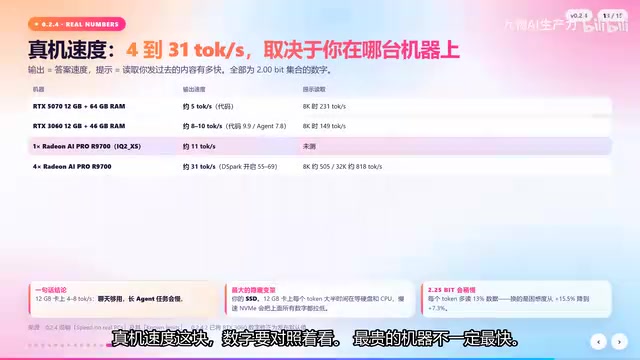
Speed numbers need to be read in context—the most expensive machine isn't necessarily the fastest. RTX 5070 gets 5 tok/s, while RTX 3060 actually gets 8 to 10—the difference is in the CPU and memory ratio, not the GPU itself. To go fast you need multiple cards: DSpark on 4x R9700-31K hits 55–69 tok/s. And one honest statement: on a 12GB card it's 4 to 8 tok/s, and agent tasks will be slow. The hidden variable is your SSD—on a 12GB card, most of each token's time is spent waiting on the disk and CPU, and a slow NVMe will drag all the numbers above down together.
Two days after release, two more fixes landed: the 0.2.4 terminal package was missing the DeepSeek preparation script, so setup got stuck at Preparing your model, fixed same-day in 0.2.4.1; 0.2.4.2 then collected a string of fixes—when using existing model files, the downloaded UD-Q8-K-XL would be judged unreadable; when the engine self-update signature feed has a new package, the next launch automatically downloads and verifies it; four launches switching three old failures are wrapped in one line, and the old engine keeps running. Two subtractions also deserve praise: DeepSeek startup no longer downloads a bunch of useless stuff along the way, and an Install S error no longer closes your terminal.
Mixture of Experts (MoE) and Quantization Levels
Mixture of Experts (MoE) is the core architecture adopted by the DeepSeek series: the model internally contains a large number of parallel "expert" subnetworks, but each token activates only a very small number of them, so actual computation and VRAM usage during inference are far lower than the total parameter count. Strata exploits this sparsity by putting rarely used expert weights in memory or even on SSD, keeping only high-frequency experts resident in VRAM. Note that MoE's "few activated parameters" does not equal "small VRAM requirement"—all expert weights still need to be stored, which is exactly why disk requirements are as high as 239–274GB.
The IQ1M and IQ2XS mentioned in the article are K-quant / I-quant quantization levels under the GGUF format; the smaller the number, the more aggressive the compression and the greater the precision loss. Perplexity is a built-in metric for measuring a language model's predictive ability—lower is better; dropping from 15.5% to 7.3% means noticeably improved coherence and accuracy in text generation, especially critical for tasks requiring precise output like writing code and running agents.
How Speculative Decoding Works
Speculative decoding is a technique that accelerates generation by having "a small model guess and a large model verify": a lightweight draft model first quickly predicts the next several tokens, then the main model verifies these candidates in parallel all at once. If the guesses are right, it can output several words in the time it would otherwise take to generate one; if wrong, it falls back to generating one by one. Its benefit depends heavily on the draft model's hit rate and hardware conditions—on machines where the CPU is the bottleneck, the draft model's own overhead can offset or even exceed the time saved, which is why Strata disables it by default in 0.2.4 and only enables it when explicitly named in the terminal. D-Flash2 is Strata's other implementation path for this mechanism, but since no GPU has yet been proven comprehensively faster, it likewise remains off by default.
Three Judgments and Recommendations by User Type
Compute has been spread across the whole computer: when VRAM isn't enough, borrow memory; when memory isn't enough, borrow SSD. Hardware support has become named packages: CUDA, HIP, Metal, and SYCL each verifiable and self-updating. Failure paths are also treated as product: port occupation, shards not found, context too large, GitHub unreachable—each one gives a reason and a next step.
Recommendations by user type: terminal users should just update; 0.2.0 Beta users need to rerun the install command once; to try DeepSeek, first check your VRAM, RAM, and disk; old AMD platforms must upgrade to 0.2.4.2, otherwise they'll be three times slower; IP users should upgrade to 0.2.4.2. 0.2.3 is worth upgrading—that's a real 31 to 45; 0.2.3.1 only fixes installation, but it's a question of whether you can install at all.
The real barrier to local AI has never been the model—it's this tedious stuff nobody wants to write. In these 18 hours, Strata turned the tedious into product.
Related articles

Ending Multi-AI Agent Collaboration Conflicts: A Practical Guide to Git Worktrees
Multiple AI coding agents overwriting each other in a shared repo? Git worktrees are the root solution. This article breaks down the isolation mechanisms and trade-offs of Claude Code, Claude Squad, Conductor, and Vibe Kanban, with selection advice.

Cognition Open-Sources Devin Vulnerability Fix Plugin; New Research on AI Coding Agent Efficiency and Cost
Cognition open-sources Devin vulnerability fix plugin for PHP, Node.js, GitLab; study finds coding agent tool complexity decoupled from success rate with triple costs; Microsoft Agent Grid supports 1,024 agents without central coordination; Entropic releases containerless sandbox; Python 3.15 adds sampling profiler.

AI Agents Buying Their Own Servers: The Automation Revolution of MCP and VPS
Explore how AI agents autonomously buy VPS servers via MCP: ClaudeCode connects to EQVPS, prepaid crypto top-ups, autonomous ordering, and confirmation before destructive ops.