AI Agents Buying Their Own Servers: The Automation Revolution of MCP and VPS
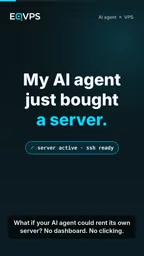
EQVPS lets ClaudeCode autonomously buy and operate VPS servers via MCP, with prepaid crypto as the payment base for the agent economy.
The article covers EQVPS's YouTube demo of MCP integration: ClaudeCode connects to the EQVPS backend via MCP, letting the agent autonomously register, select a plan, order, and pay for a VPS. Users top up once with crypto, no KYC required; afterward the agent procures within the balance and delivers SSH access in about a minute. The agent handles routine ops autonomously but asks before destructive actions. This shows MCP's potential as a universal interface for agents to call external services, moving them from advisors to executors—though enterprises still need finer budget control and auditing.
Title
AI Agents Buying Their Own Servers: The Automation Revolution of MCP and VPS
Meta Description
Explore the complete process of an AI agent autonomously purchasing a VPS server through the MCP protocol: from ClaudeCode connecting to EQVPS and prepaid crypto top-ups, to the agent placing orders on its own, monitoring servers, and asking the user before destructive operations. An analysis of the payment foundation and security boundaries of the agent economy.
Article Content
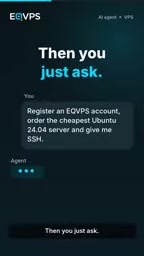
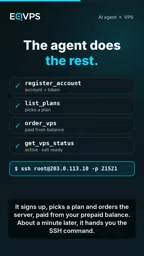
Can an AI agent rent its own server? With a single command connecting ClaudeCode and the EQVPS MCP server, all you have to do next is ask. It automatically registers, picks a plan, places the order, and deducts payment from the prepaid balance. About a minute later, the SSH command is in your hands. The only thing you need to do is top up once with cryptocurrency — no KYC required. After that, the agent orders on its own and asks you before performing any destructive operation. It can also restart, rename, and monitor servers. EQVPS lets servers buy themselves.
From "People Finding Servers" to "Servers Finding Agents"
Traditional VPS procurement is a typical human workflow: open the console, compare prices, fill out forms, pay, wait for an email. The MCP integration demonstrated by EQVPS in a YouTube video compresses this chain into a single natural-language instruction. Once ClaudeCode connects to the EQVPS backend through the MCP protocol, the agent can invoke tools for registration, plan selection, ordering, and payment. The entire process requires no graphical interface and is fully API-driven.
The key here isn't that "AI can click buttons" — it's that MCP (Model Context Protocol) abstracts external services into a set of tools that agents can invoke. The agent doesn't need to understand the underlying logic of a VPS; it simply calls the "create server" tool semantically and passes in the plan parameters. EQVPS handles accounts, billing, and resource allocation. In other words, server procurement shifts from "a human operating an interface" to "an agent invoking tools."
MCP (Model Context Protocol) is an open-source protocol standard proposed by Anthropic, designed to establish a unified communication interface between AI models and external tools and data sources. Its core idea is to abstract each external service into a set of tools with semantic descriptions; the model reads each tool's name, description, and parameter schema, and autonomously decides when to call which tool and with what parameters. MCP uses a client-server architecture: the agent acts as the client, interacting with the server through standardized JSON-RPC messages, while the server maps requests to actual API calls. Compared with traditional function calling approaches, MCP's advantage lies in cross-model, cross-service portability — the same MCP server can be reused by agents from different vendors without separate adaptation for each model. This gives MCP the potential to become an infrastructure layer in the agent ecosystem akin to a "USB interface."
Prepaid + Cryptocurrency: The Payment Foundation of the Agent Economy
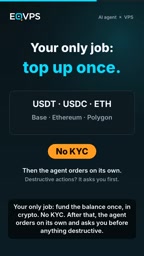
The most controversial yet most practical design in the demo is the payment step. Users only need to top up a prepaid balance once with cryptocurrency, with no KYC. After that, every order the agent places is deducted from the balance, with no human intervention in payment. This solves the core obstacle to autonomous transactions by AI agents: traditional payment methods are tied to human verification, whereas a prepaid balance gives the agent programmable purchasing power.
From a product perspective, this is a real-world implementation of the "agent wallet" concept. The agent is no longer just an advisor but an executor — it can make autonomous decisions within a budget. Of course, the risk shifts accordingly: the balance is the only brake, and users need to control their top-up amounts themselves.
KYC (Know Your Customer) is a compliance process in which financial regulators require service providers to verify customer identity, typically including submitting identity documents, proof of address, and facial recognition. Traditional cloud service providers and payment platforms generally require KYC to comply with anti-money laundering (AML) and counter-terrorism financing (CFT) regulations. For AI agents, KYC constitutes a structural barrier: agents cannot complete identity verification on their own, and every transaction requires human intervention. The cryptocurrency prepaid model bypasses this limitation — the user completes the top-up once (the top-up step may still involve the exchange's KYC), and subsequent balance spending occurs on-chain or within the account, no longer triggering per-transaction identity verification. This is why the demo emphasizes "no KYC": it makes the agent's purchasing behavior truly unattended, but it also means compliance responsibility shifts to the user, with the balance amount becoming the de facto risk control mechanism.
Security Boundaries: Must Ask Before Destructive Operations
Letting an agent place orders on its own sounds like handing a credit card to a robot. But there's a key constraint in the EQVPS demo: the agent asks the user before performing destructive operations. Routine operations like restarting, renaming, and monitoring can be done autonomously, but when it comes to data deletion or configuration resets, the agent pauses and requests confirmation.
This "autonomous execution + confirmation for danger" model is more realistic than either full autonomy or full manual control. It positions the agent as an operator with permission boundaries rather than an administrator with unlimited power. The MCP tool layer can define a side-effect level for each tool, and the agent decides whether to request human confirmation based on that level. If this mechanism can be standardized, it will become a common paradigm for agent-operated infrastructure.
Destructive operations in infrastructure management generally refer to irreversible or high-impact actions, such as deleting server instances, formatting disks, resetting SSH keys, modifying firewall rules, or wiping databases. Unlike recoverable operations such as restarting or renaming, the consequences of destructive operations often cannot be eliminated through a simple rollback. In scenarios where agents execute autonomously, distinguishing the risk level of operations is crucial. A common approach is to annotate each tool in the MCP tool definitions with a side-effect level (e.g., read-only, reversible write, irreversible write), and the agent decides whether to trigger a human confirmation flow based on that level. More mature solutions also introduce "dry-run" modes, operation rehearsals, and approval workflows to reduce the probability of misoperations. If this tiered confirmation mechanism can be standardized at the MCP level, it will greatly reduce the repetitive cost of each service implementing its own security policies.
What This Means for Developers and Operations
For independent developers and small teams, this model lowers the friction of acquiring temporary compute. You don't need to provision servers in advance before developing; instead, you let the agent procure on demand when needed. For CI/CD pipelines, the agent can automatically scale up when a test fails, reproduce the environment, and then scale down. For security research, the agent can quickly spin up isolated instances for vulnerability verification.
But this also brings new governance questions: How do you audit an agent's procurement behavior? How do you set budget caps and approval flows? EQVPS currently uses the prepaid balance as a hard constraint, but enterprise scenarios require finer-grained policy control. The MCP ecosystem needs something like an "agent permission policy" standard; otherwise, every service will have to implement its own confirmation logic.
Editorial View: MCP Is Becoming the USB Interface for Agents
The value of this demo isn't the VPS itself, but the pattern it demonstrates: any API service can become a tool invocable by an agent through MCP. Payment, procurement, deployment, monitoring — operations originally scattered across multiple consoles are compressed into a conversational workflow. The agent is no longer just an assistant in a chat window but an operating entity that can genuinely change the state of infrastructure.
Of course, there's still a gap before production-grade reliability. The "about a minute" in the demo is an ideal case; real network latency, payment confirmation, and resource scheduling can all go wrong. How does the agent handle order failures, insufficient balance, or sold-out plans? These edge cases determine whether it can go from a cool demo to an everyday tool. But the direction is clear: agents need their own wallets, their own servers, and their own operating permissions — provided humans set up the guardrails.
One-line Summary
EQVPS enables ClaudeCode to autonomously handle VPS procurement and operations through MCP, with prepaid crypto top-ups becoming the payment foundation of the agent economy.
Paragraph Summary
The article introduces the MCP integration demonstrated by EQVPS on YouTube: once ClaudeCode connects to the EQVPS backend through the MCP protocol, the agent can autonomously complete the entire VPS process of registration, plan selection, ordering, and payment. Users only need to top up a prepaid balance once with cryptocurrency, with no KYC; afterward, the agent procures autonomously within the balance, and the SSH command is available about a minute later. The agent can autonomously perform routine operations such as restarting, renaming, and monitoring, but requests user confirmation before destructive operations. The article argues that this model demonstrates MCP's potential as a universal interface for agents to invoke external services, pushing agents from advisors to executors, though enterprise scenarios still require finer-grained budget control and audit strategies.
Related articles

Does Agentic AI Need Its Own "Second Foundation"? A Three-Loop Architecture Explored
Inspired by Asimov's Foundation series, a multi-agent AI architecture hypothesis proposes execute, verify, and adapt control loops to reduce correlated errors and improve trust in AI results.
Rewriting a Commercial Engine in Jai: The Trade-off Between Performance and Productivity
Exploring the engineering practice of rewriting a commercial game engine in Jai: compile-time metaprogramming and data-oriented design advantages, plus ecosystem maturity and learning curve challenges.
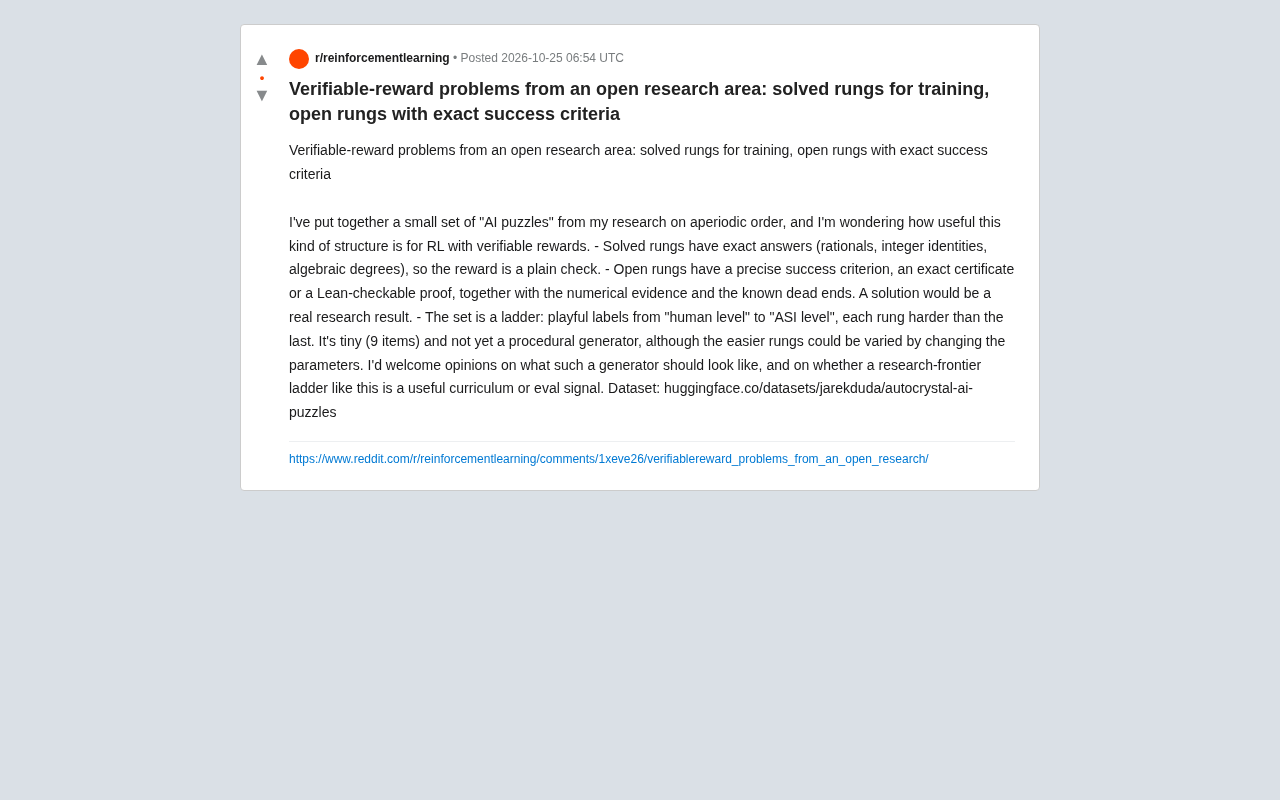
Building an AI Reasoning Ladder with Aperiodic Order Research: An Open Dataset of Verifiable Reward Problems
Researchers release an aperiodic order AI puzzle dataset with solved rungs for RL training and open rungs tied to real math research, exploring verifiable reward RL curricula.