Thunderduck: Building a Modular Data Warehouse for AI Agents

Thunderduck gives each AI agent an isolated DuckDB engine with cross-source SQL and pre-query pricing.
Thunderduck on Product Hunt proposes a modular data warehouse for AI agent teams, built on DuckDB with an isolated engine per agent to avoid resource contention under concurrent queries. Key features: ETL-free single-SQL joins across Postgres, BigQuery, Iceberg, and S3; pre-query pricing as a cost guardrail; and managed cloud, BYOC, and on-prem options. Positioning fits two trends—agents needing fine-grained data infrastructure and DuckDB going service-oriented—but public details remain conceptual.
When AI Agents Start Managing the Data Warehouse
Thunderduck, which debuted on Product Hunt, introduces a rather forward-looking concept: a modular data warehouse built for Agentic Data Teams. Built on the DuckDB engine, each AI agent gets its own isolated engine, with the goal of turning the data warehouse from "heavy infrastructure built for humans" into "a lightweight service that agents can call directly."
Thunderduck received 62 votes on Product Hunt, ranking 20th, spanning the developer tools, AI, and data analytics categories. Supporters believe it fills a gap in AI-native data architecture, and while the comment section discussion wasn't particularly heated, questions centered on practical matters like "how do isolated engines coordinate" and "is the pricing model transparent."
Modularity and Agent Isolation: What Pain Points Does It Solve
Traditional data warehouses are typically divided by team or business line, with coarse-grained permission and resource boundaries. But AI agents work with high-frequency, fine-grained, potentially concurrent queries—one agent running attribution analysis while another cleans logs. If they share the same computing resources, they can easily drag each other down.
Thunderduck's approach is to assign each agent an independent DuckDB engine. DuckDB itself is known for being embedded, lightweight, and strong at OLAP performance. This "one agent, one engine" architecture means: queries are naturally isolated, with no resource contention causing long-tail latency; agent context lifecycles can be managed independently, released when done.
The term "modular" in the official description points precisely to this pluggable resource unit—engines are no longer fixed-spec clusters, but modules assembled according to agent needs.
DuckDB is an open-source embedded OLAP database, often called "the analytical SQLite." It requires no separate server process and embeds directly into applications as a library, supporting the full SQL dialect and columnar storage, with high performance for analytical workloads like aggregation and joins in single-machine environments. Thanks to its zero-ops, low-latency characteristics, DuckDB has recently been increasingly used to build lightweight data services. Thunderduck chose DuckDB as the underlying engine for each agent precisely because of its fast startup, low resource footprint, and ease of isolation. However, the embedded architecture also means that each engine instance's data and computing resources are relatively independent, and federated queries across engines require an additional coordination layer—which is one reason the comment section focused on "how do isolated engines coordinate."
Cross-Source Queries Without ETL: One SQL to Connect Four Types of Data
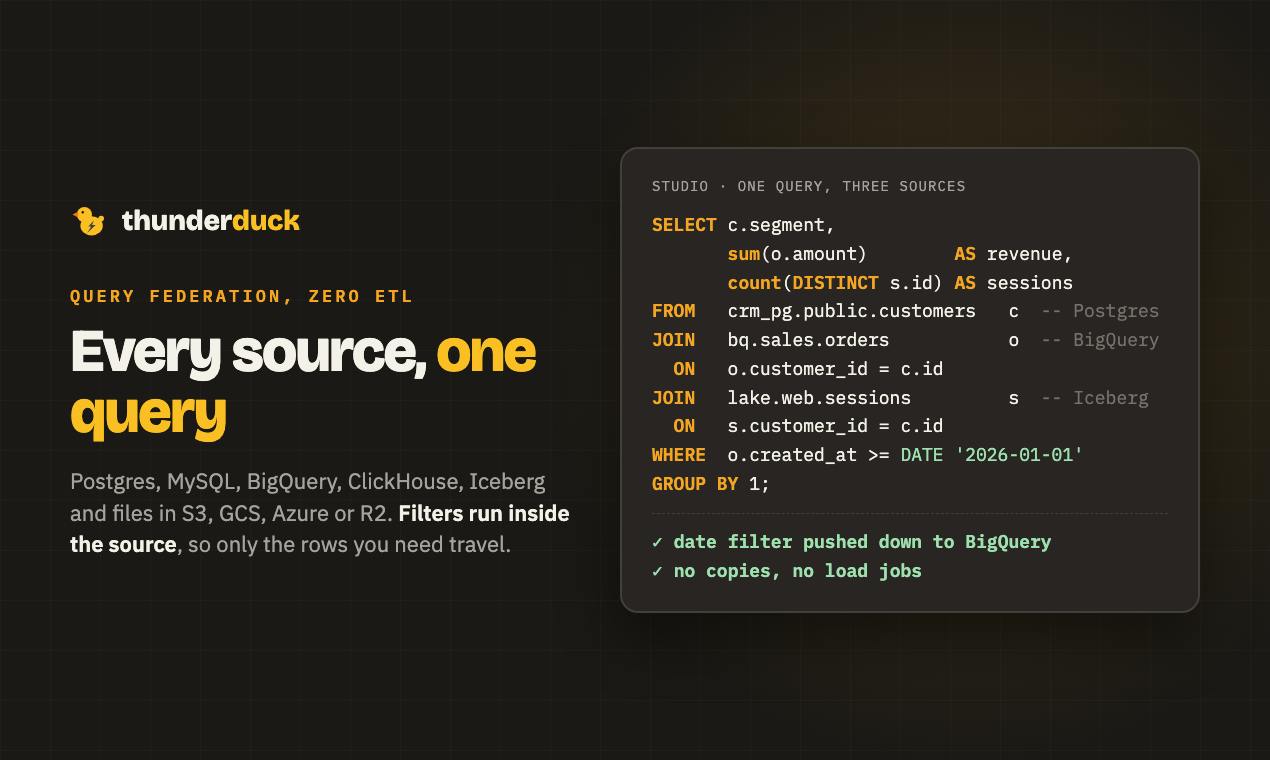
Thunderduck's most compelling capability is supporting joining Postgres, BigQuery, Iceberg, and S3 files in a single SQL query without ETL.
For data analytics teams, this combination covers the vast majority of real-world scenarios: business databases in Postgres, the data warehouse in BigQuery, the data lake managed with Iceberg, and raw logs and temporary files sitting on S3. The traditional approach requires extracting data to unified storage first, then modeling, then querying—each step means latency and operational overhead.
Thunderduck pushes the work of connecting these heterogeneous data sources down to the engine layer, so agents writing SQL don't need to care where the data actually lives. This is especially critical for AI agents—the agent's decision chain demands low latency, and if every query has to wait for ETL jobs, the entire automation flow loses its meaning.
ETL (Extract-Transform-Load) is the traditional paradigm in data engineering: extract data from source systems, clean and transform it, load it into a unified data warehouse, and then make it available for analysis. This process is typically executed periodically by scheduling systems, introducing hour-level or even day-level latency, and requires maintaining pipelines and handling failures. Thunderduck's claimed "ETL-free cross-source queries" follow an ELT or Federated Query approach—not moving data, but connecting directly to each data source at query time, with the engine layer responsible for pushdown filtering and merging results. This approach can significantly reduce data freshness latency, but places higher demands on connector stability, cross-source query optimization, and permission management. For scenarios like AI agents that need instant feedback, the ETL-free query path can prevent agents from idling while waiting for data synchronization.
Pre-Query Pricing: A Cost-Controllable Agent Economy
"Every query is priced before it runs" is Thunderduck's differentiated design for cost control.
A typical risk with AI agents is losing control: an agent might generate a large number of exploratory queries, and the bill balloons before anyone notices. Thunderduck moves cost to before execution, meaning the agent (or the human managing the agent) can judge whether the expense is worthwhile before submitting a query, thereby building cost guardrails into the architecture for agent autonomy.
In terms of deployment, Thunderduck offers three options: managed cloud, BYOC (Bring Your Own Cloud), and on-premises. BYOC has real value for enterprises with strict data compliance requirements—data can remain in their own cloud account while still enjoying the product's capabilities.
BYOC (Bring Your Own Cloud) is a software delivery model: customers run the vendor's software in their own cloud account (such as AWS, GCP, Azure), data always stays in the customer's account, and the vendor typically only manages the control plane and billing. Compared to multi-tenant SaaS, BYOC better satisfies data residency, compliance audit, and network isolation requirements, while allowing customers to use their existing cloud contracts and discounts. Thunderduck offering a BYOC option means it's attractive to regulated industries like finance and healthcare. But BYOC also shifts operational complexity—customers need to manage the underlying cloud resources themselves, while the vendor must ensure a secure connection between the control plane and the data plane.
Points Worth Watching
Thunderduck's positioning sits at the intersection of two trends: AI agents need finer-grained data infrastructure, and the DuckDB ecosystem is moving from single-machine analytics toward service-ization. But its currently public information is still rather conceptual, and the questions raised in the comment section—how do isolated engines perform federated queries, what are the specific pricing dimensions—have yet to see detailed answers.
For teams building multi-agent data pipelines, Thunderduck is an option worth adding to the evaluation list, especially suited for scenarios where data is scattered across multiple storage systems and you want agents to access it directly. What to watch going forward is its engine scheduling performance as concurrent agent scale grows, and the performance boundaries of cross-source queries under real data volumes.
Single-source note: The information in this article comes primarily from Thunderduck's product page on Product Hunt; some product details await supplementation from official documentation.
One-line Summary
Thunderduck assigns each AI agent an independent DuckDB engine, supporting cross-source SQL queries and pre-query pricing.
Paragraph Summary
Thunderduck on Product Hunt proposes "a modular data warehouse built for AI agent teams," based on DuckDB, assigning each agent an independent isolated engine to solve resource contention under high-frequency concurrent queries. Its core capabilities include: joining Postgres, BigQuery, Iceberg, and S3 files in a single SQL query without ETL; pricing completed before query execution, providing cost guardrails for agent autonomy; and three deployment modes: managed cloud, BYOC, and on-premises. The product positioning hits the intersection of two trends—AI agents needing fine-grained data infrastructure and the DuckDB ecosystem becoming service-oriented—but public information remains conceptual, with multi-engine federated query mechanisms and pricing dimensions awaiting official supplementation. Suitable for teams with scattered data who want agents to access it directly.
Related articles

Sugra MCP: One-Click Access to 200+ Data Sources, Connecting Mainstream AI Applications
Sugra MCP connects mainstream AI apps like Claude, ChatGPT, and Cursor through a unified MCP protocol, offering 200+ data sources and 1,600+ endpoints. Listed in Anthropic, OpenAI, and GitHub directories—integrate with one command.
 Tech Frontiers
T3 Code: Free, Open-Source, and a Unified Way to Manage All AI Coding Agents
T3 Code is a free open-source app that aggregates AI coding tools like Cloud Code and Codex into one interface, with conversation handoff, branch isolation review, automatic PR creation, and remote access.
 Tech Frontiers
Conductor Cloud Service Shutting Down? A Comparative Review of Three Parallel AI Coding Agent Solutions
Conductor's cloud service is shutting down—how can developers keep running AI coding agents in parallel? This article compares three alternatives: Orca, Codex, and Cursor: Orca is open-source and free and compatible with old workspaces, Codex is built into the ChatGPT desktop app and supports cloud handoff, and Cursor offers multi-agent windows within the editor. Choose the tool that best fits your workflow.