Tidy Design: An Open-Source Figma and Paper Alternative That Lets AI Agents Design Interfaces Directly

Tidy Design is an open-source design tool for designing interfaces directly within coding environments and AI agents.
Tidy Design is an open-source design tool gaining attention on Product Hunt. Positioned as an alternative to Figma and Paper, its core difference is that it allows users to design interfaces directly from coding environments such as Claude Code, Codex, and Opencode. It targets designers, engineers, and AI agents, emphasizing open-source customizability, source code exploration, and adaptation to personalized workflows. The article analyzes the advantages of its "design while you code" workflow, the potential and review challenges of AI agents participating in design, and points out practical issues such as Figma's ecosystem barriers, designers' usage habits, and insufficient community activity. Overall, Tidy represents the trend of blurring boundaries between design tools, development tools, and AI agents, but the maturity of its ecosystem remains to be seen.
Tidy Design: An Open-Source Figma and Paper Alternative That Lets AI Agents Design Interfaces Directly
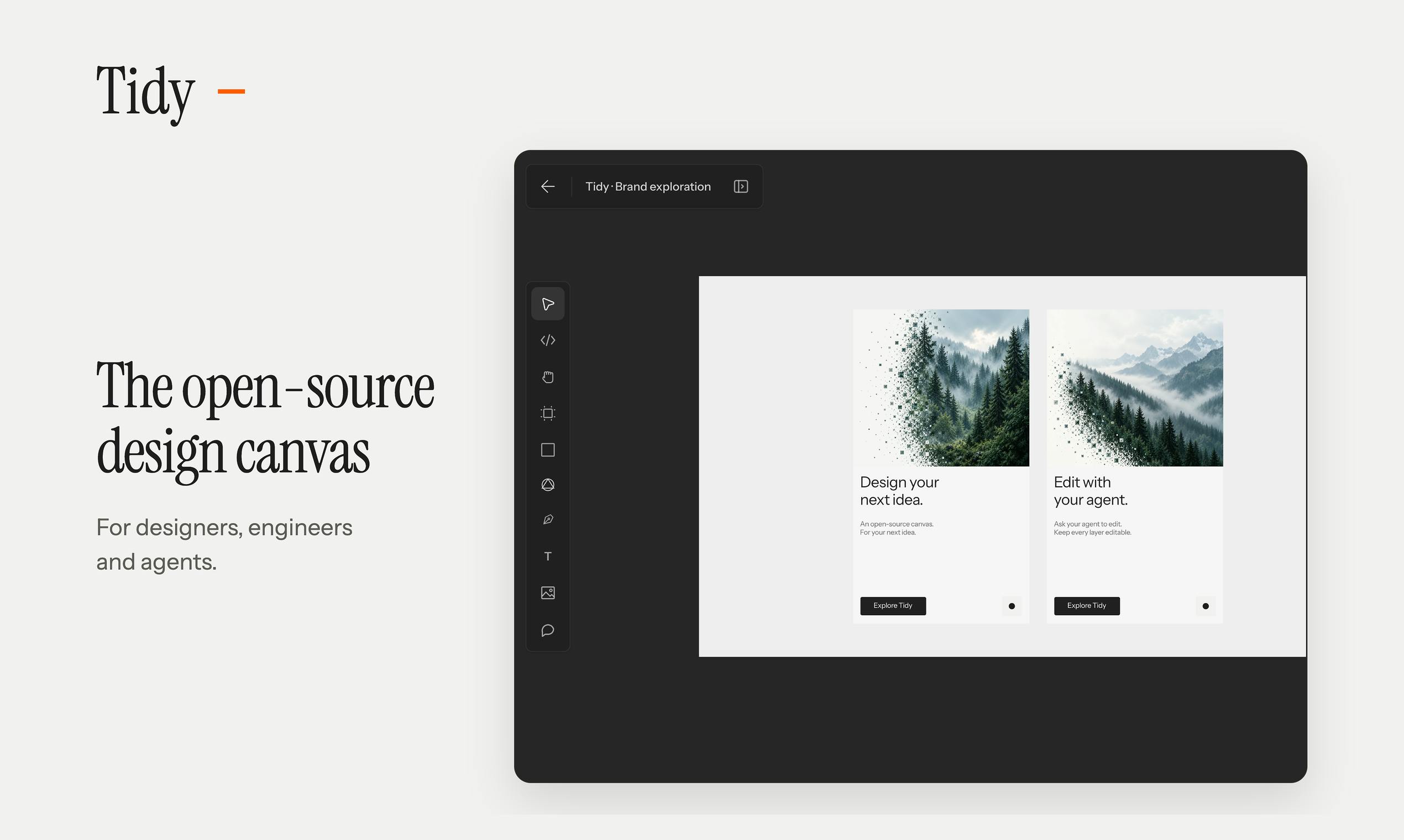
On Product Hunt, an open-source design tool called Tidy Design is drawing attention. It positions itself as an open-source alternative to Figma and Paper, but its target users include not only designers but also engineers and AI agents. More unusually, Tidy lets users design interfaces directly from coding environments such as Claude Code, Codex, and Opencode, explore the source code, and customize the tool on demand. This sounds like a deep fusion of design tools and development environments—worth unpacking in detail.
A New Species of Design Tool: Built for Coding Environments
Tidy Design's core differentiator is "designing directly from the coding environment." Traditionally, designers complete interface designs in Figma or Paper and then hand them off to engineers for implementation, a process that often introduces fidelity gaps. Tidy flips this around, letting designers or engineers draw interfaces directly in the environment where they write code—meaning the gap between design mockups and code implementation is greatly compressed.
The official description mentions "Design interfaces directly from your coding harness (Claude Code, Codex, Opencode, etc)," suggesting Tidy is deeply integrated with these AI coding tools. Users can invoke design capabilities directly within coding assistants, or have design outputs seamlessly converted into code. For developers accustomed to writing code with AI agents, this offers a smooth "design while you code" experience.
The Claude Code, Codex, and Opencode mentioned here all belong to the category of "AI coding agents" or "coding harnesses." Claude Code is a command-line coding assistant launched by Anthropic that can read and write local codebases, execute commands, and complete multi-step development tasks; Codex originally referred to OpenAI's code generation model and later also to coding agent products based on that model; Opencode is an open-source terminal coding agent that emphasizes local execution and extensibility. What these tools share is that they let large models operate autonomously in real code environments, rather than merely completing code. By embedding design capabilities into these harnesses, Tidy essentially treats "interface generation" as part of the coding task, making design outputs naturally close to runnable code.
Open Source and Customizable: Adapt to Your Workflow
Tidy emphasizes "open source" and "adapting to the way you work." Users can not only view and modify the source code but also adjust the tool to their own habits. This openness is rare in a market dominated by closed-source tools like Figma. Open source means greater transparency, auditability, and community-driven feature expansion.
For enterprises, open-source design tools can avoid vendor lock-in and facilitate internal integration and secondary development. One of Tidy's creators, Sean Dowdall, said on Product Hunt that Tidy's vision is to make design tools as collaborative and versionable as code. However, the Product Hunt page currently has only one comment, and community discussion is not yet active—the maturity of the open-source ecosystem remains to be seen.
Vendor lock-in refers to users being deeply dependent on a vendor due to data formats, interfaces, or workflows, making migration costs so high that switching products becomes difficult. In closed-source design tools, design file formats, collaboration data, and plugin ecosystems are often controlled by the vendor, making it hard for enterprises to switch once they adopt at scale. Open-source tools, by disclosing source code and file formats, allow users to self-deploy, audit, and build on them, thereby reducing lock-in risk. For design tools, open source also means teams can customize component libraries according to internal standards, review data flows, and take over maintenance themselves if the vendor stops supporting the product. This is also the underlying logic behind Tidy's emphasis on "adaptable workflows," but open source itself does not automatically guarantee a thriving ecosystem—it still requires sustained community investment.
The Possibility of AI Agents Participating in Design
Tidy explicitly lists "AI agents" as one of its target users, which is quite forward-looking. With the rise of AI coding agents like Claude Code and Codex, having AI agents directly produce designs or interfaces has become a new question. Tidy may provide APIs or command-line interfaces that enable AI agents to generate and modify interface designs, or even directly output runnable code.
The advantage of this model is that design is no longer exclusive to humans—AI agents can quickly iterate on design options after understanding requirements and simultaneously generate implementation code. But the challenges are also obvious: How can the design quality of AI agents be guaranteed? How can human designers review and intervene? Tidy needs to provide sufficiently fine-grained controls and review mechanisms. Public information is currently limited, but this remains a direction worth watching.
Letting AI agents participate in interface design usually relies on two types of interfaces: first, structured APIs, through which agents can programmatically create, query, and modify design objects (such as artboards, components, and styles); second, command-line or file-level interfaces, through which agents directly read and write design source files or code. Unlike humans using graphical interfaces, agents need design tools to expose machine-understandable semantic structures in order to iterate reliably. At the same time, review mechanisms need to be designed accordingly, such as version comparison, change previews, rule validation, and human confirmation steps. Without these control points, AI-generated designs can easily deviate from brand guidelines or accessibility requirements. Tidy's public information is currently limited, and the specific form of its agent interfaces and review processes remain key to judging its practicality.
Market Positioning and Challenges
Tidy Design positions itself as "an open-source alternative to Figma and Paper," but Figma's moat lies not only in the tool itself but also in its massive community, plugin ecosystem, and collaboration network. Paper focuses on conversion from design to code. Tidy chooses to enter through the coding environment, avoiding direct competition with Figma, but this also means it needs to persuade designers to accept working in a code editor—which is no easy task.
In addition, 65 votes and a #20 ranking on Product Hunt indicate that Tidy is still niche. Open-source design tools such as Penpot and Excalidraw have already accumulated users, and Tidy needs to prove its unique value in AI integration and developer experience.
Penpot and Excalidraw, mentioned here, are two representatives in the field of open-source design tools. Penpot is an open-source design and prototyping platform for UI/UX, emphasizing Web standards and support for connecting design mockups with code; Excalidraw focuses on hand-drawn-style whiteboard and sketch collaboration, and is lightweight and easy to embed. Both have already built communities and plugin ecosystems, showing that the open-source design tool market is not empty. Tidy differs from them in that its entry point is "design within the coding environment" and "direct invocation by AI agents," rather than replacing a complete graphical design suite. Therefore, its competitive focus is not on the number of features, but on whether it can create an irreplaceable experience within developer workflows and gradually build an ecosystem of components, templates, and integrations.
Summary and Outlook
Tidy Design represents a trend: the boundaries between design tools, development tools, and AI agents are blurring. Designing directly from the coding environment, combined with open-source customizability, offers a new option for specific workflows. If Tidy can improve AI agent integration, lower the barrier to use, and cultivate its community, it may carve out a place in developer-driven design scenarios. For now, it remains a new project worth watching.
One-line Summary
Tidy Design is an open-source design tool that lets users design interfaces directly within coding environments and AI agents.
Paragraph Summary
Tidy Design is an open-source design tool gaining attention on Product Hunt. It positions itself as an alternative to Figma and Paper, but its core difference is that it allows users to design interfaces directly from coding environments such as Claude Code, Codex, and Opencode. It targets designers, engineers, and AI agents, emphasizing open-source customizability, source code exploration, and adaptation to personalized workflows. The article analyzes the advantages of its "design while you code" workflow, the potential and review challenges of AI agents participating in design, and points out practical issues such as Figma's ecosystem barriers, designers' usage habits, and insufficient community activity. Overall, Tidy represents the trend of blurring boundaries between design tools, development tools, and AI agents, but the maturity of its ecosystem remains to be seen.
Related articles

JobRunner MCP Server: AI Agents Can Now Fix Failed Java Jobs
JobRunner launches an open-source MCP server enabling AI agents to view cluster status, diagnose failures, and recover Java jobs—incident response from any cloud coding environment or existing agent.

MLAI Digital Launches 9 Security Agents: MCP Server Safeguards the Full Lifecycle of Agentic AI
MLAI Digital launches Security MCP Server with nine built-in specialized security agents covering vulnerability discovery, attack simulation, prompt injection detection, API and infrastructure assessment, and accelerated remediation—embedding security validation across the full Agentic AI lifecycle from development to production.

Running Isaac Lab on H100 GPUs: Exploring Better Approaches
Exploring optimization methods for running Isaac Lab on NVIDIA H100 GPUs, including MIG configuration, mixed precision, TensorRT acceleration, and community experience to improve robotics simulation and reinforcement learning efficiency.