TikTok Blocks Peptide Searches: No Results for semaglutide and Other Keywords

TikTok blocks peptide keyword search results, reflecting the dilemma of platform health information governance.
TikTok recently blocked peptide-related search terms such as semaglutide, BPC-157, and retatrutide, showing "No results found" when users search. Peptides include GLP-1 receptor agonists and other substances for weight loss, anti-aging, and muscle repair; some are prescription drugs, while others are in a regulatory gray area. Search blocking only cuts off the entry point for active searching, and related content can still be accessed through hashtags, comment sections, and other channels. This move affects the discoverability of health science content and may force creators to use variant spellings to evade blocking, reducing information quality. The platform has not disclosed the basis for the blocking, and enforcement standards are opaque, raising concerns about the boundaries of censorship. This reflects the long-term governance challenge social platforms face in preventing potential harm while avoiding an information vacuum.
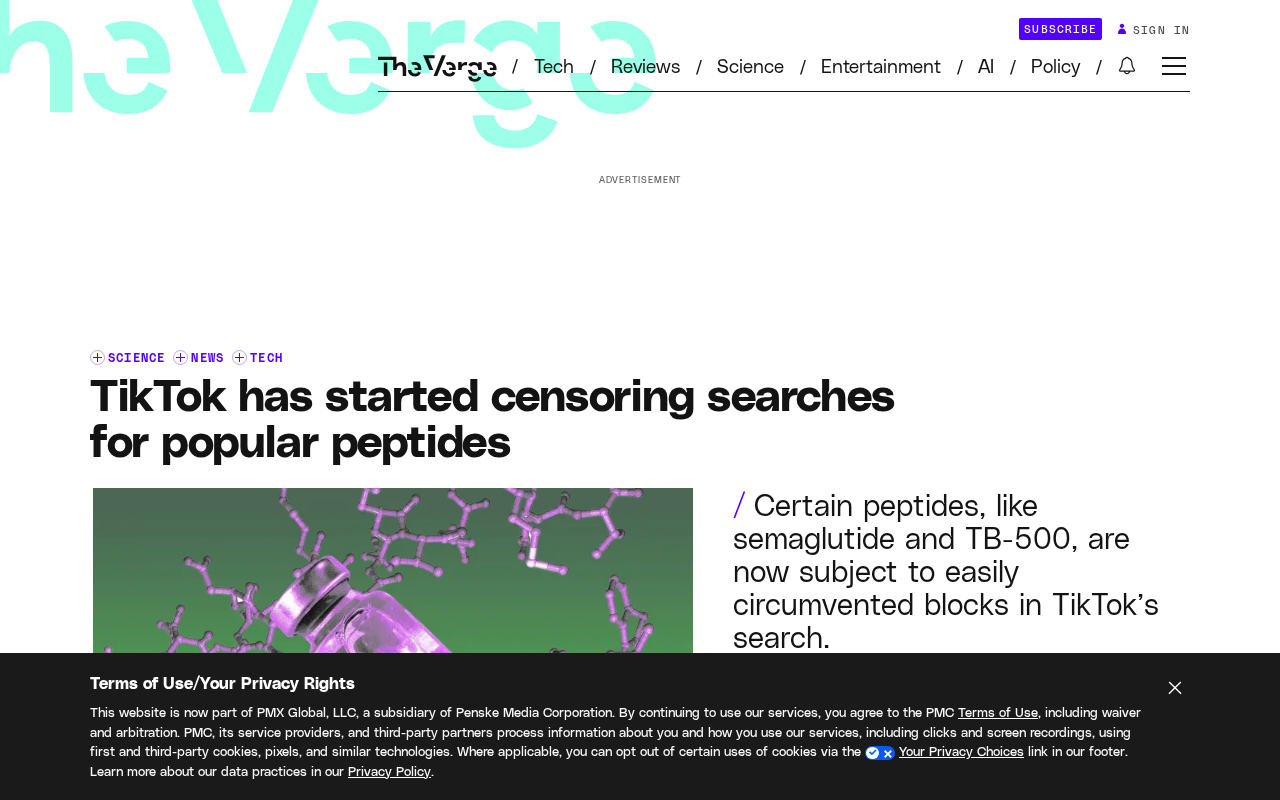
On TikTok, users searching for popular peptide substances like semaglutide, BPC-157, and retatrutide now see a "No results found" page. This change was first reported by foreign media and quickly sparked discussion in communities focused on health and biotech content. Peptides are combinations of amino acids, encompassing substances like insulin and GLP-1, and the blocked search terms are mostly closely related to topics such as weight loss, anti-aging, and muscle repair.
Search Blocking ≠ Content Disappearance
Although search results are cleared, peptide-related content on TikTok has not completely disappeared. Users may still encounter relevant information through hashtags, comment sections, or creator profiles. The platform's search blocking mainly cuts off an entry point for active searching rather than completely removing all related content.
This kind of "search-layer" intervention is not uncommon in content governance. It usually means the platform is balancing information accessibility with potential risks, but the specific enforcement standards and boundaries remain opaque.
Hashtags are metadata tags used on social media to aggregate related content; users can browse collections of posts on the same topic by clicking or searching for a specific tag. Unlike keyword searches, hashtags are often added by creators themselves, and the platform's moderation granularity may be coarser. Therefore, even if search terms are blocked, related hashtag pages, comment discussions, or creator profiles may still retain peptide content, creating a situation where "the search entrance is closed but content still flows beneath the surface." This also explains why search blocking is not a complete removal but merely raises the threshold for active discovery.
Why Peptides?
Peptide drugs and supplements have gained increasing popularity on social media in recent years, especially GLP-1 receptor agonists related to weight loss (such as semaglutide) and BPC-157 used for tissue repair. Among these substances, some are prescription drugs, while others are in a regulatory gray area, and their safety, legality, and marketing methods often spark controversy.
The platform's choice to block search terms may be intended to curb unverified health claims, illegal sales, or misleading content. But this also raises a question: when users cannot obtain information through search, will they turn to less reliable information sources?
GLP-1 receptor agonists are a class of drugs that mimic the action of the body's natural glucagon-like peptide-1 (GLP-1). GLP-1 is secreted by intestinal L cells and can promote insulin release, inhibit glucagon secretion, slow gastric emptying, and act on the central nervous system to produce a feeling of fullness. Semaglutide is a representative of this class of drugs; it was initially used for type 2 diabetes treatment and later widely used for weight management due to its significant weight-loss effects, usually administered via subcutaneous injection or orally. Because it is heavily discussed on social media and even circulates through informal channels, this type of prescription drug has become a focus of platform content governance.
BPC-157 (Body Protection Compound-157) is a synthetic peptide composed of 15 amino acids, derived from a protective protein fragment in human gastric juice. In animal experiments and some small-scale human studies, it has been reported to have the potential to promote tissue repair, reduce inflammation, and accelerate wound healing. However, this substance has not yet received formal approval from mainstream regulatory agencies (such as the FDA) for clinical treatment and is mostly sold online as a "research chemical." Its long-term safety and efficacy lack sufficient human clinical trial evidence, so it often sits in a regulatory gray area and is one of the direct triggers for the platform's search-term blocking.
Impact on the Content Ecosystem
For health science creators and users who rely on TikTok for information, this change directly affects content discoverability. Creators may be forced to use variant spellings or obscure expressions to evade blocking, further reducing information quality.
On the other hand, the platform has not publicly explained the specific basis and scope of the blocking. This opacity easily raises concerns about the boundaries of censorship, especially in the field of health information, where both over-blocking and allowing unchecked spread carry risks.
The Long-Term Challenge of Information Governance
TikTok's adjustment reflects the dilemma social platforms face when dealing with sensitive health topics: they must prevent potential harm while avoiding an information vacuum. Simply blocking keywords cannot solve the complex issues surrounding peptides in regulation, science communication, and commercial promotion.
In the future, whether the platform will pair such measures with more refined content labeling, authoritative information guidance, or creator education mechanisms will determine the long-term effectiveness of this type of governance. At least for now, searching and getting "No results found" is only a beginning, not an answer.
One-line Summary
TikTok blocks search results for peptide keywords, reflecting the dilemma of platform health information governance.
Paragraph Summary
TikTok recently blocked peptide-related search terms such as semaglutide, BPC-157, and retatrutide, showing "No results found" when users search. Peptides include GLP-1 receptor agonists and other substances for weight loss, anti-aging, and muscle repair; some are prescription drugs, while others are in a regulatory gray area. Search blocking only cuts off the entry point for active searching, and related content can still be accessed through hashtags, comment sections, and other channels. This move affects the discoverability of health science content and may force creators to use variant spellings to evade blocking, reducing information quality. The platform has not disclosed the basis for the blocking, and enforcement standards are opaque, raising concerns about the boundaries of censorship. This reflects the long-term governance challenge social platforms face in preventing potential harm while avoiding an information vacuum.
Related articles

Kimi K3.1 Hands-On Test: Open-Source Model Nears Opus, Video Generation Steals the Show
Kimi K3.1 completed motion graphics, 3D rendering, mini-games, and video generation in a live test. Analysis of its 2.8T MoE architecture, gap vs Opus/GPT, and hidden video generation.

Sam Altman: Why Life's Biggest Advice Should Still Come from Humans
OpenAI CEO Sam Altman on the limits of AI advice: AI can talk you out of an impulsive email, but life's biggest advice should still come from humans.

"Black October": Did AI Uncover 3% of All Critical Vulnerabilities Ever?
A Reddit post claims 3% of all critical software vulnerabilities ever were found in the past month, dubbed 'Black October.' We break down the statistical issues, how AI-assisted code auditing accelerates discovery, and how developers should respond.