Tim Sweeney Champions AI Game Development: One-Person Teams Will Create Great Works

Tim Sweeney champions AI game development, sparking debate on barriers, competition, and double standards.
Epic Games CEO Tim Sweeney said on Reddit he's been low-investment experimenting with game prototypes using leftover Claude Max tokens, and is extremely excited about AI's potential in game development. He believes one-person teams can also make good games, while the community calmly notes competition will be brutal and curation will matter more than ever.
Epic Games founder and CEO Tim Sweeney's comments on Reddit have once again ignited a heated debate about AI in the gaming industry. He stated outright that he's been "low-effort" tinkering with game prototypes using leftover Claude Max tokens, and expressed tremendous excitement about AI's potential in game development. This stance stands in sharp contrast to the "AI-phobia" currently permeating the gaming community.
"I Completely Don't Understand": Sweeney's Optimism About AI Games
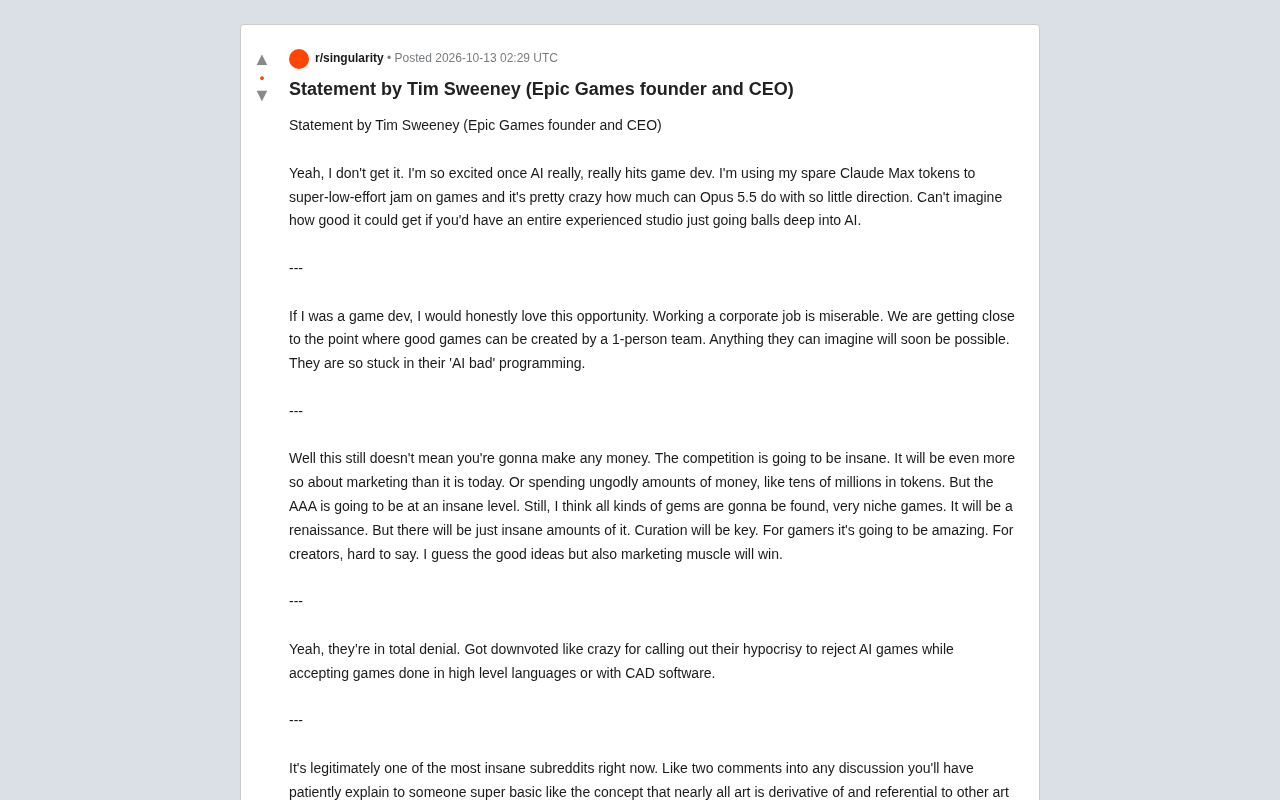
In his post, Sweeney made no effort to hide his confusion: "I really don't get it. I'm so excited for when AI truly goes deep into game development." He revealed that he's been using leftover Claude Max tokens for low-investment game development experiments, and that Opus 5.5's capabilities with minimal prompting left him feeling "pretty crazy."
His core judgment: if an experienced, full studio went all-in on AI, the results would be unimaginable. The weight behind these words lies in the fact that Sweeney is no outsider to AI—Epic Games' Unreal Engine is the infrastructure of AAA game development, and he has firsthand knowledge of the industry's pain points.
One-Person Teams and a "Renaissance"-Style Explosion
In this discussion, a view shared by multiple participants was that AI is lowering the barrier to making "good games" all the way down to the individual developer level. Sweeney believes that if he were a game developer, he'd see this as a golden opportunity—"working at a company is painful," and AI lets one person accomplish what used to require an entire team.
But calmer voices in the community pointed out that being able to make something and being able to make money from it are two different things. One commenter predicted: competition will become brutally fierce, marketing will matter even more than it does today, and token consumption could reach the tens-of-millions-of-dollars level. "Curation will become key"—for players, this is a golden age, with a flood of niche gems emerging; for creators, what wins may still be the combination of "good ideas + marketing muscle."
The Essence of the AI Controversy: The Double-Standard Debate in Gaming
The sharpest part of the discussion pointed to the gaming community's resistance to AI. One participant criticized as "hypocritical" those who reject AI games while accepting games made with high-level languages or CAD software, and noted that AI discussions in gaming forums often descend into irrational arguments within two or three comments.
One commenter's analogy was particularly representative: "It's been this way since we stopped drawing with our fingers." This echoes the basic common sense that "almost all art is derivative and referential to other art"—something that, in today's AI discussions, apparently needs to be explained over and over again.
Game development has long relied on various automation and assistive tools, such as high-level programming languages, game engines, 3D modeling software, and CAD. These tools have also replaced a great deal of manual labor, yet they are rarely accused of being "cheating." The "hypocrisy" critics point to is precisely this selective resistance: players accept compilers translating code into machine instructions, accept physics engines automatically calculating collisions, yet react fiercely to generative AI participating in art or level design. Behind this divide lies differing understandings of "creative subjectivity"—whether a tool diminishes human expression often depends on where it intervenes, not on the tool itself.
AAA Studios Adopting AI: Inevitable or "Abuse"?
Multiple discussants predicted that nearly all AAA studios will embrace AI in the near future. The reason is practical: game scale and scope keep expanding, and with 10-to-15-year cycles between releases, neither players nor developers can accept the status quo.
Regarding the word "abuse," one commenter explicitly corrected: "This isn't abuse, it's making good use of a powerful capability." This war over wording itself reflects the industry's split on AI—whether the same behavior is described as "utilizing" or "abusing" depends on stance, not facts.
Sweeney's comments are worth paying attention to not because he provided answers, but because he represents a rare attitude: in an emotionally charged industry debate, choosing to form judgments through hands-on experimentation. For game developers who are on the fence about AI, this may be more valuable than any prediction.
Background
Claude Max is the highest tier of Anthropic's Claude subscription service, offering usage quotas (token allowances) far exceeding the free and Pro versions. A "token" is the basic unit of measurement for how large language models process text, roughly understood as a word or word fragment; every time a model receives instructions and produces output, it consumes tokens, so token allowances directly determine how many AI interactions a developer can perform and at what scale. When Sweeney mentions "using leftover tokens," he means that with his subscription quota not fully consumed by daily work, he's putting the idle allowance into game prototype experiments. This approach is known in developer circles as a "low-effort" attempt—not pursuing a complete product, but using minimal prompts to quickly validate ideas at extremely low cost.
In the gaming industry context, "curation" refers to the mechanisms for filtering, recommending, and giving visibility to works out of a massive supply, including platform recommendation algorithms, editorial picks, streamer playthroughs, and community word-of-mouth. When AI drives production costs extremely low, the market will be flooded with similar products, and player attention becomes the scarcest resource. At that point, simply "being able to make something" no longer constitutes an advantage—whether you can be discovered by your target players is what matters. This also explains why discussants emphasize the importance of marketing muscle: distribution channels and trust endorsements will replace production capacity as the new battleground where individual developers compete with teams.
One-line Summary
Tim Sweeney champions AI game development, sparking industry debate over barriers, competition, and double standards.
Paragraph Summary
Epic Games CEO Tim Sweeney said on Reddit that he's been low-investment experimenting with game prototypes using leftover Claude Max tokens, and is extremely excited about AI's potential in game development. He believes that an experienced full studio going all-in on AI would produce unimaginable results, and that one-person teams can also make good games. While the community agrees the barrier is lowering, it also calmly reminds: competition will be brutally fierce, and marketing and curation will be more critical than ever. The discussion also extends to the gaming community's double standards on AI, and the inevitable trend of AAA studios embracing AI due to overly long development cycles. Sweeney's value lies not in providing answers, but in replacing emotional tribal alignment with hands-on experimentation.
Related articles

How Big Can Stars Really Get? The Physical Limits of the Largest Stars
Red supergiants are the largest stars by volume, with radii up to 2,000 times the Sun, engulfing the inner solar system. But there is no precise upper limit on stellar size—models predict up to 15,000 solar radii. The most massive blue stars are far smaller than red supergiants—biggest and heaviest are two different things.

Apple HomeView Smart Display Full Feature Breakdown: Wall-Mount or Desktop, $299
Apple launches HomeView, a $299 smart display with wall-mount and desktop options, 12MP camera for facial recognition, smart home control, music playback, and recipe step-by-step cooking. Full breakdown of watch faces, apps, privacy, and cooking integration.

Where Did the Promised New Studio Go? Craft Computing Answers After Five Years
Craft Computing's host responds to viewer questions: the new studio promised five years ago was shelved as construction costs soared from $30,000 to $75,000, and was replaced by a 168-square-foot garage conversion.