Timbre: Reliable Harmonic Consensus for Multimodal Test-Time Reinforcement Learning

Timbre uses weighted harmonic aggregation and confidence drift signals to correct erroneous consensus in label-free test-time reinforcement learning.
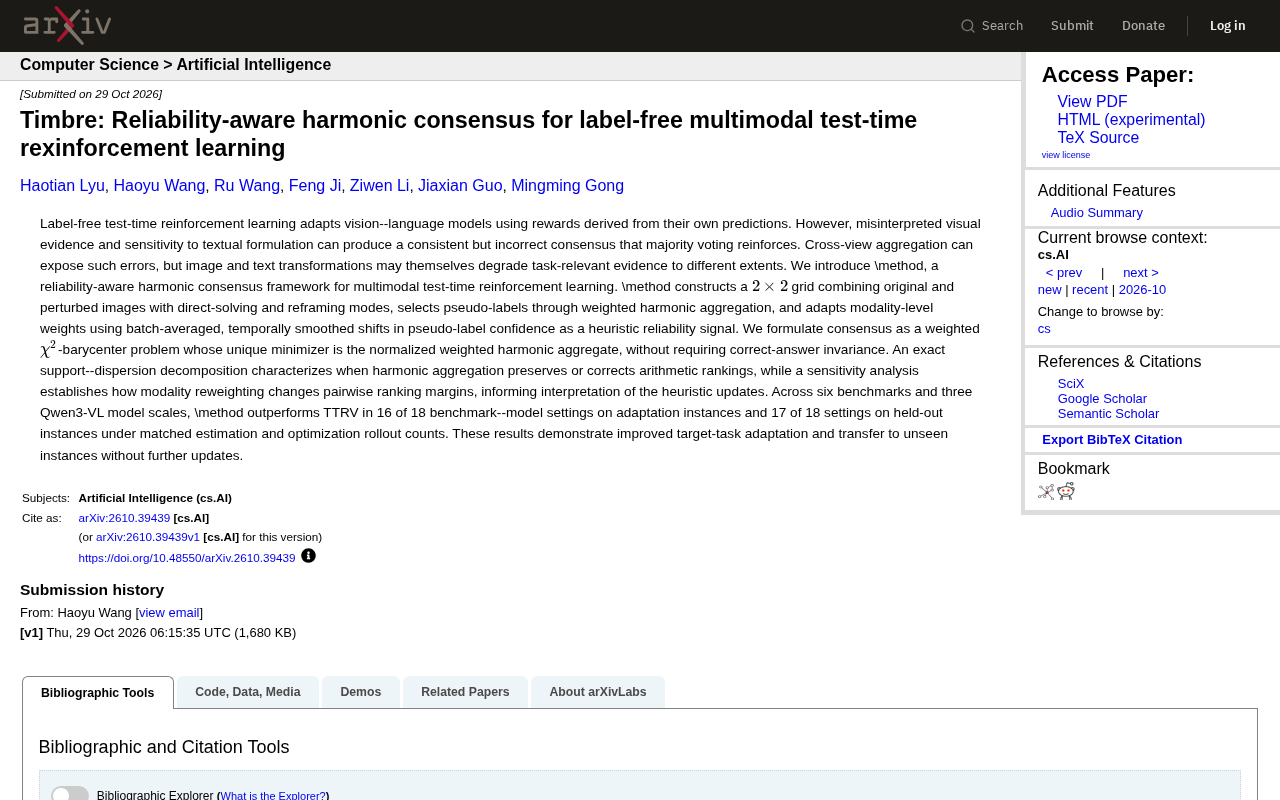
The article discusses how majority voting in label-free test-time reinforcement learning can reinforce a "stable but wrong" consensus, and introduces the Timbre framework's approach. Timbre builds a 2×2 view grid of original/perturbed images and direct/rephrased text, replacing equal-weight averaging with weighted harmonic aggregation to select pseudo-labels, leveraging the harmonic mean's heavier penalty on low values to be more sensitive to clearly unreliable views. It also uses batch-averaged, temporally smoothed pseudo-label confidence drift as a heuristic reliability signal for modality-level weights, and formalizes the consensus problem as a weighted χ² barycenter whose unique minimum is the normalized weighted harmonic aggregation. Across six benchmarks and three Qwen3-VL scales, Timbre outperforms TTRV in most benchmark-model settings, and held-out instance results show the improvement transfers. The authors also note limitations such as cross-model-family generalization and dependence on batch statistics.
Vision-language models often need to adapt to new tasks after deployment, but labeled data is frequently unavailable. Label-free test-time reinforcement learning offers a path: let the model self-adjust using rewards generated from its own predictions. But there's a pitfall—the model may misinterpret visual evidence or be overly sensitive to how text is phrased, forming a "stable but wrong" consensus, and majority voting only reinforces this error.
A recent study called Timbre proposes a reliability-aware harmonic consensus framework to address this problem, attempting to distinguish which signals are more trustworthy during multi-view aggregation.
Why Majority Voting Reinforces Errors
The core logic of label-free test-time reinforcement learning is: the model produces predictions for different transformed versions of the same input, aggregates these predictions to obtain pseudo-labels, and then uses the pseudo-labels as reward signals to update the model. The problem is that if the original image and text phrasing themselves contain systematic biases, multiple views may be "consistently wrong."
According to the original analysis, cross-view aggregation could expose such errors, but image transformations and text transformations damage task-relevant evidence to different degrees. Simply averaging all views with equal weight amounts to assuming every view is equally reliable, which is hard to justify in practice.
Test-Time Reinforcement Learning refers to a model updating its parameters or policy online during inference using reward signals constructed from its own predictions, under conditions with no labeled data. It differs from supervised fine-tuning that relies on human annotations, and from test-time adaptation that only adjusts prompts. Its key assumption is that the model's own predictions contain exploitable self-consistency information, enabling rapid adaptation to distribution shifts or new tasks. But this assumption holds only if the initial predictions have no systematic bias—once multiple views share the same error source, self-consistency actually amplifies the error, which is exactly the risk this paper addresses.
Pseudo-Label is the prediction a model gives for unlabeled data, used as a training target. In test-time reinforcement learning, pseudo-labels directly serve as the reward baseline: agreement with the pseudo-label yields a positive reward, otherwise a penalty. Pseudo-label quality therefore determines the success of adaptation. When pseudo-labels come from multi-view aggregation, the aggregation method (equal-weight averaging, weighted averaging, or harmonic averaging) directly determines whether the pseudo-label favors the majority or the reliable views—which is the fundamental reason this paper focuses on the aggregation step.
2×2 Grid and Harmonic Aggregation
Timbre's approach is to construct a 2×2 view grid: original and perturbed images, each paired with two text modes—direct solving and rephrasing. After all four views produce predictions, the framework does not simply average them but selects pseudo-labels through weighted harmonic aggregation.
The key difference between harmonic and arithmetic means is that the former penalizes low values more heavily. The original paper notes that harmonic aggregation preserves arithmetic ordering under some conditions and corrects it under others, depending on the decomposition of support and dispersion. In other words, harmonic aggregation is not unconditionally better; it is more sensitive to the case where "one view is clearly unreliable."
Weighted Harmonic Aggregation is a generalization of the weighted harmonic mean: for non-negative values (x_i) and weights (w_i), it takes the form (\left(\sum_i w_i x_i^{-1}\right)^{-1}). Compared with the arithmetic mean, the harmonic mean penalizes smaller values more heavily, so when a view gives near-zero confidence, the aggregated result is pulled down significantly rather than masked by other high-confidence views. This property makes it naturally conservative when fusing multi-source evidence, suitable for pseudo-label selection scenarios where "better to underestimate than to trust blindly." The cost is sensitivity to noise: if a view has low confidence due to transformation rather than task difficulty, harmonic aggregation may over-penalize.
χ² Barycenter originates from information geometry and refers to the weighted barycenter on the probability simplex using χ² divergence as the distance metric. For a set of probability distributions, the χ² barycenter has a closed-form solution and, under a certain weight normalization, is equivalent to the weighted harmonic mean. This formalization turns "how to aggregate multi-view predictions" into a convex optimization problem with a unique minimum, thereby providing an optimality interpretation for harmonic aggregation without relying on strong assumptions such as "the correct answer remains invariant across views."
Using Confidence Drift as a Reliability Signal
The other component of the framework is adaptive adjustment of modality-level weights. Timbre uses batch-averaged, temporally smoothed changes in pseudo-label confidence as a heuristic reliability signal: when the prediction confidence of a modality drifts systematically, its weight is lowered.
This update rule has no theoretical optimality guarantee, and the original paper also positions it as a heuristic method. However, the authors add a sensitivity analysis characterizing how modality reweighting changes the margin of pairwise rankings, thereby providing a basis for interpreting these heuristic updates. The consensus problem itself is formalized as a weighted χ² barycenter problem whose unique minimum is exactly the normalized weighted harmonic aggregation—a conclusion that does not require the strong assumption of "correct-answer invariance."
Confidence Drift refers to a systematic shift in a model's prediction confidence for a given modality over time or across batches, rather than random fluctuation around a stable mean. In test-time adaptation, if a modality consistently gives abnormally high or low confidence due to distribution shift or transformation damage, the reliability of its predictions is questionable. Measuring drift via batch averaging plus temporal smoothing suppresses single-batch noise, making weight adjustments reflect trends rather than instantaneous fluctuations. This signal is an unsupervised heuristic—it does not require knowing the true labels, only assuming that "confidence stability" is positively correlated with "prediction reliability," making it practical in label-scarce scenarios but lacking theoretical guarantees.
Experimental Performance and Boundaries
Across six benchmarks and three Qwen3-VL model scales, under matched estimation and optimization rollout counts, Timbre outperforms TTRV on 16 of the 18 benchmark-model settings on adaptation instances, and on 17 on held-out instances. Performance on held-out instances shows that the improvement does not merely come from fitting the current test samples but transfers to unseen instances without additional updates.
It is worth noting that the experiments are concentrated on the Qwen3-VL series, and generalization across model families has not been verified; the reliability signal depends on batch statistics, so batch size and distribution shift may affect the stability of weight updates.
Summary
Timbre's value lies in advancing "aggregation" from equal-weight averaging to reliability weighting, and using the mathematical properties of harmonic aggregation to explain when to correct rather than follow the majority. For multimodal systems requiring online adaptation, this is a noteworthy idea, but its heuristic weight updates and single-model-family experimental scope remain areas for future work.
Related articles

iPhone Duo Transformed into a Windows 98 Gaming PC: Hands-On Test and Experience
XDA tests turning the iPhone Duo foldable into a Windows 98 gaming PC using RetroArch and DOSBox Pure with virtual 3DFX, running Unreal Tournament, Half-Life, and Quake 3, plus Windows XP feasibility and limits.

Type-Safe Keep Rules in R8 and DEX Optimization in Practice
Google Play requires over 25% DEX optimization. This article explains the R8 configuration analyzer, Jetpack Keep type-safe annotations, and the Android CLI validation tool to help Android developers narrow keep rules, improve shrinking/optimization/obfuscation, and reduce ANRs.

Why Are Old Buildings More Beautiful Than New Ones? Pulitzer Prize-Winning Author Reveals an Overlooked Economic Truth
Pulitzer Prize-winning author Robert Caro found that poorer countries built more beautiful buildings. He reveals how cheap skilled craftsmen created the intricate details of old New York architecture, and how rising labor costs changed architectural aesthetics.