TimeSeek: A Unified Multi-Domain Multi-Task Time Series Pre-Training Model

TimeSeek achieves generalized time series analysis through multi-domain feature extraction and multi-task collaborative training.
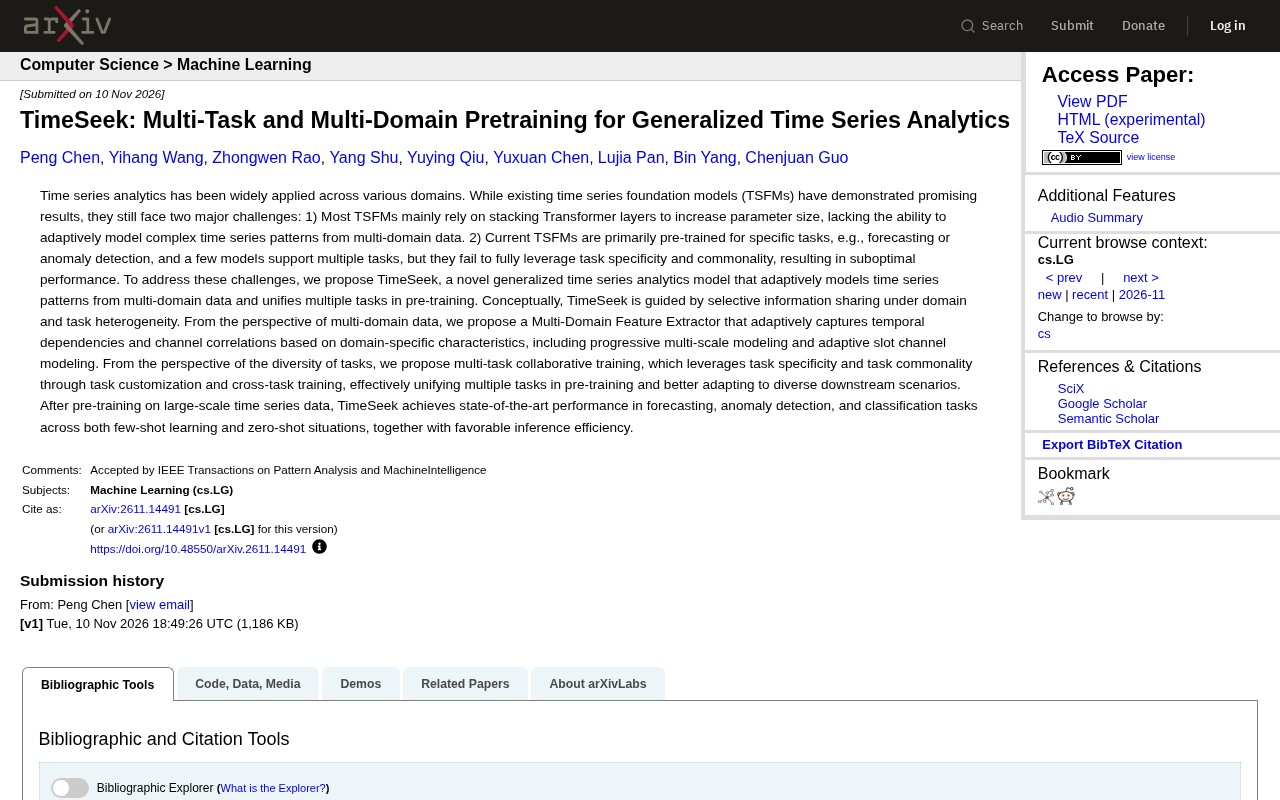
TimeSeek is a time series foundation model designed to address existing models' shortcomings in multi-domain adaptation and multi-task unification. It has two core components: a multi-domain feature extractor that adaptively captures temporal dependencies and channel correlations across domains via progressive multi-scale modeling and adaptive slot channel modeling; and a multi-task collaborative training strategy that unifies forecasting, anomaly detection, and classification during pre-training through task customization and cross-task training, balancing task specificity and commonality. After pre-training on large-scale data, TimeSeek achieves state-of-the-art performance on all three tasks in few-shot and zero-shot settings while maintaining good inference efficiency. The work proposes a "selective information sharing" approach, offering a new paradigm for generalizing time series foundation models.
Time series analysis is widely used in finance, industry, healthcare, and other domains, but existing foundation models often struggle to address all needs at once: some try to boost parameter count by stacking Transformer layers, yet fail to adapt to the complex patterns in multi-domain data; others pre-train for only a single task (such as forecasting or anomaly detection) and cannot balance the commonalities and specificities across tasks. TimeSeek is proposed to tackle both pain points simultaneously—through multi-domain feature extraction and multi-task collaborative training, it achieves generalized time series analysis within a unified framework.
Two Core Challenges: Multi-Domain Adaptation and Multi-Task Unification
The limitations of existing time series foundation models (TSFMs) manifest in two ways. First, most models rely on deepening Transformers to expand capacity, but time series from different domains (such as energy, transportation, and healthcare) have vastly different periodicities, trends, and channel relationships, and a fixed architecture struggles to adaptively capture these differences. Second, most current models are pre-trained for specific tasks; even the few that support multiple tasks fail to fully exploit the specificities and commonalities among tasks, resulting in suboptimal downstream performance. TimeSeek's starting point is precisely "selective information sharing under domain and task heterogeneity"—neither treating all domains and tasks uniformly nor isolating them completely, but selectively sharing useful information.
A Time Series Foundation Model (TSFM) refers to a large model pre-trained on large-scale, multi-domain time series data that can be transferred to downstream tasks via fine-tuning or zero-shot approaches. Similar to GPT-style models in natural language processing, TSFMs aim to learn general representations of time series, thereby reducing each task's dependence on large amounts of labeled data. The core challenge lies in the high heterogeneity of time series data itself: sampling frequencies, periodicities, trends, and inter-channel relationships vary enormously across domains, and downstream tasks span forecasting, anomaly detection, classification, and more. Therefore, TSFMs need strong cross-domain generalization and multi-task adaptability, rather than merely scaling up model size.
Multi-Domain Feature Extraction: Progressive Multi-Scale and Adaptive Channel Modeling
To address the heterogeneity of multi-domain data, TimeSeek designs a Multi-Domain Feature Extractor. It contains two key components: progressive multi-scale modeling and adaptive slot channel modeling. The former captures dependencies at different time scales by gradually expanding the receptive field, while the latter dynamically adjusts inter-channel interactions based on domain characteristics. This design frees the model from relying solely on layer stacking, instead adaptively modeling temporal dependencies and channel correlations according to the data's own characteristics, thereby extracting meaningful representations across data from multiple domains.
Progressive Multi-Scale Modeling is a technique that captures dependencies at different time scales by gradually expanding the receptive field. In time series, short-term fluctuations and long-term trends often require receptive fields of different sizes for modeling. This technique typically employs dilated convolutions, multi-branch pooling, or hierarchical structures, enabling the model to attend to both local details and global patterns simultaneously, avoiding the omission of important information due to a fixed receptive field. Compared with simply stacking Transformer layers, progressive multi-scale modeling more explicitly handles the diversity of time scales, improving the model's adaptability to non-stationary time series.
Adaptive Slot Channel Modeling is a design that dynamically adjusts inter-channel interactions. In multivariate time series, the correlations among different channels (sensors or features) vary by domain: current and voltage are strongly correlated in energy data, whereas relationships among different physiological signals in healthcare data may be weaker and time-varying. The slot mechanism typically refers to a set of learnable parameters or attention units; the model dynamically allocates and combines these slots based on the input data's characteristics, thereby adaptively modeling the dependency structure among channels. This design avoids the inductive bias introduced by fixed channel mixing, enhancing the model's generalization on multi-domain data.
Multi-Task Collaborative Training: Customization and Cross-Task Learning
At the task level, TimeSeek proposes a multi-task collaborative training strategy. It preserves each task's specific output head and loss design through task customization, while sharing underlying representations through cross-task training, allowing tasks such as forecasting, anomaly detection, and classification to benefit one another during pre-training. This "harmony in diversity" approach enables the model to leverage task commonalities to improve generalization while retaining task specificities to avoid negative transfer. Compared with models pre-trained on a single task only, TimeSeek exhibits better adaptability in downstream scenarios.
Cross-Task Training is closely related to Multi-Task Learning (MTL) but places greater emphasis on knowledge transfer and sharing among tasks. In MTL, models typically share underlying representations and retain independent output heads for each task, improving generalization by jointly optimizing multiple task losses. However, when tasks differ greatly, simple sharing may lead to negative transfer, where learning one task harms another's performance. Cross-task training mitigates negative transfer through task customization (such as task-specific loss weights and output head designs) and selective sharing (such as sharing certain layers or modules), while leveraging inter-task commonalities to improve data efficiency. TimeSeek applies this idea to time series pre-training, unifying forecasting, anomaly detection, and classification tasks.
Experimental Results: Leading Performance in Few-Shot and Zero-Shot Settings
After pre-training on large-scale time series data, TimeSeek achieves state-of-the-art performance on all three task types—forecasting, anomaly detection, and classification—covering few-shot learning and zero-shot scenarios while maintaining good inference efficiency. This means the model performs excellently not only when data is abundant but also adapts quickly to label-scarce or entirely new domains, which is crucial for real-world deployment—after all, many business scenarios cannot provide large amounts of labeled data.
From a broader perspective, TimeSeek's value lies in offering a "unified yet not rigid" paradigm: multi-domain feature extraction addresses data heterogeneity, and multi-task collaborative training addresses task diversity; together they bring time series foundation models a step closer to truly general analysis. Of course, the paper does not disclose specific parameter counts or inference latency data, and actual deployment results still require more independent evaluation and verification.
Key Takeaways
- TimeSeek targets two pain points of existing TSFMs: insufficient multi-domain adaptability and inadequate multi-task unification.
- The multi-domain feature extractor adaptively captures temporal dependencies and channel correlations through progressive multi-scale modeling and adaptive slot channel modeling.
- Multi-task collaborative training leverages task customization and cross-task training to unify forecasting, anomaly detection, and classification during pre-training.
- Under few-shot and zero-shot settings, TimeSeek achieves state-of-the-art results on all three major tasks while maintaining good inference efficiency.
One-line Summary
TimeSeek achieves generalized time series analysis through multi-domain feature extraction and multi-task collaborative training.
Related articles

Prompt Engineering for Beginners: From Writing Prompts to Engineering Thinking
Starting from the essence and four functions of prompts, this article systematically explains the six-step process, four success criteria, learning value, and practical limitations of prompt engineering to help you build a complete understanding.

Anthropic Launches Nasdaq IPO: AI Giant's Listing and Risk Disclosures
Anthropic officially launches its Nasdaq IPO under ticker ANT, with market valuation expected to potentially exceed SpaceX's record. The prospectus devotes nearly 100 pages to AI risks, while first-half revenue grew over 14x but net losses widened sharply, reigniting the AI bubble debate.

Rust cURL Clone Uses 4,832 unsafe Blocks—Is the Memory Safety Myth Broken?
A Rust cURL clone uses 4,832 unsafe keywords, challenging Rust's memory safety narrative. We analyze what unsafe really means, compare Fil-C, and examine rewrite motives.