TimeThink: A Synthetic Framework for Teaching Temporal LLMs Compositional Reasoning
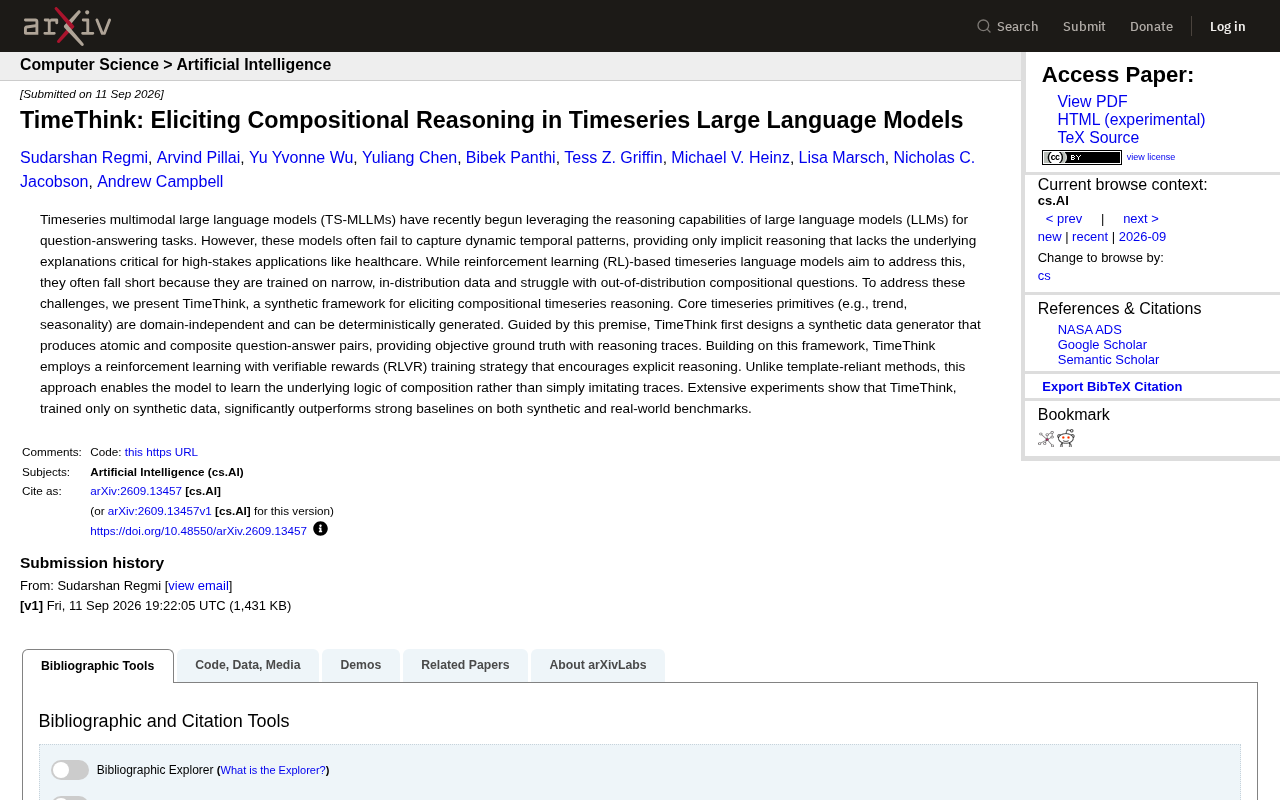
TimeThink uses synthetic time-series data and verifiable-reward RL to teach temporal LLMs explicit, generalizable compositional reasoning.
TS-MLLMs face a critical flaw in high-stakes domains like healthcare and finance: they produce only implicit reasoning conclusions without explaining the underlying logic. Existing RL approaches show improvement but fail to generalize to real-world compositional problems due to narrow in-distribution training. TimeThink proposes a new path: deterministically generating large volumes of atomic and composite synthetic QA data using domain-agnostic time-series primitives like trend and seasonality, combined with RLVR training to teach genuine compositional reasoning rather than template memorization. Trained solely on synthetic data, TimeThink significantly outperforms strong baselines on both synthetic and real-world benchmarks, offering a valuable direction for interpretable and scalable temporal reasoning.
The Reasoning Gap in Temporal LLMs
Time-series multimodal large language models (TS-MLLMs) have increasingly leveraged the reasoning capabilities of LLMs to handle question-answering tasks, aiming to deliver intelligent analysis that is both predictive and explainable in domains like finance, healthcare, and industrial monitoring. Yet a persistent and sharp problem remains: these models struggle to genuinely capture dynamic temporal patterns, typically offering only implicit reasoning without any explicit explanation of the logic behind their conclusions.
For high-stakes applications like medical diagnosis, providing answers without justification is a critical failure. A physician needs to understand why a model flags an anomaly in an ECG signal — not simply accept a black-box output. This is one of the core obstacles preventing TS-MLLMs from real-world deployment.
Why Reinforcement Learning Alone Isn't Enough
The field has already explored reinforcement learning (RL)-based temporal language models to address this issue, training models to follow clearer reasoning paths. However, the paper identifies a significant limitation: these methods are typically trained on narrow, in-distribution data, and break down when confronted with out-of-distribution compositional problems.
Compositional problems are complex questions that require chaining and combining multiple fundamental reasoning steps to answer — for example, simultaneously assessing trend and seasonality while inferring their interaction. Real-world problems are full of exactly this kind of compositional complexity, and the scarcity of targeted training data prevents traditional RL approaches from generalizing.
The distinction between in-distribution and out-of-distribution is key to understanding this limitation. In-distribution means test data comes from the same statistical distribution as training data; out-of-distribution means the model encounters data patterns never seen during training. For temporal reasoning, this is especially problematic: real financial or medical data contains a near-infinite variety of compositional scenarios — trend reversals, overlapping anomalies, cross-cycle interactions — while supervised RL approaches can only form reliable reasoning paths for combinations they've already seen. When faced with a novel combination absent from the training set, the model degrades into surface-level pattern matching, producing conclusions that cannot be traced back. This stands in stark contrast to how human experts reason — flexibly recombining foundational concepts to handle entirely new situations — a capability current RL models lack.
TimeThink's Core Idea: Synthesizing Verifiable Reasoning
TimeThink is built on a key insight: the core primitives of time-series data — such as trend and seasonality — are domain-agnostic and can be generated deterministically. This means it is possible to produce large volumes of training samples with objective ground-truth labels without relying on expensive, scarce real-world annotations.
Building on this premise, TimeThink first designs a synthetic data generator that produces both atomic and composite question-answer pairs. Each pair includes not only a correct answer but also a complete reasoning trace, providing an objective supervision signal for training.
From Imitation to Understanding Compositional Logic
On top of this data framework, TimeThink employs a Reinforcement Learning with Verifiable Rewards (RLVR) training strategy to encourage explicit reasoning. The elegance of this design lies in what it teaches: unlike template-dependent methods, RLVR trains the model to learn the underlying logic of composition rather than simply copying and imitating reasoning traces.
In other words, the model doesn't memorize a fixed set of patterns — it understands how to flexibly combine fundamental reasoning units to tackle new problems. This is precisely the capability needed to handle out-of-distribution compositional questions.
RLVR (Reinforcement Learning with Verifiable Rewards) is a training paradigm that has gained traction in the LLM alignment field. Its core principle is simple: reward signals are only provided when answers can be objectively verified by an automated process. This differs fundamentally from RLHF (Reinforcement Learning from Human Feedback), where rewards come from subjective human raters — a process prone to bias and high in cost. RLVR rewards, by contrast, come from deterministic verifiers, such as checking whether a math answer is correct or whether code runs successfully. The objective computability of temporal primitives (trend direction, cycle length, etc.) makes them a natural fit for the RLVR framework: a model's reasoning conclusions can be directly compared against synthetic ground-truth labels to produce unambiguous reward signals, driving the model to learn genuinely correct reasoning rather than crafting responses designed to please a rater.
Experimental Results and Implications
The experimental results reported in the paper are compelling: TimeThink, trained exclusively on synthetic data, significantly outperforms strong baseline models on both synthetic and real-world benchmarks. This is particularly noteworthy — a model trained purely on synthetic data achieving an advantage on real data validates the core hypothesis that temporal primitives are domain-agnostic.
For the field as a whole, TimeThink offers a low-cost, scalable path forward: by deterministically generating verifiable synthetic data, it sidesteps the bottleneck of real-world annotation, while RLVR ensures the model acquires interpretable, generalizable reasoning capabilities. This has direct value for high-stakes domains like healthcare and finance where explainability is non-negotiable.
Of course, as a newly released arXiv preprint, TimeThink's methods still await broader reproduction and scrutiny, and whether synthetic primitives can fully cover the complexity of real-world temporal patterns remains an open question. But the "synthetic data + verifiable rewards" combination it demonstrates offers a genuinely inspiring direction for advancing reasoning capabilities in temporal LLMs.
Related articles
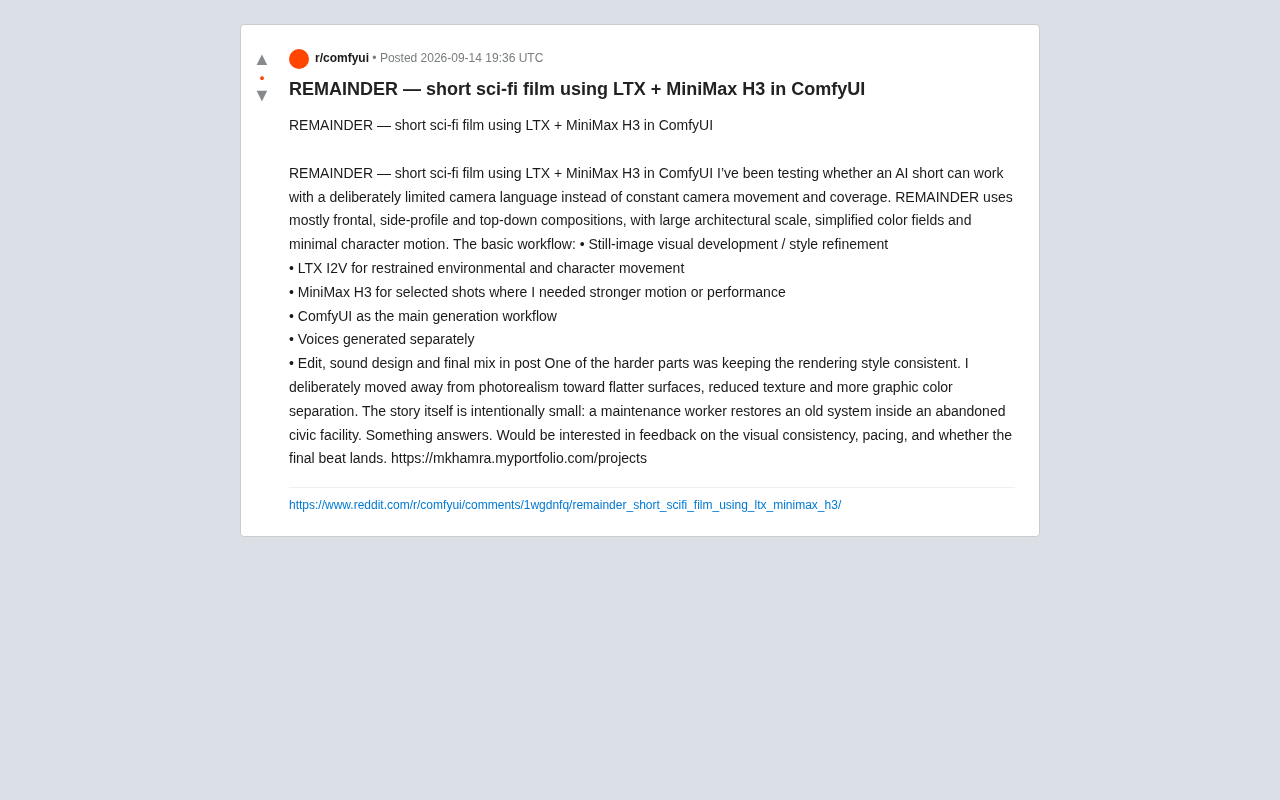
Building an AI Sci-Fi Short with LTX + MiniMax H3: Restrained Cinematography in ComfyUI
Sci-fi short REMAINDER uses LTX, MiniMax H3, and ComfyUI with restrained cinematography and flat aesthetics to solve visual consistency in AI filmmaking.

LangChain Deep Agents vs. MDA: Clearing Up the Confusion for Developers
What's the difference between LangChain's Deep Agents and MDA (Managed Deep Agents)? We break down create_deep_agent vs. define_deep_agent and help developers choose.

Why Is AI Agent Development So Fragmented? The Real Causes and How to Work Around Them
Why does AI Agent development feel so fragmented? Logic scattered across prompts, configs, and frameworks makes portability nearly impossible. Here's why — and how to cope.