Tinder Launches Group Hangouts: Dating App Pivots Toward Social and In-Person Experiences

Tinder launches group dating feature to replace exhausting endless-swipe model with social, real-world experiences.
Tinder has officially launched "Group Hangouts," allowing friends to participate in dating interactions as a group — marking a deliberate shift in the world's largest dating app's core product logic. While the swipe-to-match model reshaped online dating over the past decade, it also bred user fatigue: the endless swipe cycle lacks real emotional connection, and younger users especially crave more social, in-person dating experiences. Group Hangouts lowers the pressure and barrier of first-time social interactions through group participation, aiming to transform dating from a "one-on-one screen game" into a more natural collective social activity. This move is not unique to Tinder — it reflects a broader industry trend toward socialization and offline experiences, though whether it will truly change young users' habits remains to be seen.
Tinder's New Direction: From Endless Swiping to Group Socializing
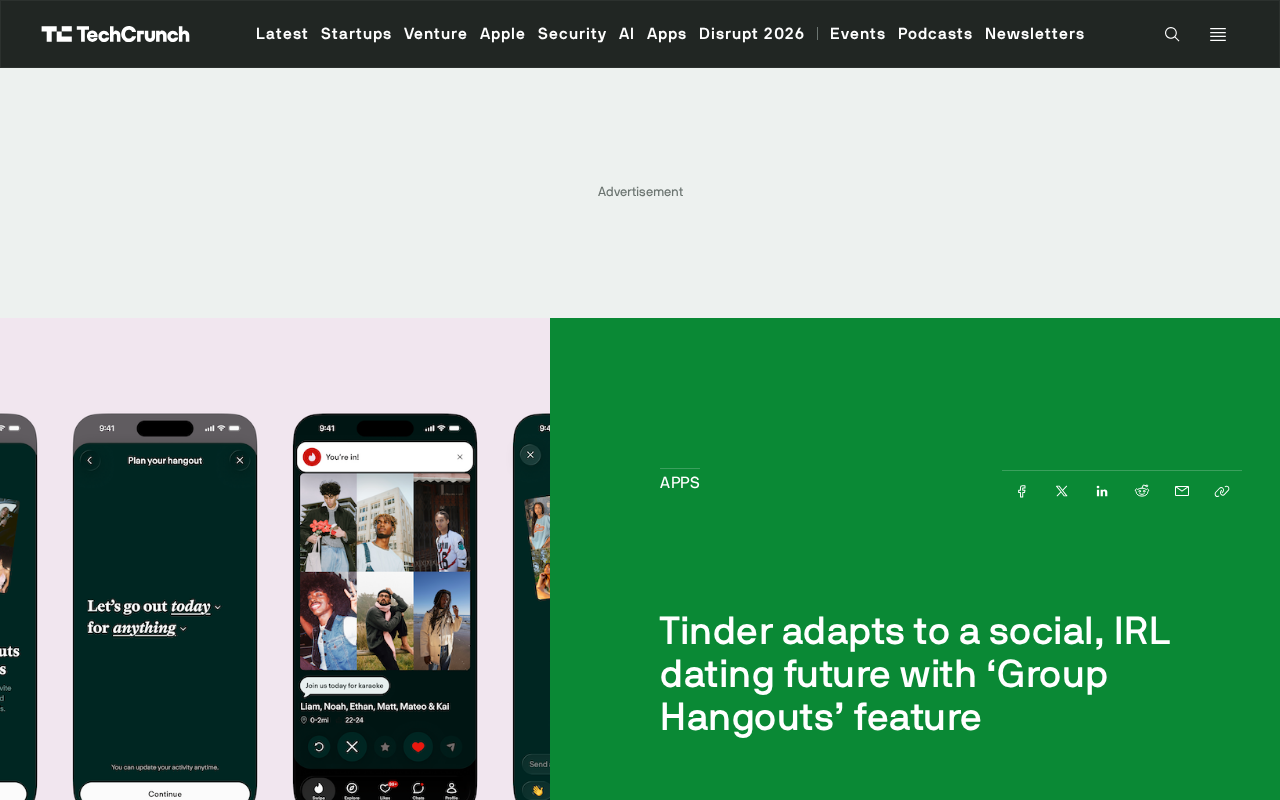
Tinder announced on Wednesday the launch of a new feature called "Group Hangouts," which allows friends to participate in dating interactions as a group. The move signals that the veteran dating app is adapting to a shift in younger users' preferences — away from monotonous left-and-right swiping and toward a more social, real-world dating experience.
As younger generations grow increasingly burned out by "endless swiping," the dating app industry is rapidly recalibrating its strategy to appeal to a user base that wants dating to feel "more social and more grounded in real-world experiences." Tinder's Group Hangouts is the latest product of this trend.
Why Dating Apps Are All "Pivoting"
For over a decade, Tinder reshaped the online dating industry with its swipe-to-match interaction model. But this highly individualized, rapid-consumption matching mechanism is gradually leaving some younger users feeling fatigued. The relentless cycle of swiping, matching, and chatting often lacks genuine emotional connection or social appeal.
The new generation grew up in an environment saturated by social media, and they place greater value on group interaction and real-life (IRL, In Real Life) experiences. For them, dating shouldn't just be a one-on-one game played out on a screen — it should feel more like a social activity shared among friends. This structural shift in user expectations is the core force driving dating apps to rethink their product design.
How Group Hangouts Works
According to Tinder, the Group Hangouts feature allows a group of friends to collectively participate in a dating scenario. Compared to traditional one-on-one matching, the group format lowers the social pressure of first contact and makes interactions feel more like the natural dynamic of friends gathering or doing activities together in real life.
The logic behind this design is that when dating is placed within the context of group socializing, users experience significantly less anxiety around meeting strangers — lowering the barrier to entry while making the experience more fun. For young people who have grown weary of traditional dating apps, this may offer a more relaxed and authentic way to connect.
Industry Trend: Dating Is "Going Back Offline"
Tinder's move is not an isolated case — it's a snapshot of a broader wave of transformation sweeping the entire dating app industry. More and more platforms are recognizing that a model relying purely on algorithmic matching and online chat struggles to retain younger users who crave genuine experiences over the long term.
Building social features and in-person experiences into products has become an industry-wide consensus. Dating apps are no longer content to serve as mere "matching tools" — they're trying to become platforms that facilitate real social relationships. This shift from "digital swiping" to "real-world connection" may redefine the competitive landscape of online dating products over the next few years.
For Tinder, Group Hangouts is both a response to changing user needs and an attempt to find new growth in an increasingly competitive market. Whether it can truly reshape the habits of younger users remains to be seen.
Background
The "swipe-to-match" mechanic was pioneered by Tinder in 2012. Users swipe right to indicate interest and left to pass, and a "match" is formed when both parties swipe right. This design reduced interpersonal attraction to a split-second visual judgment, dramatically lowering the barrier to entry, and drew on the psychology of slot machine-style random rewards — creating a near-addictive behavioral loop as users anticipated matches. For this reason, researchers and psychologists have increasingly pointed out that while this design boosts usage frequency, it may also lead users to "commodify" others and erode the willingness to invest genuine emotional energy. As competitors like Hinge and Bumble entered the market touting "deeper, more meaningful matches," the limitations of the swipe model became increasingly apparent, prompting the industry to broadly reconsider the sustainability of this interaction paradigm.
Beyond Tinder, several emerging dating products have already pioneered the "social-first" approach. Thursday, for instance, operates on a model that opens only one day per week, using scarcity to drive real-world meetups. Timeleft uses an algorithm to assign strangers to the same restaurant for dinner, bypassing online chat entirely. The shared logic across these products is: reduce the time users spend inside the app, and paradoxically exchange that for higher-quality real interactions — boosting both retention and word-of-mouth. For Match Group's Tinder, the launch of Group Hangouts also carries a defensive dimension. With both monthly active users and subscription revenue under pressure, the pivot toward social features is simultaneously a product innovation and a direct response to emerging competitors.
Related articles

Workbuddy for Absolute Beginners: How a Desktop AI Agent Fits Into Real Workflows
A beginner's guide to the Workbuddy desktop AI agent: installation, claiming credits, file management, and building automated workflows—compared with CodeX for fit and cost, helping professionals shift from AI question-askers to AI managers.

OpenAI's New Agent Stack: Computer Use, Decisions API, and Ultra-Fast Workflows
OpenAI Dev Day unveiled a new agent stack: Computer Use outperforms humans, Decisions API delivers ultra-low-latency classification via Luna, Agents API opens the same Computer Use capabilities, and GPT-6.1 Sol costs only one-seventh of Astra. Core updates, benchmark data, and developer insights.

Liang Wenfeng Open-Sources DeepInfo Inference Framework, Takes On U.S. Ban
DeepSeek open-sources its DeepInfo inference framework after its models, featuring GPU/CPU cross-pipelining, small-model prediction with large-model verification, and full Huawei Ascend and NVIDIA chip support—facing the U.S. federal ban head-on. This article analyzes its significance for AI deployment and open-source strategy.