TinyFish: A Unified Web Operating Layer Built for AI Agents

TinyFish provides a unified web operating layer enabling AI agents to reliably search, extract, browse, and authenticate on the real web.
TinyFish is a new platform positioning itself as the unified web operating layer for AI agents. It addresses the critical last-mile problem of AI interacting with the real internet by offering four core capabilities: real-time web search, structured content extraction, dynamic website browsing, and authenticated workflow automation. Launched on Product Hunt with 64 upvotes on day one, TinyFish aims to abstract away the complexity of web interaction so developers can focus on building AI applications rather than maintaining fragile crawling infrastructure.
The "Last Mile" Problem for AI Agents
When we talk about AI agents, we tend to focus on the reasoning capabilities of large language models, multi-turn conversations, or task planning. But a long-underestimated bottleneck remains: How can AI reliably access and operate on the real-world web?
The real internet is filled with dynamically rendered pages, workflows requiring login authentication, and chaotically structured HTML content. For humans, browsing, searching, and filling out forms are second nature; but for AI agents, these are precisely the most error-prone and hardest-to-scale "last mile" challenges.
TinyFish, which recently debuted on Product Hunt, targets exactly this pain point. Positioned as "The web operating layer for AI agents," it aims to provide AI systems with a unified, reliable foundation for web interaction. On its launch day, it received 64 upvotes, ranked 15th for the day, and was featured in both the Developer Tools and Artificial Intelligence categories.
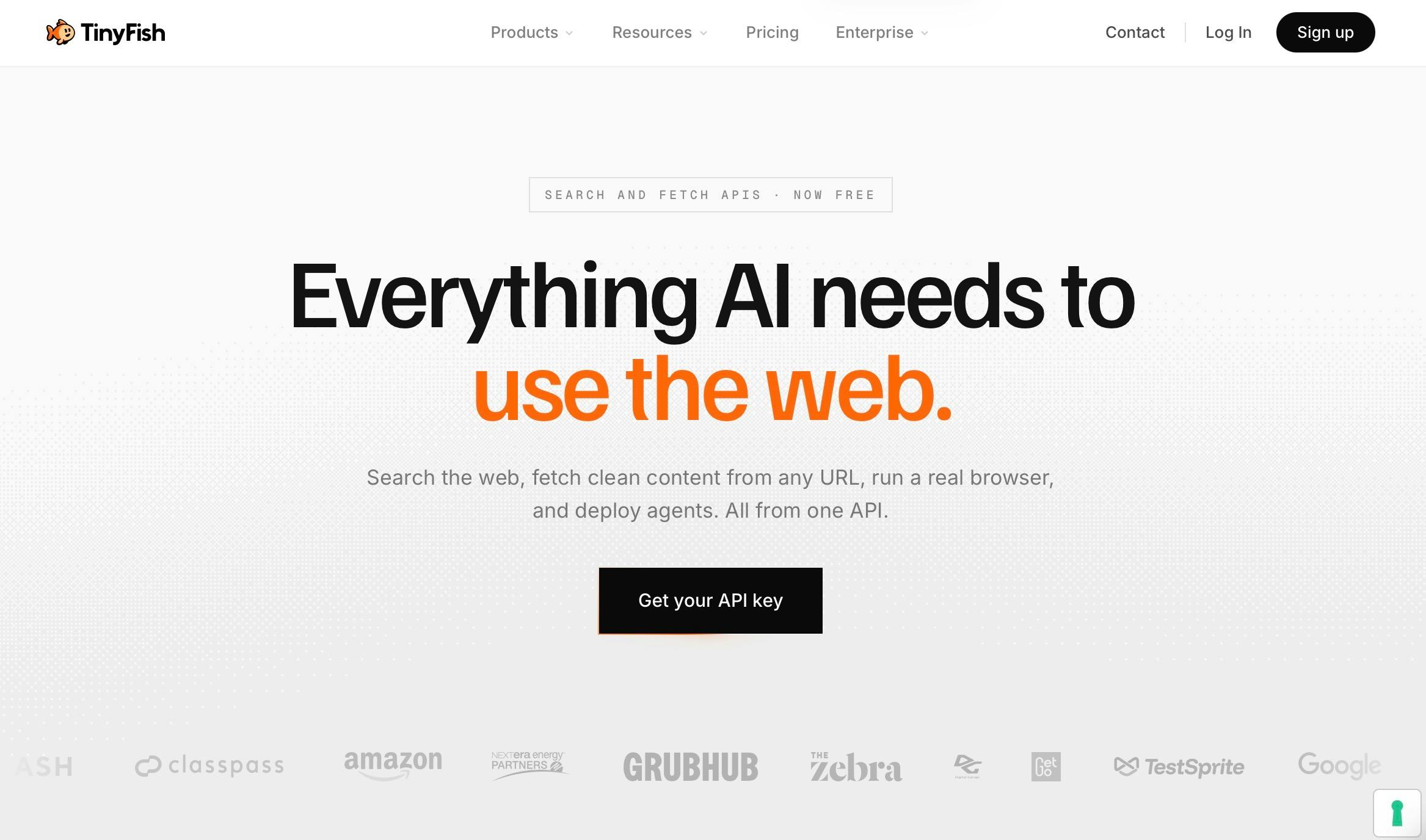
TinyFish Core Features: Four Web Operating Capabilities Explained
According to official descriptions, TinyFish is a unified web operating platform built specifically for AI agents and AI applications. It consolidates multiple complex and fragmented web capabilities into a single platform, covering four core scenarios:
Real-Time Web Search
Large models have an inherent limitation: a training data cutoff date. LLMs are trained on data up to a fixed point in time, meaning models know nothing about events that occurred after that date. For example, GPT-4's training data cuts off in April 2023, and Claude has a similar time boundary. This "knowledge freeze" phenomenon is particularly critical in scenarios requiring real-time information—when users ask about today's stock prices, the latest policy changes, or current product pricing, models either provide outdated answers or admit ignorance. RAG (Retrieval-Augmented Generation) technology was born to solve this problem, dynamically injecting external knowledge during inference to compensate for training data staleness.
TinyFish enables AI agents to retrieve real-time web information, maintaining accuracy when answering time-sensitive questions. This is especially crucial for high-timeliness scenarios like news, finance, and e-commerce pricing.
Structured Content Extraction
Raw web pages are often cluttered with ads, navigation bars, scripts, and other noise. TinyFish can extract clean, structured content from these pages, outputting formats directly consumable by LLMs, reducing the burden on developers to write their own parsing rules. The technical difficulty lies in the fact that DOM structures vary enormously across websites—the same type of information is marked up completely differently on different sites. Traditional rule-based extraction methods using XPath or CSS selectors are extremely fragile and break whenever a site undergoes a redesign. Modern structured extraction solutions typically combine heuristic rules, machine learning models, and the LLM's own comprehension capabilities to achieve more robust content extraction.
Dynamic Website Browsing
A large proportion of today's websites rely on JavaScript for dynamic rendering, making it difficult for traditional crawlers to obtain complete content. Modern web development heavily uses frontend frameworks like React, Vue, and Angular—page content is no longer static HTML returned directly from the server but is dynamically generated by the browser after executing JavaScript. Traditional crawlers (like Scrapy, which is based on HTTP requests) can only fetch the initial HTML document and cannot execute JavaScript, so they often "see" a blank or skeleton page. To address this, the industry developed headless browser technology, such as Puppeteer (based on Chrome DevTools Protocol) and Playwright (open-sourced by Microsoft, supporting multiple browsers), which can simulate a complete browser environment to render pages. However, headless browsers consume significant resources, concurrent management is complex, and they need to handle various anti-detection mechanisms, making scaled deployment a major engineering challenge.
TinyFish supports browsing dynamic websites, ensuring AI can "see" the same pages real users see, while encapsulating the underlying browser management complexity so developers don't need to worry about resource scheduling and anti-detection details.
Authenticated Workflow Automation
This is the most challenging yet most valuable capability. Many real business processes require authentication before operations can be performed—back-office management, order processing, account inquiries, and more. TinyFish provides authenticated workflow automation support, enabling AI agents to truly participate in production-grade business processes. Authentication automation involves multiple technical challenges: Cookie and Session management, automated completion of OAuth 2.0 authorization flows, handling of multi-factor authentication (MFA), and Token refresh mechanism maintenance. The deeper issue is security—how to securely store and use user credentials, how to ensure the principle of least privilege for operations, and how to establish comprehensive audit trail mechanisms.
Why "Web Operating Layer" Is a Critical Abstraction for AI Agents
What's most noteworthy about TinyFish is its choice to position itself as an "operating layer."
In the layered architecture of AI infrastructure, the model layer handles reasoning, the orchestration layer handles task scheduling, and what TinyFish fills is the execution and access layer between agents and the open internet. The tech stack of an AI agent system can be analogized to a traditional software's layered architecture: the model layer is like the "brain," responsible for understanding, reasoning, and generation; the orchestration layer (frameworks like LangChain, AutoGen, CrewAI) is like the "nervous system," responsible for decomposing complex tasks into subtasks and coordinating multi-component collaboration; the tool layer provides specific execution capabilities like code execution, database queries, and API calls; and the web operating layer serves as the bridge between agents and the open internet. The core value of this layered design is separation of concerns—each layer focuses on solving specific problems, upper layers don't need to care about lower-layer implementation details, thereby reducing overall system complexity and improving maintainability.
Without this layer, developers often have to cobble together an entire toolchain of crawlers, headless browsers, proxy IPs, CAPTCHA solvers, session managers, and more—a setup that's both fragile and difficult to maintain.
By abstracting these capabilities into a single platform, TinyFish delivers three-fold value:
- More accurate answers: With real-time, clean web data, AI system outputs become more reliable;
- Lower operational complexity: Developers don't need to reinvent the wheel, reducing attention to low-level networking details;
- Stronger scalability: Designed for production workloads, capable of supporting scaled loads.
In other words, what TinyFish aims to do is make "AI operating on the web" as simple as calling an API.
TinyFish Arrives at a Critical Window for AI Agent Deployment
AI agents are moving from concept to reality, with Computer Use, Browser Use, and other directions for "letting AI operate computers/browsers" becoming industry hotspots. In October 2024, Anthropic released its Computer Use feature, allowing Claude to directly operate computer desktops—moving the mouse, clicking buttons, typing text, and taking screenshots to observe results. This marks a paradigm shift from "conversational assistants" to "executive agents." Meanwhile, the open-source community has produced numerous browser automation projects like Browser Use, WebVoyager, and Mind2Web, exploring how AI can complete web tasks through visual understanding or DOM manipulation. Together, these projects validate a trend: the value of agents is ultimately realized through operating real systems.
On this track, stability and engineering rigor often matter more than flashy demos. Real-world web environments are full of uncertainty—page redesigns, anti-crawling mechanisms, expired login sessions—fragility at any point will cause agents to crash in production. Modern websites deploy multi-layered anti-automation defense systems: CAPTCHAs have evolved from simple text recognition to behavioral analysis types like reCAPTCHA v3 and Cloudflare Turnstile; browser fingerprint detection can identify headless browser characteristics (such as missing WebGL rendering or abnormal navigator properties); rate limiting and IP reputation systems block anomalous traffic patterns; and some sites even detect mouse movement trajectories and keyboard input patterns to distinguish humans from bots. This ongoing "sword and shield" arms race means maintaining a stable web automation system requires continuous investment of substantial engineering resources.
TinyFish's emphasis on "reliable access" and "production workloads" precisely captures the deepest chasm between demo and deployment.
It's worth noting that TinyFish's Maker team includes Sudheesh Nair—a background that lends additional credibility to its engineering and deployment capabilities.
Opportunities and Points Yet to Be Proven
As a product that just debuted on Product Hunt, TinyFish currently presents itself more in terms of vision and capability lists. Several questions remain to be validated through time and practice:
- Where are the boundaries of reliability: Against frequently redesigned websites and increasingly strict anti-automation mechanisms, how stable is the platform? Web automation has a widely recognized "fragility problem"—even the most mature automation testing frameworks require continuous maintenance when facing frequently changing frontend code. TinyFish needs to prove it can maintain a sufficiently high success rate in this ongoing arms race.
- Compliance and security of authentication automation: Performing post-login operations on behalf of users involves credential management and permission boundaries, requiring mature security design. This isn't just a technical issue—it also involves legal compliance. Different regions have varying legal definitions for automated access; regulations like the CFAA (Computer Fraud and Abuse Act) strictly limit unauthorized access, and the platform needs to find balance between technical capabilities and compliance frameworks.
- Pricing and ecosystem: As an infrastructure product, whether it can support high-frequency calls at reasonable cost will directly determine its adoption rate among developers. Referencing pricing models of similar products (like Browserless, ScrapingBee, etc.), per-request billing is common practice, but AI agents may call at frequencies far higher than traditional crawler scenarios, making cost control a key consideration.
Nevertheless, the direction TinyFish points toward is undoubtedly correct. As more AI applications need to "step outside the model and into the web," a reliable web operating layer will become an indispensable component of agent infrastructure.
Conclusion
TinyFish represents a microcosm of AI infrastructure evolution: as agent capabilities improve, the industry's focus is shifting from "can AI think" to "can AI reliably act." Whoever can make the dirty, hard work of "operating the real web" solid and scalable has the opportunity to become one of the foundational pillars of the agent era. For developers building AI applications, the emergence of web operating layer platforms like TinyFish means they can redirect more energy back to their core business, rather than being dragged down by the complexity of web interaction.
Related articles

Chain of Thought Isn't Just for AI: How Humans Can Use CoT to Improve Thinking Quality
Chain of Thought isn't just a prompt trick for large models. Starting from a Hacker News discussion, this article analyzes why CoT works for human thinking too, breaks down actionable ways to transfer it, and highlights the key differences between human CoT and machine CoT.
Cloudflare Teams Up with OpenAI: Closi…
Cloudflare Teams Up with OpenAI: Closing the Loop from Vulnerability Discovery to Defense with AI
Cloudflare uses OpenAI Daybreak to investigate security vulnerabilities and generate reviewable remediation plans, while developers use Codex to boost coding efficiency and quality.

Orca Multi-Agent Orchestration in Practice: A Guide to Parallel Collaboration with Claude and Codex
Orca is Stable AI's free open-source agent workbench supporting 34 agents like Claude Code and Codex in parallel. Learn its Git worktree isolation, multi-model orchestration, and mobile management.