Tired of Checking GPU Cloud Prices by Hand, So I Built a Price Index API

Tired of manual price comparison, the author built a normalized GPU cloud price index API and expanded it into multiple pricing and data query endpoints.
The author got tired of manually comparing prices across multiple GPU cloud pricing pages, so he built GPU Index — an hourly-refreshed dataset and API that normalizes GPU cloud prices and clearly tags spot, on-demand, and contract types. Its core value is preserving price type labels to prevent comparing three-year contract rates with spot instances. The API offers /prices, /summary, /gpus, and /providers endpoints, filterable by GPU family, provider, and price type, with each price row including a source URL. The author also extended the same pattern to an LLM Token price index, a domain price index, CT Lookup, and an email deliverability check API, all sharing a free tier of 1,000 requests per month.
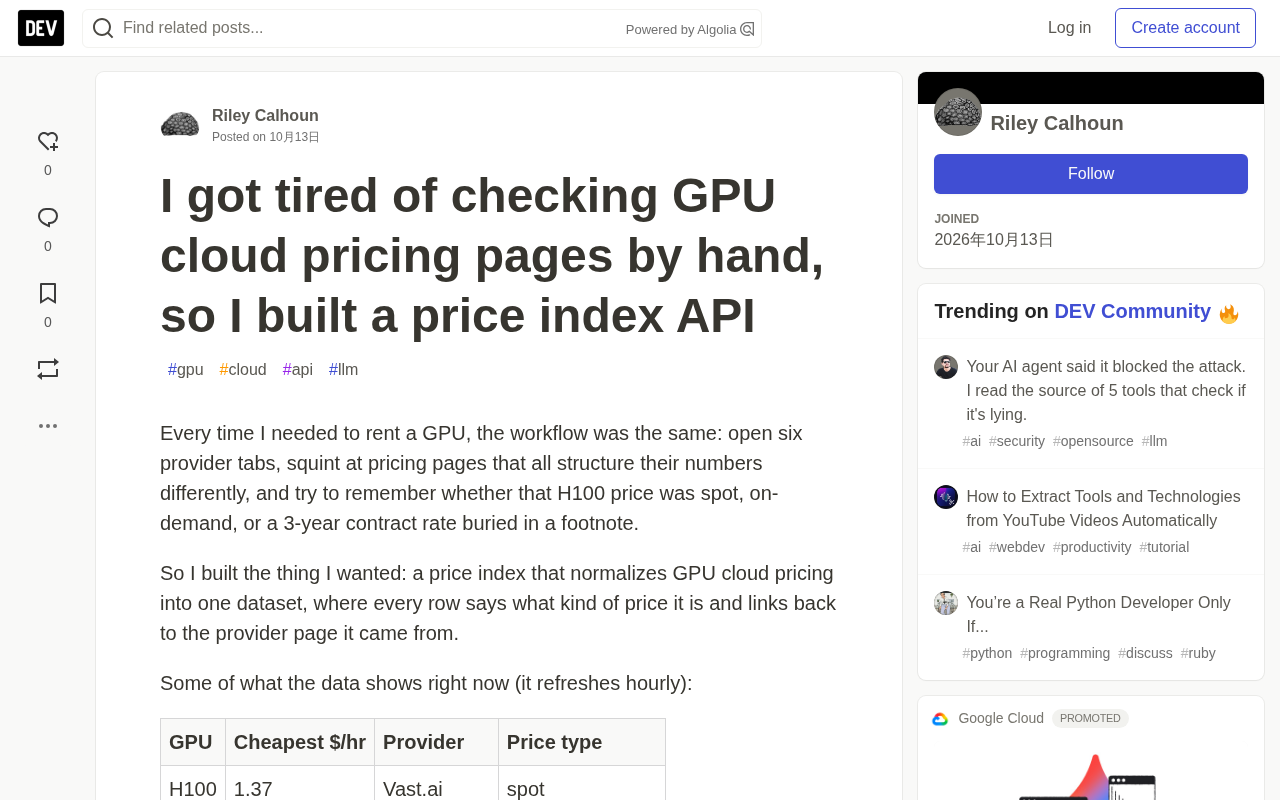
Every time I rent a GPU, I have to open six tabs, squint at pricing pages with wildly different layouts, and try to figure out whether this H100 price is a spot instance, on-demand, or a three-year contract rate buried in a footnote. That repetitive grind made me decide to build a price index that normalizes GPU cloud pricing into a single dataset, where every row is tagged with its price type and links back to the original provider page. The data refreshes hourly, and it's now live on RapidAPI as the GPU Index, with a free tier you can try.
Unified Price Types, No More Numbers Games
The core value of this index is the price type column. An A100 at $1.15 sounds cheaper than an H100 at $1.37, but the former is a three-year contract and the latter is a spot instance — they're not remotely comparable. Most comparison content erases this distinction, while this index preserves it.
Here's a snapshot of the current data:
| GPU | Lowest $/hr | Provider | Price Type |
|---|---|---|---|
| H100 | 1.37 | Vast.ai | Spot |
| H200 | 2.62 | CoreWeave | Spot |
| A100 | 1.15 | Paperspace | 3-Year Contract |
| L40S | 0.79 | RunPod | Community Cloud |
| B200 | 4.26 | CoreWeave | Spot |
According to the author, each price row includes a source URL for verification. The API endpoints are designed for simplicity: /prices returns the full normalized dataset with filtering by GPU family, provider, or price type; /summary gives the lowest price per family; /gpus and /providers list coverage and freshness for each source.
Spot Instances are a model where cloud providers sell idle compute capacity at a discount. Prices are usually far below on-demand instances, but they can be reclaimed at any time — when on-demand users need those resources, spot instances get interrupted within a short window. That makes them suitable for workloads that can tolerate interruption and support checkpointing, such as batch inference or fault-tolerant tasks in model training. On-Demand Instances are the standard mode: instant availability, fixed pricing, no forced reclamation, suited to production services that demand stability. Reserved/Committed pricing typically requires a one- or three-year commitment in exchange for a significant discount, but offers the least flexibility. Unit prices across these three can't be compared directly — you have to look at the price type first, then factor in workload characteristics to judge true cost.
Beyond GPUs: Other Price Indexes I Built Along the Way
The author applied the same pattern to several other datasets he was frequently checking by hand:
- LLM Token Price Index: 458 models, with input/output token prices normalized across providers, making it easy to compare the same model side by side.
- Domain Price Index: Lists registration/renewal/transfer prices by TLD. The author specifically points out that renewal pricing is where registrars actually make their money.
- CT Lookup: Outputs Certificate Transparency data as JSON, with a monitoring list that can catch certificates issued for your domain that you never requested.
- Email Deliverability Check: Returns SPF/DKIM/DMARC/MX/rDNS verdicts for a domain in a single call, with remediation hints.
These APIs share the same free tier, reportedly 1,000 requests per month.
Certificate Transparency (CT) is a public auditing mechanism that requires Certificate Authorities (CAs) to record every issued TLS certificate in publicly accessible, append-only, verifiable logs. Anyone can query these logs to monitor for certificates issued for their domain without their knowledge — often a precursor to domain hijacking, mis-issuance, or phishing attacks. APIs like CT Lookup output raw log data as JSON and allow maintaining a monitoring list, triggering an alert whenever a new certificate matching a target domain appears. For ops and security teams, this is a practical complement to certificate lifecycle management and intrusion detection.
Why an API Beats Rolling Your Own Scraper
The author makes a clear point in the post: if you're building a router, a cost dashboard, or anything that programmatically selects compute or models, calling an API is less hassle than maintaining your own scraper. That's especially true for him.
He notes that manually comparing prices isn't just time-consuming — it's error-prone. Different providers have different pricing page structures, and spot, on-demand, and contract prices are often mixed together without unified labels. A self-built scraper has to continuously deal with page redesigns and anti-scraping mechanisms.
This price index tries to solve the data normalization problem, not to provide the lowest price itself. It makes price types explicit so developers can filter based on their own needs: if a workload can tolerate interruption, spot instances may be cheaper; if long-term stability is required, contract pricing may be more appropriate. Without price type labels, those decisions lack a foundation.
SPF, DKIM, and DMARC are the three core mechanisms of email authentication: SPF uses DNS TXT records to declare which servers are authorized to send mail on behalf of the domain; DKIM uses public-key cryptography to sign messages, letting recipients verify signature integrity and origin; DMARC builds on the previous two to tell recipients how to handle verification failures and to receive aggregate reports. MX records specify a domain's mail-receiving servers, while rDNS (reverse DNS) resolves an IP back to a hostname, often used to judge whether a sending IP matches its claimed identity. The email deliverability check API returns all these verdicts at once, helping developers quickly pinpoint why emails are landing in spam.
Free Tier and Invitation for Feedback
All APIs have a free tier. The author welcomes feedback and directly asks which providers or GPU families are still missing. For developers who need to programmatically choose GPU cloud or LLM services, this kind of normalized pricing API may be more practical than manually maintaining scrapers.
If you're building a cost comparison tool or a compute scheduler, you can start with the GPU Index free tier and see whether its provider coverage and price types meet your needs.
One-line Summary
The author got tired of manual price comparison and built a normalized GPU cloud price index API, expanding it into multiple pricing and data query endpoints.
Paragraph Summary
Tired of manually comparing prices across multiple GPU cloud pricing pages, the author built GPU Index — a dataset and API that refreshes hourly, normalizes GPU cloud prices, and clearly tags spot, on-demand, and contract types. Its core value is preserving price type labels to avoid directly comparing three-year contract rates with spot instances. The API offers /prices, /summary, /gpus, /providers endpoints with filtering by GPU family, provider, and price type, and each price row includes a source URL. The author also extended the same pattern to an LLM Token price index, a domain price index, CT Lookup, and an email deliverability check API, all sharing a free tier of 1,000 requests per month.
Related articles

MCP Protocol in 60 Seconds: A Real Session, Message by Message
Dissecting a real MCP session message by message: how an Agent dynamically discovers tools, forwards call requests, and has an MCP server execute them — all in just 9 JSON messages, with the model and reasoning loop untouched.

n8n 40-Minute Masterclass: Build Your First AI Automation Workflow from Scratch
Distilled from a 40-minute n8n masterclass: the core differences between automation, AI, and AI Agents, a comparison of n8n's four deployment methods, and a complete guide from dashboard to your first workflow.

Why Does a 35GB Quantized Model Blow Up an 80GB GPU? The Truth About KV Cache VRAM
Why does a 35GB 4-bit quantized LLM still blow up an 80GB GPU? This article breaks down the four components of inference VRAM, provides precise KV Cache formulas, compares GQA vs DeepSeek MLA memory, and offers production-grade OOM prevention like FP8 KV Cache.