TITAN Framework: Unlocking the Sparse Circuit Mechanism Behind Low-Resource Multilingual Translation

Research reveals the internal sparse circuit mechanism of low-resource translation in multilingual models, proposing a method that significantly improves translation quality by updating only 5% of parameters.
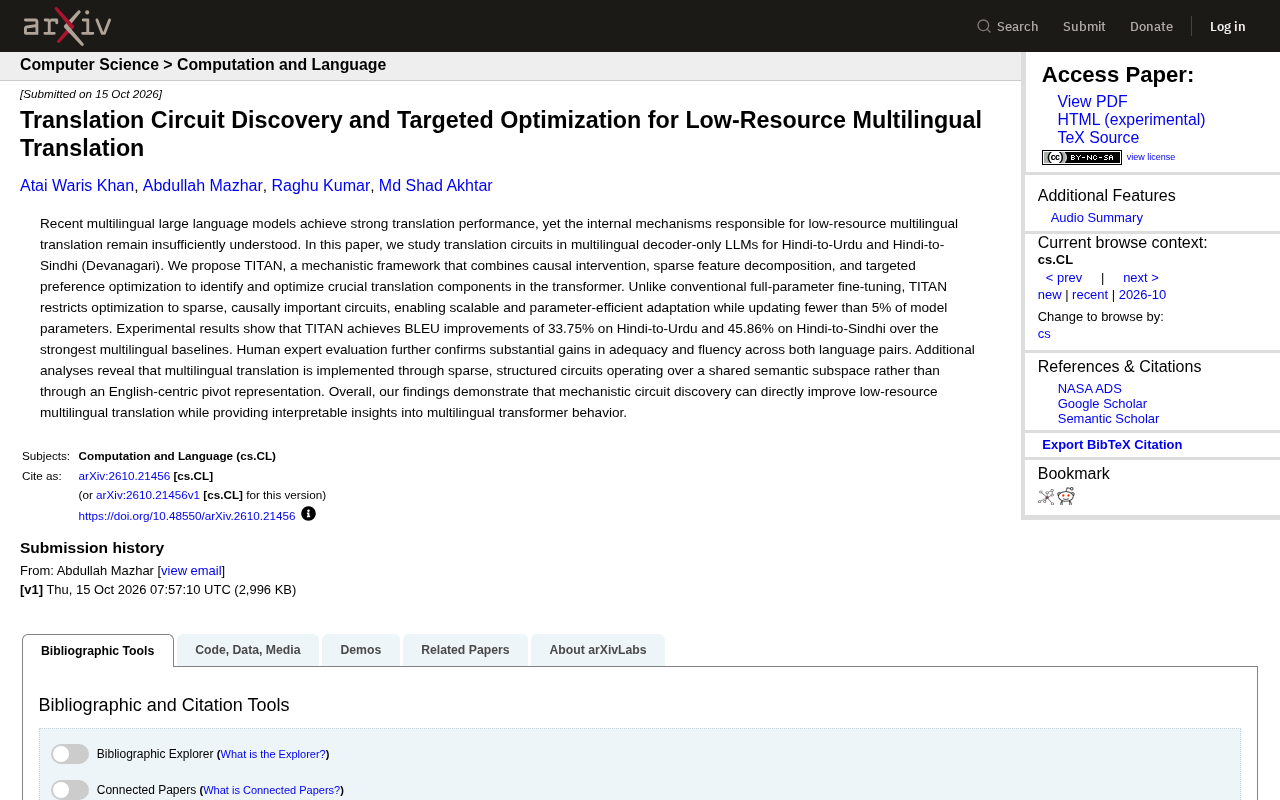
This study addresses the translation bottleneck for low-resource language pairs such as Hindi-to-Urdu and Hindi-to-Sindhi by proposing the TITAN framework, which combines causal intervention, sparse feature decomposition, and targeted preference optimization. By localizing the key circuits that truly carry translation capability, it achieves precise optimization updating less than 5% of parameters. TITAN achieves 33.75% and 45.86% BLEU improvements on the two language pairs respectively, with human evaluation confirming significantly better adequacy and fluency. Mechanistic analysis shows translation relies on sparse structured circuits on a shared semantic subspace rather than pivoting through English, challenging traditional assumptions and offering a new path for low-resource NLP that does not depend on stacking data.
Multilingual large models perform impressively on translation tasks, but a fundamental question remains unresolved: when a model handles a low-resource language pair like Hindi to Urdu, what exactly happens inside the transformer? A recent study provides a mechanistic answer and proposes a new method that dramatically improves translation quality by updating less than 5% of parameters.
Why the "Black Box" of Low-Resource Translation Must Be Opened
The current mainstream approach to multilingual model training is to scale up parameters and corpus coverage, but quality improvements for low-resource language pairs often hit a bottleneck. Researchers realized that the key issue may not be that the model "hasn't learned enough," but rather that our understanding of the model's internal translation mechanisms is essentially zero.
This study focuses on two typical low-resource language pairs: Hindi to Urdu, and Hindi to Sindhi (Devanagari script). These two pairs were not chosen arbitrarily—they share some cultural context and lexical roots, yet show significantly different translation performance in existing models, providing a natural controlled comparison for mechanistic analysis.
The conventional view tends to assume that multilingual models implicitly use English as a "pivot" when handling non-English language pairs. But the findings of this study directly challenge that assumption.
The TITAN Framework: A Three-Pronged Precision Surgery
The core idea of the TITAN framework proposed by the research team is to shift translation capability optimization from "full-parameter fine-tuning" to "causal circuit localization and targeted optimization." Specifically, it combines three technical approaches:
Causal intervention is used to identify which attention heads or feed-forward layers have a decisive impact on translation output. Sparse feature decomposition helps researchers distill structured features that truly carry translation information from high-dimensional activations. Targeted preference optimization strictly limits the optimization scope to the identified key circuits.
The effect of this combination is quite direct: the entire optimization process updates less than 5% of the model's total parameters. Compared to traditional fine-tuning approaches that require retraining all weights, TITAN has clear advantages in computational cost and deployment flexibility.
The core tools of causal intervention are activation patching and causal tracing. Researchers first feed a source-language text into the model and record the activation values of attention heads and feed-forward networks at each layer; then, under the target-language input, they restore these activations layer by layer and observe whether the translation output recovers correctly. If restoring a particular position significantly improves the output, that position is judged to be a key node in the translation circuit. This method has been validated in tasks such as factual recall and syntactic processing, and here it is systematically applied for the first time to circuit localization in low-resource translation.
Sparse feature decomposition is typically implemented with a Sparse Autoencoder (SAE). Activation vectors inside a transformer are extremely high-dimensional and highly entangled, with individual neurons often responding to multiple semantics simultaneously. Through joint training with reconstruction error and sparsity penalties, SAE decomposes dense activations into thousands of interpretable sparse feature directions. Researchers can thus distinguish which features truly encode cross-lingual semantic mappings and which are merely noise, avoiding wasted optimization budget on irrelevant directions.
A Quantitative Leap in Translation Quality
The experimental data is the most convincing part of this study. In the Hindi-to-Urdu direction, TITAN achieves a 33.75% BLEU improvement over the strongest multilingual baseline model; in the Hindi-to-Sindhi direction, this figure reaches 45.86%.
Absolute improvements of this magnitude in BLEU scores are uncommon in low-resource translation. An improvement of over thirty or even forty percent means the translation output has undergone a qualitative change in lexical matching and phrase structure.
Human expert evaluation further validates the credibility of the automatic metrics. Evaluators gave significantly higher scores than the baseline on both adequacy and fluency dimensions, indicating that the improvement is not an artifact of overfitting to a particular automatic metric.
BLEU (Bilingual Evaluation Understudy) measures translation quality by calculating the overlap rate of n-grams (typically 1- to 4-grams) between model output and reference translations, with a length penalty for overly short outputs. Its range is 0 to 100, but it is not a linear scale: an improvement of around 30 points is already considerable in medium-to-high-resource tasks, while low-resource language pairs often have low baseline scores due to scarce reference corpora and large morphological differences. A relative leap of 33% to 46% means the output crosses from "barely readable" into "basically usable" territory.
It is worth noting that BLEU is sensitive to morphological variation, and Hindi, Urdu, and Sindhi all have rich morphological inflection, where the same meaning can be realized through multiple word forms. Therefore, researchers introduced human evaluation as cross-validation: adequacy examines whether the translation fully conveys the source text information, and fluency examines whether the translation conforms to the target language's expression conventions. Significant improvements on both dimensions simultaneously indicate that the gains do not come merely from incidental optimization of surface-level word matching.
Sparse Circuits Challenge the "English Pivot" Hypothesis
The most theoretically impactful finding of this study lies in its reconceptualization of the internal representations underlying multilingual translation. Analysis shows that the translation process actually operates through sparse, structured circuits on a shared semantic subspace, rather than relying on English-centric pivot representations.
In other words, the model does not need to first "translate Hindi into English" and then translate into Urdu or Sindhi. It has more direct cross-lingual mapping pathways internally—these pathways are just distributed across specific sparse circuits, which past full-parameter fine-tuning methods struggle to precisely strengthen.
This finding also advances interpretability research on multilingual models. If translation capability can be localized to specific circuit structures, then future optimization for other low-resource language pairs has a reusable methodological framework.
The English pivot hypothesis stems from a widely observed phenomenon: English corpora constitute an extremely high proportion of multilingual model pretraining, so translation between non-English language pairs may implicitly go through English as an intermediary. The typical evidence supporting this hypothesis is the "zero-shot translation" phenomenon—the model has never seen parallel corpora for a certain language pair yet can complete the translation, leading researchers to speculate that English serves as a shared semantic hub.
This study directly tested this pathway using causal intervention: if English pivoting holds, then when translating Hindi to Urdu, masking or replacing English-related intermediate representations should cause output collapse. However, experiments show that key circuits are concentrated in sparse subspaces with low overlap with English processing, indicating that the cross-lingual mappings the model learns are more direct than the pivot hypothesis describes. This conclusion engages in dialogue with recent research on the "semantic hub" in multilingual models—shared representations may exist, but their carrier is not necessarily English itself.
Implications for Low-Resource NLP
The value of TITAN lies not only in the performance numbers on two language pairs, but more importantly in demonstrating a technical path different from "stacking data and parameters." For truly resource-scarce languages, the cost of collecting large-scale parallel corpora is extremely high, and mining existing capabilities from within the model for targeted enhancement is clearly a more pragmatic path.
Of course, this study currently covers a limited number of language pairs, and whether the circuit discovery method can transfer to language combinations with greater grammatical differences still requires more validation. But at least it points in a direction: understanding internal model mechanisms can, in turn, become a direct means of improving model capabilities.
One-line Summary
Research reveals the internal sparse circuit mechanism of low-resource translation in multilingual models, proposing a method that significantly improves translation quality by updating only 5% of parameters.
Paragraph Summary
This study addresses the translation bottleneck for low-resource language pairs such as Hindi-to-Urdu and Hindi-to-Sindhi by proposing the TITAN framework, which combines causal intervention, sparse feature decomposition, and targeted preference optimization. By localizing the key circuits that truly carry translation capability within the model, it achieves precise optimization updating less than 5% of parameters. Experimental results show that TITAN achieves a 33.75% BLEU improvement in the Hindi-to-Urdu direction and 45.86% in the Hindi-to-Sindhi direction, with human evaluation also confirming significantly better adequacy and fluency than the baseline. More importantly, mechanistic analysis shows that translation relies on sparse structured circuits operating on a shared semantic subspace rather than pivoting through English, challenging traditional assumptions about multilingual models and offering a new path for low-resource NLP that does not depend on stacking data.
Related articles

Chain of Thought Isn't Just for AI: How Humans Can Use CoT to Improve Thinking Quality
Chain of Thought isn't just a prompt trick for large models. Starting from a Hacker News discussion, this article analyzes why CoT works for human thinking too, breaks down actionable ways to transfer it, and highlights the key differences between human CoT and machine CoT.
Cloudflare Teams Up with OpenAI: Closi…
Cloudflare Teams Up with OpenAI: Closing the Loop from Vulnerability Discovery to Defense with AI
Cloudflare uses OpenAI Daybreak to investigate security vulnerabilities and generate reviewable remediation plans, while developers use Codex to boost coding efficiency and quality.

Orca Multi-Agent Orchestration in Practice: A Guide to Parallel Collaboration with Claude and Codex
Orca is Stable AI's free open-source agent workbench supporting 34 agents like Claude Code and Codex in parallel. Learn its Git worktree isolation, multi-model orchestration, and mobile management.