ToDo.is: Hand Your To-Dos to an AI Agent That Actually Does the Work

ToDo.is lets an AI agent actually execute your to-dos and report results across platforms.
ToDo.is upgrades the to-do list into an AI execution agent—write down a task and the agent actually completes it and reports back. It covers research with sources, file and image generation, scheduled briefings, and price alerts, runs tasks in an isolated sandbox, and supports web, Android, WhatsApp, Telegram, and your own Chrome browser. It emphasizes "limited autonomy," asking before irreversible actions like payment, sending, or deletion. A $1 trial lowers the barrier, but long-term value depends on execution success rates. Target users are knowledge workers handling many trivial, automatable tasks.
From To-Do List to "Execution Agent": A Leap Forward
Traditional to-do apps only record tasks—whether they get done is entirely up to you. ToDo.is, a new product ranked #9 on Product Hunt, tries to break that boundary: you write down a to-do, and a always-on AI agent actually goes out and executes it. The official examples are refreshingly blunt—type "find a cheap flight to Lisbon" or "convert this PDF to Word," and the agent will research on its own with sources attached, generate files and images, call websites, and finally report back to you via web, Android, WhatsApp, or Telegram.
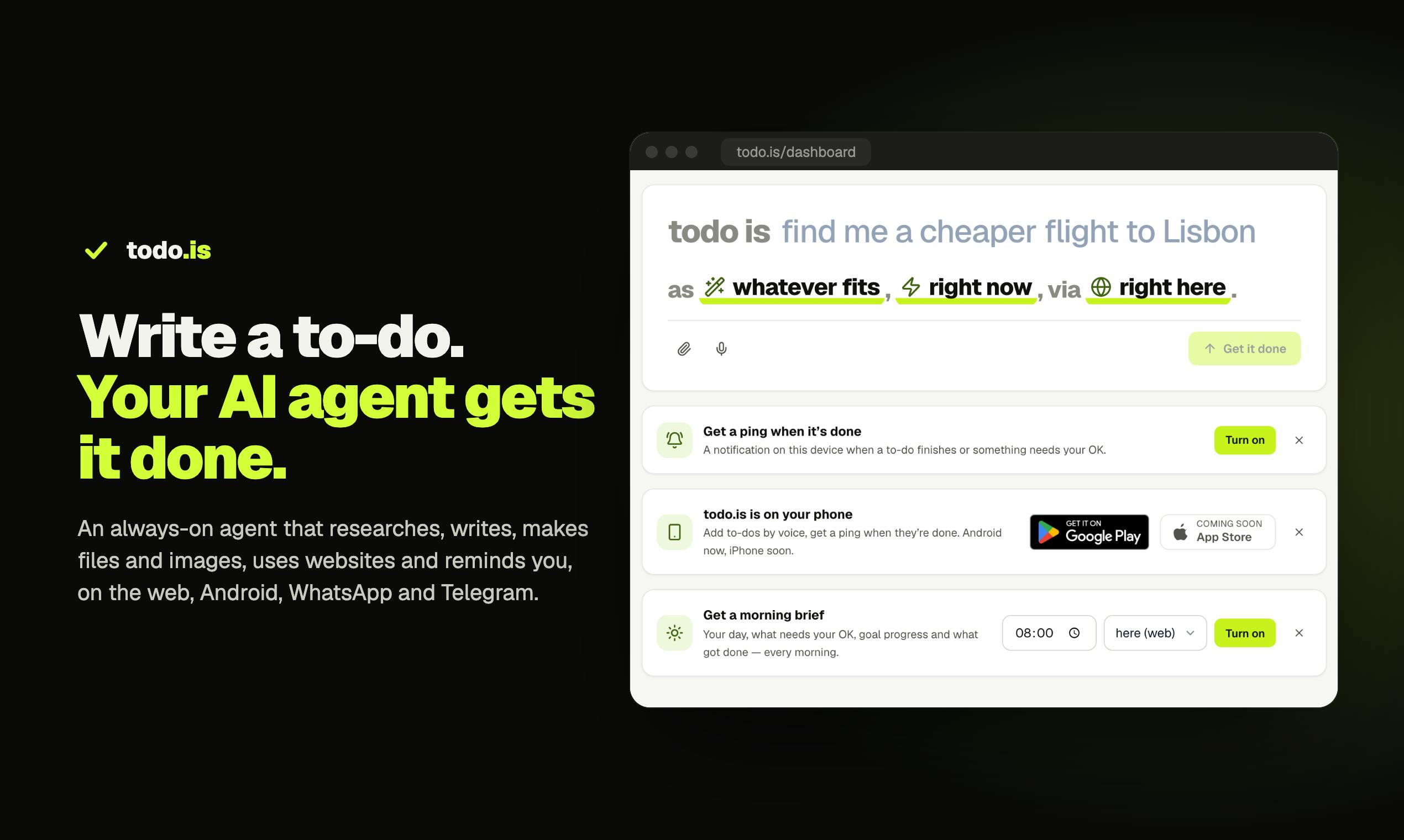
This "write it down and someone does it" interaction turns the to-do list from a passive recording tool into a task execution entry point. The product is currently priced at a $1 trial, has earned 79 votes and 11 comments on Product Hunt, and spans categories including Android, Chrome extensions, productivity, task management, and artificial intelligence.
What It Can Actually Do for You
Research, Generation, and Automation
According to the official description, ToDo.is's capabilities fall into roughly three layers. The first is information research: for open-ended tasks like "find a cheap flight," the agent retrieves information and provides sources rather than tossing out an unsupported answer. The second is content production: converting PDFs to Word, generating files and images—typical format conversion and asset creation. The third is scheduled automation: the agent executes daily briefings and price alerts on a schedule, meaning it doesn't just respond to one-off commands but can also handle recurring monitoring work.
Interestingly, these tasks run in the agent's own sandbox and are claimed to be online 24/7. The agent remembers your preferences and retains context across sessions—this is the key differentiator from an ordinary chatbot: a to-do isn't a one-off conversation but a task stream with continuous memory.
Working in Your Browser
The product also supports operating in your own Chrome, with a Chrome extension included. This is practical for tasks that require a logged-in state (such as checking orders or filling out forms), because the agent can directly reuse your already-authenticated browser environment. Of course, this also means permission boundaries need extra care, and the official response is that it "will ask before paying, sending, or deleting anything."
Login-state reuse and risks in browser automation
ToDo.is's mention of "operating in your own Chrome" typically relies on a browser extension or remote debugging protocol (such as Chrome DevTools Protocol) to drive the user's already-logged-in browser instance. The advantage is that the agent can directly access the user's authenticated session, bypassing the login flow, making it suitable for tasks requiring identity like checking orders or filling out forms. But the risks are obvious too: the agent could theoretically access all logged-in sites in that browser, and if induced by malicious instructions or if a logic flaw occurs, it could cause unauthorized actions. As a result, common industry safeguards include restricting operable domains, requiring secondary confirmation for sensitive actions, and running the agent in an isolated browser profile. ToDo.is's claim that it asks before paying, sending, or deleting is a direct response to this risk.
AI agent "memory" and cross-session context
Traditional chatbot conversations are usually stateless—context is lost after each session ends. ToDo.is emphasizes that the agent remembers preferences and retains context across sessions, which typically relies on persistent memory storage: writing the user's historical instructions, task results, and preference settings to a database, then retrieving relevant memories and injecting them into the prompt when a new task begins. This mechanism makes to-dos a continuous task stream rather than isolated one-off conversations. However, memory also brings privacy and accuracy issues—what information should be remembered, for how long, and how to avoid outdated preferences interfering with new tasks are all design trade-offs the product needs to weigh.
Multi-Platform Reach: Putting the Agent Inside Your Existing Chat Tools
ToDo.is doesn't force users to install a new app. Beyond web and Android, it places entry points in WhatsApp and Telegram—you can issue to-dos and receive reports directly within your everyday chat interfaces. This design choice is pragmatic: the biggest enemy of task management is "opening one more app," and chat tools are places users already open frequently.
Daily briefings and price alerts are pushed through the same channels, forming a closed loop of "issue—execute—feedback." For people accustomed to handling errands via instant messaging, the learning curve is nearly zero.
Safety Boundaries: Ask Before Acting
The biggest concern about letting an AI agent operate web pages and process files on your behalf is losing control. ToDo.is's constraint is: for three types of irreversible actions—payment, sending messages, and deleting data—the agent will seek confirmation first. This rule seems simple but draws a reasonable boundary for agent autonomy—research, generation, and organization can be left to the agent, while destructive operations must have human oversight.
From a product positioning standpoint, this is a "limited autonomy" approach: the agent bears the execution cost while humans retain veto power. As for whether sandbox isolation can truly prevent unauthorized actions and whether browser reuse brings account risks, the official description doesn't elaborate, and actual performance still needs to be verified by users themselves.
Sandbox isolation for AI agents
A sandbox is a restricted execution environment where an agent running code, accessing the network, or manipulating files has its permissions limited to a preset scope and cannot directly affect the host system or other users' data. For cloud-hosted AI agents, a sandbox typically means an independent container or virtual machine, combined with network whitelists, read-only file system mounts, resource quotas, and similar mechanisms. Sandboxes can reduce damage from malicious instructions or accidental operations, but they cannot completely eliminate risk—if the agent is allowed to call external APIs or reuse the user's browser, the attack surface expands. Therefore, sandbox isolation and the "ask before acting" confirmation mechanism need to work together: the former limits the scope of capability, while the latter preserves humans' final veto power over irreversible actions.
Who Should Use It
ToDo.is's target audience is fairly clear: knowledge workers who need to handle large numbers of trivial, describable, automatable tasks. For example, people who repeatedly do format conversions, people who need to monitor prices on a schedule, and people who want to outsource research-type to-dos. For scenarios where tasks rely heavily on subjective judgment or require complex multi-step negotiation, the current form of the agent is probably not yet up to the job.
The $1 trial price lowers the barrier to trying it out, but long-term value depends on the agent's execution success rate—writing down a to-do that repeatedly fails actually adds management burden. This is also the common threshold all "AI agent" products face: from impressive demo to everyday reliability, what lies in between is precisely the hardest stretch of engineering.
FAQ
What's the difference between ToDo.is and an ordinary to-do app? Ordinary to-do apps only record tasks; ToDo.is has an AI agent actually execute tasks and proactively report results.
What platforms does it support? Web, Android, and reach via WhatsApp and Telegram, plus a Chrome extension that can work in your own browser.
Will the agent act without permission? The official statement says it will ask before paying, sending, or deleting, and tasks run in an independent sandbox, but it is not completely unsupervised.
One-line Summary
ToDo.is lets an AI agent actually execute your to-do tasks and report results across multiple platforms.
Paragraph Summary
ToDo.is is a product that upgrades the to-do list into an AI execution agent—after users write down tasks, the agent actually completes them and reports results. Its capabilities cover information research (with sources), file and image generation, scheduled briefings, and price alerts. Tasks run in an independent sandbox, and it supports web, Android, WhatsApp, Telegram, and the user's own Chrome browser. The product emphasizes "limited autonomy": it seeks confirmation before irreversible actions such as payment, sending, and deletion. The $1 trial lowers the barrier to trying it, but long-term value depends on task execution success rates. The target audience is knowledge workers who need to handle large numbers of trivial, automatable tasks.
Related articles

Workbuddy for Absolute Beginners: How a Desktop AI Agent Fits Into Real Workflows
A beginner's guide to the Workbuddy desktop AI agent: installation, claiming credits, file management, and building automated workflows—compared with CodeX for fit and cost, helping professionals shift from AI question-askers to AI managers.

OpenAI's New Agent Stack: Computer Use, Decisions API, and Ultra-Fast Workflows
OpenAI Dev Day unveiled a new agent stack: Computer Use outperforms humans, Decisions API delivers ultra-low-latency classification via Luna, Agents API opens the same Computer Use capabilities, and GPT-6.1 Sol costs only one-seventh of Astra. Core updates, benchmark data, and developer insights.

Liang Wenfeng Open-Sources DeepInfo Inference Framework, Takes On U.S. Ban
DeepSeek open-sources its DeepInfo inference framework after its models, featuring GPU/CPU cross-pipelining, small-model prediction with large-model verification, and full Huawei Ascend and NVIDIA chip support—facing the U.S. federal ban head-on. This article analyzes its significance for AI deployment and open-source strategy.