Together Link: Connect Open-Source Models to Your AI Coding Assistant with One Command

Together Link replaces closed-source models in your coding agent with open-source alternatives via a single command, promising 50%+ cost reduction.
Together Link is a model integration tool built for development teams around a single idea: swap the underlying model, not the toolchain. Developers keep their familiar coding agents like Cursor or Cline, and redirect backend calls to frontier open-source models like GLM 5.3 and Kimi K3 with one command — with the company claiming over 50% savings on model spend. The approach aligns with a growing industry trend of decoupling models from tools. That said, the 50% figure is a marketing claim; actual results depend on model choice, task complexity, and quality requirements, and teams should validate through pilots before committing.
A New Path for Integrating Open-Source Models into Coding Tools
Together Link's core proposition is straightforward: plug frontier open-source models like GLM 5.3 and Kimi K3 directly into the coding agents your team already uses — without migrating your toolchain or disrupting existing workflows. According to the company, this approach can cut model spend by over 50%.
For many development teams, AI coding assistants have become an everyday staple. But API bills from closed-source commercial models tend to scale linearly with usage — especially in high-frequency scenarios like code completion, code review, and automated refactoring. Together Link targets exactly this "the more you use it, the more it costs" pain point.
Swap the Underlying Model, Not the Toolchain
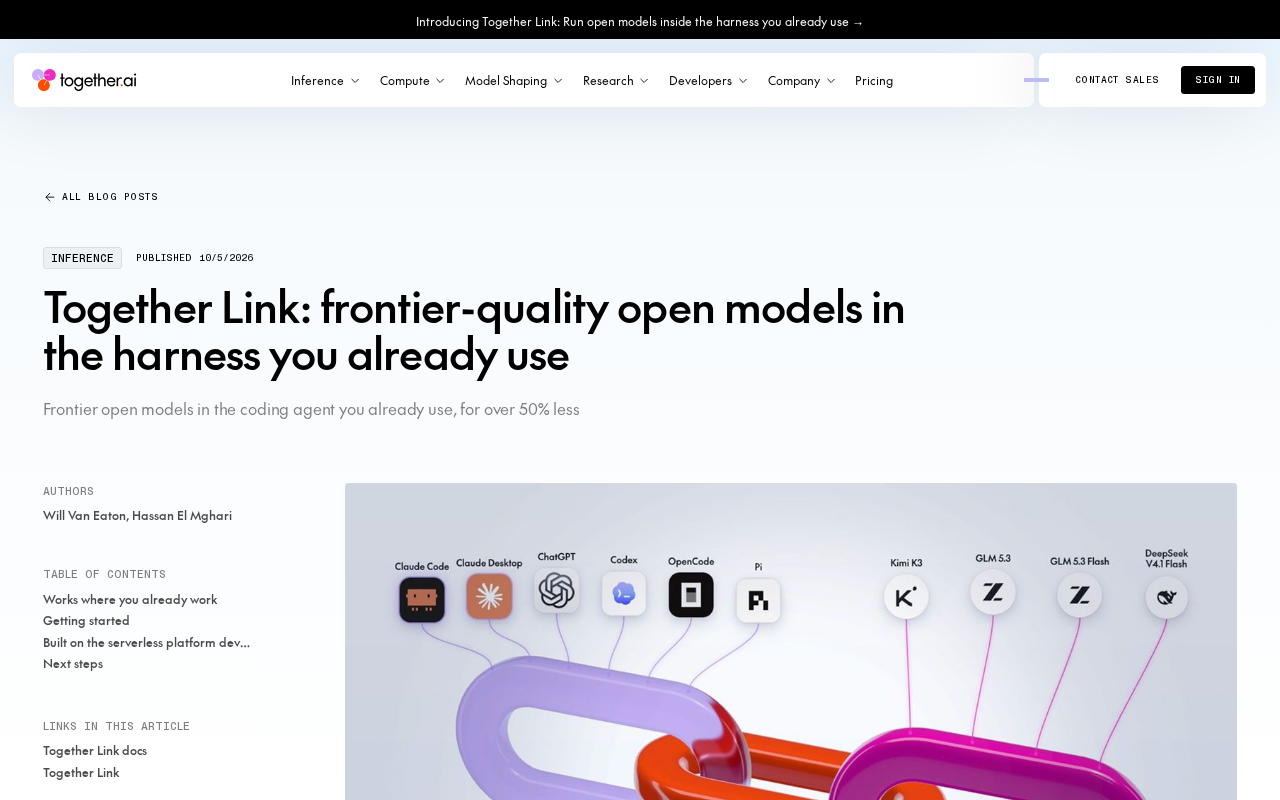
Together Link's design philosophy is captured in its slogan: "open models in the harness you already use." This means developers don't have to abandon their familiar coding agents — they simply replace the model powering them under the hood with an open-source alternative.
The appeal of this "layer swap" approach lies in its minimal migration cost. The company emphasizes "Start with one command today," meaning the integration takes a single command to complete. For teams that have already built out a full AI-assisted development workflow, low invasiveness often matters more than raw feature count when it comes to actual adoption.
Why GLM 5.3 and Kimi K3
The two models highlighted — GLM 5.3 and Kimi K3 — are both recent open-source LLMs that have drawn attention for their performance on code and general-purpose tasks. Positioning them as "frontier open models" reflects a broader thesis: open-source model capabilities have been steadily closing the gap with commercial closed-source models, making them capable enough for real-world coding tasks at a more favorable cost structure.
GLM 5.3 is the latest release in Zhipu AI's GLM series — a bilingual (Chinese/English) general-purpose model with targeted optimization for code generation and comprehension. Kimi K3, from Moonshot AI, is built around long-context processing and maintains strong coherence when reading and analyzing large codebases. Both models are released as open weights, meaning developers can call a hosted version via API or self-host on their own infrastructure — giving them greater flexibility over data privacy and cost control. This stands in fundamental contrast to fully closed commercial models like GPT-4o or Claude 3.5 Sonnet, which are only accessible through official APIs.
"Coding agent" here refers to AI-assisted development tools like Cursor, Copilot, Cline, and Aider — tools capable of code completion, conversational refactoring, or autonomous task execution. These tools typically communicate with backend language models via standardized API protocols (such as OpenAI-compatible interfaces). Together Link's "layer swap" essentially acts as a compatibility layer or proxy, transparently forwarding API requests from the agent to the selected open-source model — letting existing tools switch model providers without any friction. This approach is similar to what LiteLLM or OpenRouter offer in terms of model routing, with Together Link differentiating itself through a tighter focus on the coding use case and deeper optimization for specific open-source models.
What "Cutting Model Spend by Over 50%" Actually Means
"Cutting model spend by over 50%" is Together Link's most striking selling point. For a mid-to-large engineering team, monthly AI coding tool costs can represent a significant fixed expense. The prospect of halving that cost without sacrificing core functionality holds obvious appeal for budget-conscious organizations.
That said, this figure deserves some measured scrutiny. It's a marketing claim, and actual savings will vary depending on model selection, use case, call frequency, and the team's quality bar for outputs. Whether open-source models can fully match closed-source flagship performance on complex tasks is something each team needs to validate against their own workloads.
Practical Value for Development Teams
Together Link represents a trend that's taking shape across the industry: as open-source model capabilities improve, "decoupling models from tools" is becoming a viable strategy for reducing AI operating costs. Development teams no longer need to be locked into a single model vendor — they can flexibly switch underlying models based on cost-performance tradeoffs.
For teams considering adoption, the key questions worth investigating are: Is the onboarding process truly a single command? How broad is agent compatibility? How do the open-source models actually perform on the team's primary programming languages and frameworks? And what does long-term stability and support look like? These are questions that need to be answered through small-scale pilots, not marketing copy.
Given the limited public information currently available, specific technical implementation details, the full list of supported agents, and pricing remain to be disclosed. Developers who are interested should keep an eye on the official documentation as it becomes available.
Related articles

Looped Uniform Diffusion Language Models: 3.3x Reduction in Training FLOPs
Looped Uniform Diffusion Language Models research shows that recursively reusing early Transformer layers can cut training FLOPs by up to 3.3x and reduce generative perplexity by 9.8%.

Silent Cue Loss in Enterprise Document Ingestion: Why Agents Confidently Get It Wrong
Enterprise agents reading documents lose formatting cues like highlights and color through mainstream converters, causing confidently wrong answers. Research shows format-blind ingestion drops F1 from 0.690 to 0.150, with a cheap, measurable fix.

Agent Behavior Maps: Predicting Agent Performance Without Running the Model
Explaining Agent Behavior Maps: building behavior maps for LLM agents from action log-likelihoods on shared reference trajectories to predict performance and identify behavioral similarity without environment rollouts, validated on 100 LLMs in four environments.