Together Link: Seamlessly Connect Coding Agents to Open-Source LLMs

Together Link lets developers swap coding agent backends to cheaper open-source models without changing their toolchain.
Together Link is a developer tool from Together AI that seamlessly connects existing coding agents to open-source LLMs on its platform, delivering significant API cost savings without disrupting your workflow. The core idea is "swap the engine, keep the car" — developers retain familiar harness environments like Cursor or Aider and simply replace the underlying model with a lower-cost open-source alternative. The product also reflects a key trend in AI coding infrastructure: decoupling tools from models. That said, open-source models still have gaps on complex reasoning and long-context tasks, so real-world validation before migrating is recommended.
A New Way to Connect Open-Source Models to Coding Tools
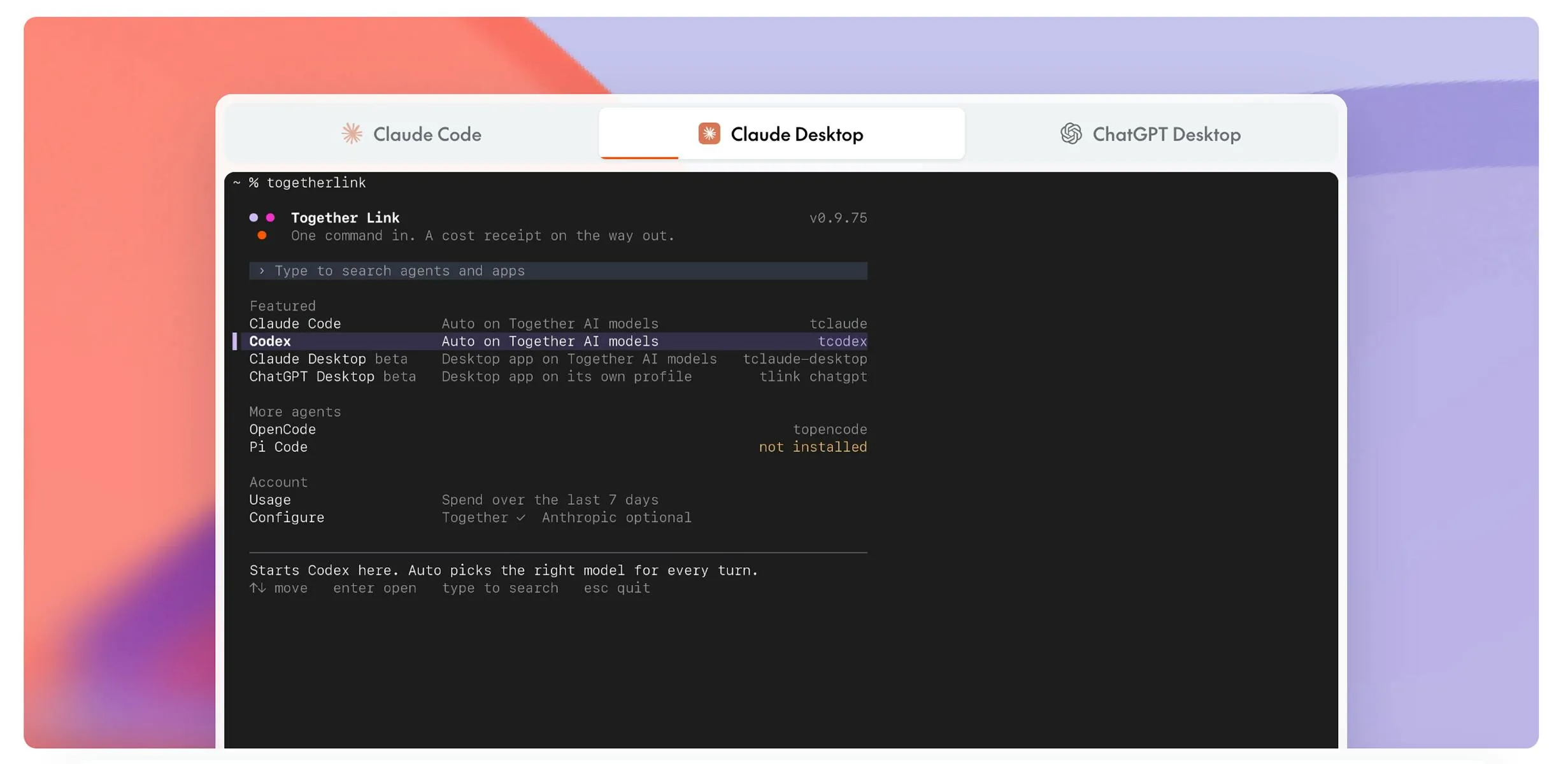
Together Link is a developer tool from Together AI with a straightforward goal: connect existing coding agents to the open-source large language models hosted on Together AI's platform, allowing developers to significantly cut model inference costs without abandoning their current toolchain or workflow.
On Product Hunt, the product debuted at #2 for the day with 131 upvotes, categorized under Open Source, Developer Tools, and Artificial Intelligence — a clear signal that it's targeting the rapidly growing AI-assisted coding market.
What Problem Does It Solve?
Today's mainstream coding assistants — whether IDE-embedded autocompletion or terminal-based agent tools — mostly default to proprietary, closed-source models. As usage frequency increases, API costs accumulate fast, especially for teams that write code heavily and often.
Together Link's angle is "don't change the user's habits." Developers don't have to give up the tools they already know (referred to as the harness — the framework or environment that runs the agent). They simply swap the underlying model for an open-source one hosted by Together AI. This "swap the engine, keep the car" approach lowers both the psychological and technical barriers to migration.
The Cost Advantage of Open-Source Models
Open-source LLMs have been steadily closing the gap with top-tier closed-source models on tasks like code generation and reasoning, while hosted inference pricing is typically a fraction of the cost. Together AI is already known for its high-performance inference service, and Together Link essentially bridges model capability with developers' existing workflows — turning "open source is cheaper" into a tangible, out-of-the-box benefit.
The term harness is key to understanding Together Link's positioning. In the AI coding world, a harness refers to the host environment that runs the agent — common examples include Cursor, Continue.dev, Aider, and Claude Code. These tools manage context, orchestrate tool calls, handle code diffs, and more, while the actual question-answering is done by a large model accessed via API. Historically, these tools were tightly coupled with specific model providers (e.g., GitHub Copilot with OpenAI). Together Link inserts a compatibility layer between the harness and the model, allowing developers to route requests to Together AI's open-source models without modifying the harness's configuration logic.
Together AI's inference service is built on optimization techniques like FlashAttention and continuous batching, emphasizing high throughput and low latency. The open-source models hosted on the platform include Meta's Llama series, Mistral, DeepSeekAd Coder, and others with strong coding capabilities. For code generation tasks specifically, models like DeepSeek Coder V2 and the Llama 3 series have approached GPT-4-level performance on benchmarks such as HumanEval and LiveCodeBench, while typically costing 5–10x less per million tokens than GPT-4o. For agent scenarios with large context windows and high call frequency, this cost difference is further amplified in practice.
What This Means for Developers
For individual developers and small-to-medium teams, Together Link offers a quantifiable path to cost reduction. Token consumption from coding agents is often invisible until the bill arrives — switching to a lower-cost open-source model can yield substantial long-term savings.
The deeper significance lies in the broader trend of decoupling tools from models. In the past, models and tools were tightly bound, locking users into specific ecosystems. Products like Together Link are handing that choice back to developers — you can freely switch the underlying model based on task complexity, budget, and privacy requirements, while keeping the upper-layer experience consistent.
Real-World Caveats to Keep in Mind
That said, open-source models still lag behind leading closed-source models on certain complex reasoning and long-context tasks. Before migrating, developers should validate performance against their actual use cases to avoid sacrificing output quality in the name of cost savings. Additionally, Together Link currently has only 2 comments on Product Hunt, meaning real-world long-term user feedback is still limited — stability and compatibility coverage remain to be proven over time.
Summary
Together Link represents a clear direction in AI coding infrastructure: making open-source models a readily available, low-cost option without disrupting existing workflows. For developers who care about cost control and tool autonomy, it's worth adding to your evaluation list. As open-source model capabilities continue to improve, the value of these "integration layer" tools will likely only grow more prominent.
Related articles

Workbuddy for Absolute Beginners: How a Desktop AI Agent Fits Into Real Workflows
A beginner's guide to the Workbuddy desktop AI agent: installation, claiming credits, file management, and building automated workflows—compared with CodeX for fit and cost, helping professionals shift from AI question-askers to AI managers.

OpenAI's New Agent Stack: Computer Use, Decisions API, and Ultra-Fast Workflows
OpenAI Dev Day unveiled a new agent stack: Computer Use outperforms humans, Decisions API delivers ultra-low-latency classification via Luna, Agents API opens the same Computer Use capabilities, and GPT-6.1 Sol costs only one-seventh of Astra. Core updates, benchmark data, and developer insights.

Liang Wenfeng Open-Sources DeepInfo Inference Framework, Takes On U.S. Ban
DeepSeek open-sources its DeepInfo inference framework after its models, featuring GPU/CPU cross-pipelining, small-model prediction with large-model verification, and full Huawei Ascend and NVIDIA chip support—facing the U.S. federal ban head-on. This article analyzes its significance for AI deployment and open-source strategy.