TokenForge: Free Open-Source AI Context Compression Engine That Saves 98% of Tokens

TokenForge is an open-source AI context engine claiming 98% token savings, but with only 15 stars, its claims remain unverified.
TokenForge is an open-source JavaScript context optimization engine positioned as a middle layer between AI tools and models, cutting token costs via tool output compression, persistent memory, and 17-platform routing. It is fully self-hostable and claims two-minute setup. However, with only ~15 GitHub stars and no independent benchmarks, it is more an early experiment than a production tool.
TokenForge: Free Open-Source AI Context Compression Engine That Saves 98% of Tokens
Developers struggle with two things every week: first, being tormented by broken installation scripts when setting up environments, and second, paying hefty SaaS subscription fees for automated coding and AI workflows. According to a YouTube channel, an open-source project called TokenForge is rapidly gaining traction on GitHub, claiming to compress tool output by up to 98% and support intelligent routing across 17 platforms. Based on the video and screenshots, this article breaks down what TokenForge actually is, what it can do, and what it really means.
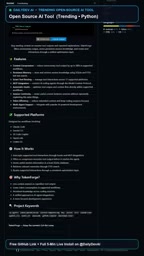
What Is TokenForge? An Open-Source Context Optimization Engine
According to the YouTube video description, TokenForge is an open-source context optimization engine built in JavaScript, designed specifically for AI-driven coding workflows to reduce token consumption, preserve session memory, and improve efficiency. Its core positioning is not another AI coding assistant, but a "middle layer" running between AI tools and models, reducing usage costs by compressing context and routing tool calls.
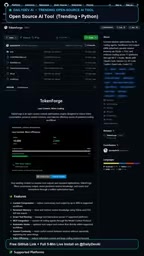
The video says the project "just blew up" on GitHub, but the figure given is "over 15 stars." That number is negligible for an open-source project, suggesting it is still in a very early stage. Therefore, the feature descriptions below should be treated as the project's claimed capabilities rather than conclusions validated at scale.
Tokens are the basic units of text processed by large language models. Models bill by token and are limited by context window length. A token roughly corresponds to part of an English word or a Chinese character, with the specific segmentation determined by the tokenizer. When an AI coding assistant calls external tools such as the terminal or file search, the raw output returned by the tool (such as an entire log or a large chunk of file content) is fully counted into the context, both consuming cost and crowding out limited window space. The essence of "context optimization engines" like TokenForge is to trim, summarize, or structurally compress tool output before it enters the model, thereby reducing billable token counts without losing key information. Understanding this is essential to see why "compressing 98% of tool output" is viewed as a commercially valuable selling point.
Core Capabilities: Context Compression and Persistent Memory
TokenForge's most eye-catching feature is context compression. The video claims that in supported workflows, it can reduce unnecessary tool output by up to 98%. This means that when an AI coding assistant calls external tools (such as terminal commands or file search), lengthy return results are compressed before being fed into the model, directly reducing token consumption and costs.
The accompanying persistent memory feature allows storage and retrieval of session knowledge, using mechanisms called "Suolite" and "FTF" (full-text search) under the hood. Simply put, it lets the AI remember key information across long sessions without repeatedly pasting context each time.
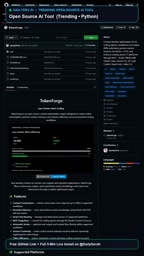
It should be noted that these percentages come from project marketing and lack independent benchmark evidence. A 98% compression rate may hold in extreme cases (such as trimming redundant logs), but the actual savings in typical coding scenarios is likely lower than this figure.
Full-Text Search (FTS) is a technology that indexes text content and supports fast retrieval of keywords and phrases, commonly found in systems such as SQLite FTS extensions and Elasticsearch. Unlike semantic retrieval based on vector embeddings, FTS relies on tokenization, inverted indexes, and relevance ranking (such as BM25). Its advantages are exact keyword matching, no need to call additional embedding models, and low resource overhead. In AI session memory scenarios, FTS is often used to quickly recall fragments related to the current question from historical conversations or tool output, which are then spliced into the context. If the "FTF" mentioned in the article indeed refers to full-text search, its value lies in enabling low-cost retrieval of long-session memory, but recall quality depends heavily on tokenization and index design, which is also a link that needs hands-on testing when evaluating such projects.
Self-Hosting and Intelligent Routing: Control and Multi-Platform Support
TokenForge supports full self-hosting and can run on a local machine. The video emphasizes that this lets developers maintain complete control over their private prompts, code, and data, with "zero API bill anxiety." For teams worried about data leaks or unwilling to be locked in by vendors, this is an attractive selling point.
Intelligent tool routing is another feature, claimed to manage tool interactions across 17 supported platforms. The video does not list which platforms are supported. From its positioning, it seeks to become a unified orchestration layer across different AI platforms.
As for installation, the video says it can be launched in under two minutes with a quick Git clone.
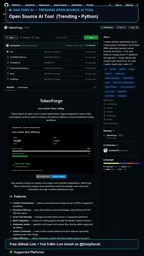
Self-hosting refers to deploying software on the developer's own machine or own servers rather than using a vendor-hosted cloud service. For AI middle-layer tools, self-hosting means prompts, code snippets, and tool output do not pass through third-party servers, data flow is fully controllable, and there is no need to pay SaaS vendors by call volume. The cost is that users must bear the burden of environment configuration, version upgrades, security patches, and availability maintenance themselves. The opposite is a hosted SaaS solution, which works out of the box but carries risks of data leaving the premises and vendor lock-in. To judge whether a self-hosted project is usable, one usually needs to look at dependency complexity, completeness of configuration documentation, and whether there is a clear license, not just whether "a single Git clone command can get it running."
Objective Assessment: Highlights and Points to Verify
TokenForge hits real pain points: token costs, context window limits, and vendor lock-in. The combination of open source and self-hosting also aligns with developers' current demands for data sovereignty. But it must be pointed out that the video information has obvious limitations.
With only 15 stars, the project's code maturity, community support, and security are all unverified. Key figures such as the 98% compression rate and 17-platform support all come from marketing language, with no third-party reproduction. The video directs viewers to "watch a 5-minute terminal installation demo" and "subscribe to the channel," which has an obvious traffic-driving nature.
For developers who want to try it, it is recommended to first clone the repository in an isolated environment, review the code, and validate the compression effect with a small-scale workflow before deciding whether to integrate it into a production environment. TokenForge's concept is worth watching, but it currently looks more like an early experiment than a production tool you can rely on directly.
One-line Summary
TokenForge is an open-source AI context compression engine claiming to save 98% of tokens, but it has only 15 stars and its data remains to be verified.
Paragraph Summary
TokenForge is an open-source context optimization engine built in JavaScript, positioned as a middle layer between AI tools and models, reducing token consumption and costs through compressing tool output, persistent memory, and intelligent routing across 17 platforms. It supports full local self-hosting, emphasizes data control and zero API bill anxiety, and claims it can be launched within two minutes after a Git clone. The article also points out that the project has only about 15 stars on GitHub, and key figures such as the 98% compression rate and 17-platform support all come from project marketing, lacking independent benchmarks and third-party reproduction; the video content has an obvious traffic-driving nature. Therefore, TokenForge is currently better viewed as an early experiment worth watching rather than a production tool you can rely on directly; it is recommended to review the code in an isolated environment and validate it at small scale before deciding whether to integrate it.
Related articles

Selective Auditing: Making AI Decisions Both Reliable and Labor-Efficient
New research on AI decision reliability: a selective auditing algorithm minimizes human audit frequency while keeping unaudited error rates below a threshold, with experiments showing major labor savings.

Low-Cost Abstention Strategy: How LLM Ticket Classification Reduces Misrouting Costs
Cost-aware abstention framework cuts ticket routing costs by 38.1%, reduces misrouting from 15.3% to 3.5% on 47,837 IT tickets, outperforming LLMs.

METTA: Memory-Enhanced Meta-Reinforcement Learning for Test-Time Adaptation
METTA proposes dual-timescale memory decomposition for efficient test-time adaptation in meta-RL with linear complexity, exceeding 50% success on Meta-World ML10/45 and outperforming Transformer baselines on PointMaze.