Too Many MCP Tools? Trim Your AI Agent's Toolset with One Line of Python

AI agents default to loading all MCP tools, wasting context and amplifying risk—filtering on demand with one line of code solves it.
The article points out that AI agents commonly inherit all tools by default when loading via MCP, causing every request to carry roughly 9,000 characters of tool descriptions. This creates three hidden costs: squeezing the context window, amplifying waste in long conversations, and exposing capabilities the task doesn't need, increasing misoperation and security risks. The author's solution is surprisingly simple—use one line of Python code to filter tools by name, achieving "16 in, 2 out." The article further emphasizes that tool management should be a standard part of agent development, that context efficiency is a competitive advantage as model capabilities converge, and that the principle of least privilege applies equally in the AI agent era. Finally, it recommends developers start with a tool whitelist and gradually build mechanisms for dynamically loading tools by task type.
Why Is Your AI Agent Loading Too Many Tools?
An AI agent loads 16 tools from two servers via MCP (Model Context Protocol), but the actual task only needs two of them. This isn't an isolated case—it's a widespread efficiency trap in AI agent development today. According to analysis from a YouTube tech channel, this agent sends descriptions of all its tools to the model with every request—roughly 9,000 characters of extra overhead that not only consumes context window but also increases the risk of the model misusing tools.
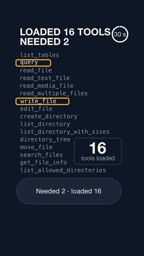
MCP, as a protocol connecting AI models with external tools, lets agents flexibly invoke capabilities like file operations and API requests. But the default behavior of "loading everything" often leaves agents carrying lots of irrelevant tools—like packing your entire wardrobe for a trip.
MCP (Model Context Protocol) is an open protocol proposed and open-sourced by Anthropic in late 2024, designed to standardize how AI models connect to external data sources and tools. Before MCP, every AI application integrating tools required custom development, making tools hard to reuse; MCP solved this by defining a unified client-server architecture: tool providers implement an MCP server, and any MCP-compatible client (such as Claude Desktop or various agent frameworks) can automatically discover and invoke these tools. The server returns tool names, descriptions, and input parameter schemas via the tools/list interface, and clients typically send this complete list along with each request so the model can decide which tool to call. It's precisely this "discover and load" default mechanism that forms the protocol-level root of the tool bloat problem described in this article.
The Hidden Costs of Loading Everything
Wasting the Context Window
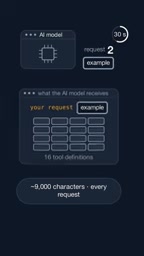
Attaching all tool descriptions to every request means a fixed overhead of 9,000 characters. For models with limited context windows, this directly squeezes the space available for handling actual tasks. In long conversations or multi-step reasoning, this waste gets amplified.
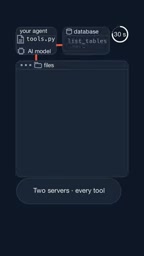
Context Window refers to the maximum number of tokens a model can process in a single inference, covering system prompts, tool descriptions, conversation history, and current input. Current mainstream models have windows in the 128K to 200K token range, which seems ample, but tool descriptions are a "fixed tax": regardless of what the user asks, they occupy the same chunk of space. 9,000 characters translates to roughly 2,000–3,000 tokens, which can exceed 10% of a single-turn simple task. More critically, the longer the context, the more the model's attention to middle information gets diluted (what the industry calls "lost in the middle")—irrelevant tool descriptions don't just take up space; they also interfere with the model's judgment about which tools are truly relevant.
Excessive Exposure of Security and Permissions
Every tool is a capability. The video specifically points out that one tool can move files, but the current task doesn't need this functionality at all. The more tools there are, the greater the possibility that the agent gets induced to perform dangerous operations. The principle of least privilege applies equally to AI agent design.
The Principle of Least Privilege originates from the classic 1975 security paper by Saltzer and Schroeder, requiring that each subject should only have the minimum permissions necessary to complete its task. In traditional systems, this principle is implemented through account permissions, sandboxes, and access control lists; but in the AI agent context, the carrier of permissions becomes "callable tools." Unlike human users, models generate tool calls based on probability, and prompt injection attacks can induce them to call tools they shouldn't touch. Therefore, treating the tool list itself as a permission boundary to trim is a hard constraint imposed outside the model layer—even if the model is misled, it "can't see" tools that don't exist in the list, physically eliminating the possibility of unauthorized calls.
The One-Line Python Solution
The fix is surprisingly simple: filter by name and keep only the tools the task needs. The video demonstrated the "16 in, 2 out" effect—the agent ultimately loads only two required tools.
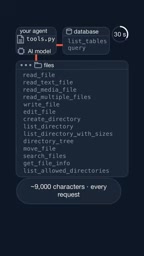
The core idea behind this approach is on-demand loading. During agent initialization, dynamically decide which tools are needed based on task type or user intent, rather than unconditionally inheriting the full tool list provided by the server. In practice, you can filter tool names in the MCP client configuration or add a whitelist mechanism to the agent logic.
Implications for AI Agent Development
Tool Management Should Be Standard Practice
The MCP ecosystem is expanding rapidly, and the number of tools will only grow. Developers need to treat tool filtering as a fundamental part of agent design, not an after-the-fact optimization.
Context Efficiency Is Competitiveness
In an era where model capabilities are converging, whoever uses the context window more efficiently will have the advantage in cost and response quality. A 9,000-character waste may seem minor, but at high concurrency it accumulates into significant costs.
Security Starts with Least Privilege
Loading only necessary tools naturally limits the agent's blast radius. This principle is consistent with traditional software security practices—it just needs to be re-emphasized in the AI agent era.
Action Recommendations
Check your existing MCP agent configuration: how many tools does it load? How many of those does the current task actually need? If the answers are "all" and "a few," then one line of Python code can deliver immediate improvement. Start with a tool whitelist and gradually build a mechanism for dynamically loading tools based on task type.
Related articles

Why Does the Tesla Roadster Need to Fly? A Deep Dive into Musk's Wild Demo
Tesla's Roadster launch showed wall-climbing, upside-down driving, and flying stunts—but The Vergecast notes the demo car may lack a battery, the Rocket version is invite-only and not street-legal, and the website terms don't guarantee delivery. After nine years of delays, why does this car still need to exist?

AI Is Not a Replacement: Human-AI Collaboration Through the Lens of Factory Root Cause Analysis
Starting from factory root cause analysis, this article explains how AI accelerates evidence chain construction rather than replacing human experts, exploring the pragmatic implementation logic and business value of 'AI supporting people rather than replacing them.'

AI Agent Decision Auditing: Building an Evidence Chain in Regulated Workflows
Starting from a Reddit discussion, this article analyzes three core issues in AI agent decision auditing within regulated workflows: what fields audit records should contain, how to handle feedback latency for erroneous decisions, and how to continuously calibrate LLM judge consistency with human judgment.